
Samsung Patents a Foldable Phone That Shows You Where to Place It on a Wireless Charger
Wireless charging on a foldable phone is trickier than it sounds, the coil is only in one half of the device, and if you set it down wrong, almost nothing charges. Samsung's new patent tackles that with a display that tells you exactly how to fix it.
How Samsung's foldable guides you to charge correctly
Ever set your phone on a wireless charger and come back an hour later to find it barely charged? On a standard phone that's annoying. On a foldable, it's a real design problem: the charging coil lives in only one half of the device, so where and how you place it matters a lot.
Samsung's patent describes a system that monitors how much power the charger is actually delivering. If that power falls below a useful threshold, the phone figures out whether it's folded or open and then shows you specific guidance on whichever screen makes sense. Folded? The small cover screen tells you to move the phone or the charger. Open and flat? The big inner screen shows the same repositioning tips, plus a suggestion to fold the device closed, since a folded position may align the coil better.
The whole point is that the phone does the thinking for you. Instead of guessing why your battery is barely moving, you get a clear, state-aware nudge on exactly the right screen.
… display first information to guide repositioning at least one of the foldable electronic device or the wireless charging device, via the second display …
Translation: It shows instructions on the outer screen on how to move the phone or charger to fix alignment.
How the coil position drives the on-screen instructions
The patent describes a foldable electronic device with two housing halves joined by a hinge, two displays (one inner, one on the cover), and a wireless charging coil built into the first housing half only.
Here is how the logic flows:
- The device receives a wireless power signal from the charging pad and checks whether the delivered power clears a set threshold.
- If the power is too low, the device checks its own physical state: is it folded closed, or unfolded flat?
- If folded, it uses the small rear cover display to show repositioning guidance.
- If unfolded, it uses the large inner display to show repositioning guidance and prompts the user to fold the device closed, because the folded orientation places the coil in a more consistent position relative to the charging pad.
The system relies on the coil's position being fixed in the first housing half. When the phone is open and lying flat, the coil's relationship to the pad beneath it depends on exactly how the user set the phone down. Folding the device effectively standardizes that geometry. The software layer ties those physical states together and picks the most visible screen to surface the alert.
… determining whether the wireless signal indicates that power provided by the external electronic device to the electronic device satisfies a threshold …
Translation: The phone checks if it is receiving enough power from the wireless charger.
What this means for Galaxy Z Fold wireless charging
For anyone who owns a foldable phone, dead-battery-despite-charging is a real frustration, and it happens precisely because foldables are not symmetric the way slab phones are. A cover screen that actively coaches you on placement is a much more user-friendly fix than burying the advice in a settings menu.
From a ship-path perspective, this patent is almost entirely a software and firmware feature sitting on top of hardware Samsung already sells. The coil, the dual displays, and the hinge are all present in current Galaxy Z Fold devices. The main work is the sensing logic, the threshold checks, and the state-aware UI, none of which require new components. That makes this one of the shorter paths from patent to shipping feature in the latest Big Tech patents covering wireless charging and foldable device design.
The hardware prerequisites for this feature already exist in Samsung's foldable lineup, which means the distance between this filing and a software update is unusually short. The threshold-based trigger and dual-display routing are straightforward UI logic, well inside what Samsung's software team ships routinely, so the engineering lift is modest. If the product team decides this is worth surfacing to users, it could realistically land in a Galaxy Z Fold software update without waiting for a new device generation.
There are more where this came from
We read every patent application Big Tech publishes and send you the ones worth knowing. Plain English, free, every week.
The drawings
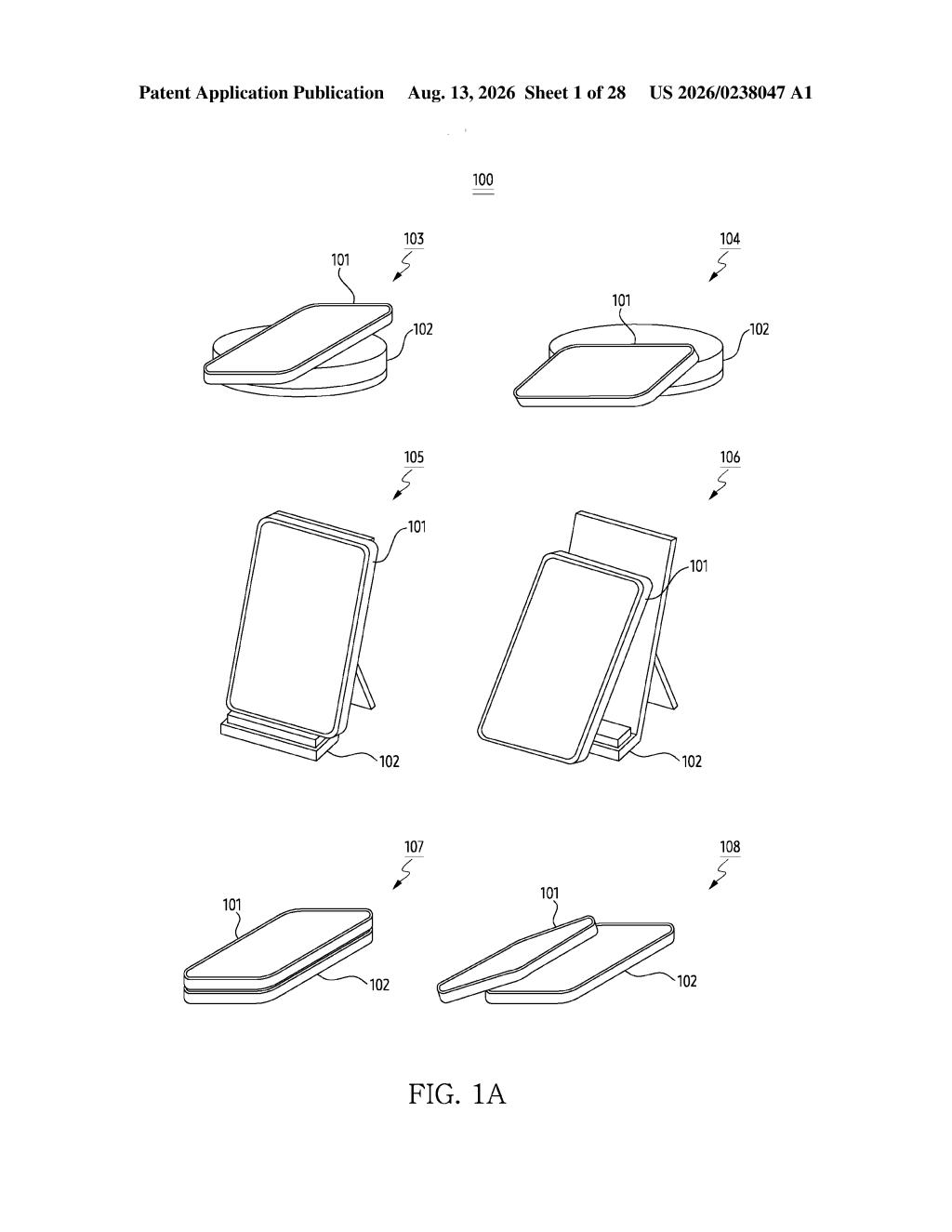
28 drawing sheets from US 2026/0238047 A1 · click any drawing to enlarge


Want this weekly breakdown for a company we don't cover? Patentlyze Pro →
Be the first to weigh in