
Apple Patents a System That Picks Which of Your Devices Runs Background Tasks
When your iPhone, iPad, and Mac are all on and connected, which one should handle a background sync or scheduled task? Apple's new patent describes a system that figures that out automatically, so the right device handles the job every time.
What Apple's device leader election actually does for you
You're sitting at your desk with your iPhone charging on the nightstand, your iPad on the couch, and your MacBook open in front of you. All three are signed into the same Apple account, and a background task, say a software update download or a scheduled backup, needs to run on one of them.
Right now, your devices don't always coordinate well on this. They might each try to handle it, wasting battery and bandwidth, or the wrong device (the one with 5% battery and a weak Wi-Fi signal) ends up doing the heavy lifting. Apple's patent describes a method where your devices check in with each other, compare their current state, and one of them volunteers as the group leader to run the scheduled task while the others stand down.
The leader is chosen based on real factors: which device type is best suited, which has the most battery, which is already plugged in, which is running the right software version, and which has the strongest signal. The device that wins the comparison takes on the job.
… comparing, by the first electronic device, the subset of device properties against one or more group criteria, wherein a device property comprises at least one of a device type, a software version, a power capacity, a charging state, a signal strength, and an activity state …
Translation: The system evaluates your gadgets based on factors like battery level, current usage, and software version.
How Apple's system scores and selects the group leader device
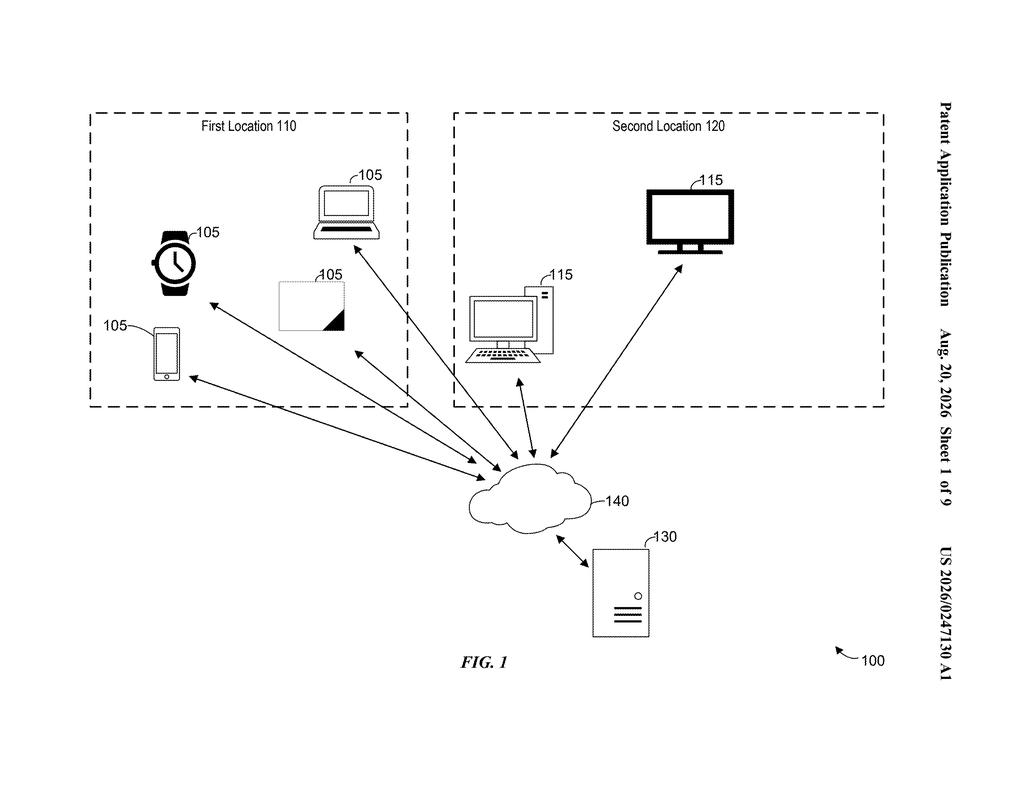
The patent describes a leader election protocol for a group of Apple devices tied to the same account. When a scheduled operation needs to run, one device in the group takes the lead rather than every device attempting the task independently.
Here's how the selection process works:
- The first device detects the identifiers (think device IDs) of the other nearby or account-linked devices.
- It pulls a set of device properties for the whole group, including device type (iPhone vs. IPad vs. Mac), software version, power capacity (total battery size), charging state (plugged in or not), signal strength, and activity state (idle or actively in use).
- It compares those properties against a set of criteria, essentially a scorecard, to decide which device is best positioned to run the task.
- If the first device wins the comparison, it designates itself the group leader and performs the scheduled operation.
The claim is broad enough to cover any scheduled operation, meaning this could apply to software downloads, health data syncing, iCloud backups, or other periodic background tasks. The system is designed to be self-contained: one device does the math and either takes the job or defers to a better-positioned device in the group.
Techniques may include detecting one or more identifiers of one or more electronic devices that are associated with a first electronic device. In addition, the techniques may include accessing a set of device properties corresponding to a set of electronic devices that includes the one or more electronic devices.
Translation: The device scans your other linked hardware to see which ones are available to help with background tasks.
What this means for your iPhone, iPad, and Mac working together
For everyday Apple users, this kind of coordination matters more than it might seem. Background tasks running on the wrong device can silently drain battery, slow down a device you're actively using, or consume mobile data when a device with a better Wi-Fi connection was sitting right there. A system that picks the most capable device for a given job, automatically, could meaningfully improve battery life and overall performance across Apple's ecosystem without the user ever touching a setting.
Apple has been building tighter multi-device coordination into its software for years, from Handoff to Universal Control, and this patent fits into that broader direction. The specific focus on power state, signal strength, and activity state as selection criteria suggests Apple is thinking carefully about the real-world conditions where poor task assignment causes the most pain. Patentlyze covers new Big Tech patents across Apple's device-coordination and wireless-networking filings, and this one sits squarely in a cluster of efforts to make the Apple device ecosystem behave more like one coherent system.
Apple's 14th filing we've tracked since May in our device handoff watchlist, following one on location sharing without towers and one on audio routing by device, adds another piece to how devices might pass tasks between each other.
Duplicated background work across a household's devices drains batteries and erodes trust in ways users notice but rarely understand, and the cost compounds every time the weakest or least appropriate device gets drafted into a job it shouldn't be doing. Apple's structured approach, comparing device type, software version, power capacity, charging state, and activity state to elect a single capable leader, targets the exact variables that make one device better suited than another for a given moment. That match between the specificity of the problem and the precision of the solution is what gives this work its weight.
Get our take in your Top Stories
Liked this breakdown? Add Patentlyze as a preferred source on Google, and our plain-English take shows up more often in your Top Stories the next time Apple patent news breaks.
There are more where this came from
We read every patent application Big Tech publishes and send you the ones worth knowing. Plain English, free, every week.
The drawings
9 drawing sheets from US 2026/0247130 A1 · click any drawing to enlarge


Show the other 1 sheets

Want this weekly breakdown for a company we don't cover? Patentlyze Pro →
Be the first to weigh in