
Google Files Patent for a Lower-Cost Way to Run Quantum Chemistry Simulations
Quantum computers promise to simulate molecules in ways ordinary computers never could, but the error costs are steep. Google's new patent describes a method that cuts those costs by exploiting a mathematical shortcut hiding in the structure of molecular physics itself.
What Google's molecular quantum simulation actually does
You're a chemist who wants to know exactly how a new drug molecule behaves at the atomic level, down to how its electrons interact. Classical computers struggle with this because the number of possible electron arrangements explodes exponentially as the molecule grows. A quantum computer should, in theory, handle it naturally because it operates on the same quantum rules the molecule does.
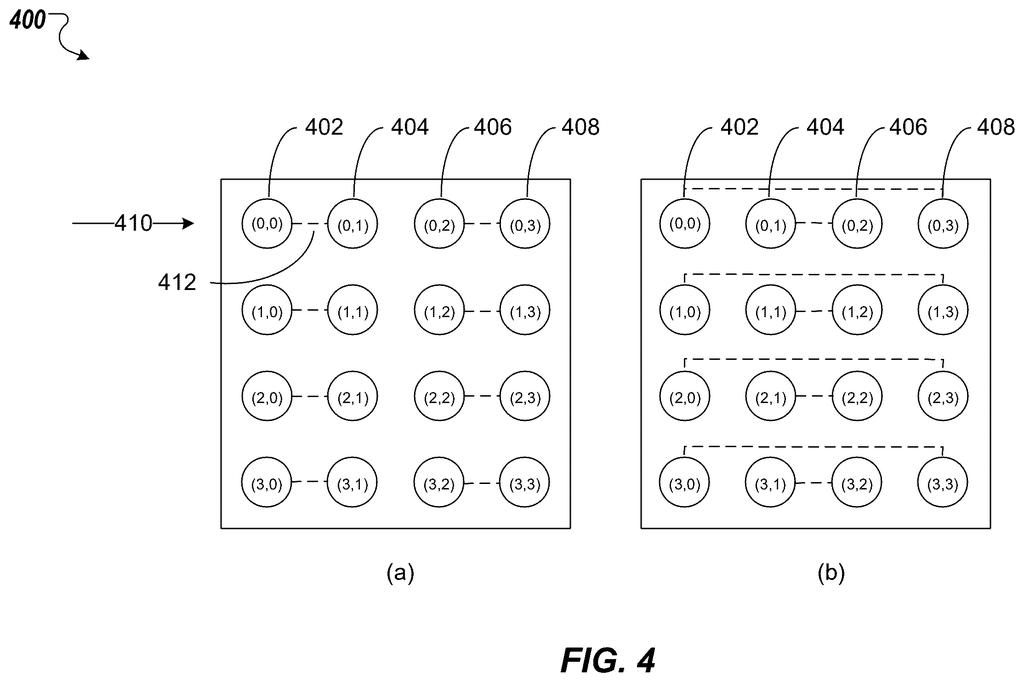
The catch is that quantum computers make errors, and running a complex simulation requires so many operations that errors pile up faster than you can fix them. Google's patent describes a way to organize the simulation into tidy, repeating layers of operations, each layer doing a fixed, predictable amount of work. Because the math of the underlying physics has a kind of built-in symmetry (the same interaction shows up repeatedly at different positions in the molecule), the circuit can reuse the same gate pattern instead of building a custom one for every step.
The result is a simulation that uses fewer quantum operations overall, which means fewer chances for errors to creep in and fewer physical qubits needed to keep everything corrected.
The qubit Hamiltonian comprises multiple two-qubit interaction terms, each comprising a respective translation invariant coefficient.
Translation: The quantum system uses paired qubit interactions that share a repeated, steady mathematical value.
How the layered gate structure keeps qubit costs down
The patent tackles a problem called Hamiltonian simulation (a Hamiltonian is just the mathematical object that describes the total energy of a physical system, in this case a molecule's electrons). The goal is to take that description and run it forward in time on a quantum processor, so you can measure properties like ground-state energy or reaction rates.
The key insight is that the molecular Hamiltonian, once translated into qubit language, has translation-invariant coefficients. That's a technical way of saying that many of the interaction terms between pairs of qubits share the same numerical weight, because they correspond to the same underlying physical interaction appearing at different positions in the molecule's grid. Instead of treating every pair independently, the circuit can batch them.
The simulation is structured as repeating Trotter steps (a well-known technique, named after physicist Hideo Trotter, that breaks a complex time-evolution into many small, manageable slices). Each slice is implemented as a layer of two-qubit quantum gates applied across the processor. Within each layer, all the gates share a constant coefficient, which means:
- The compiler can schedule them in parallel across the chip
- Error-correction overhead stays predictable and uniform
- No custom gate angles need to be recalculated at every step
Finally, the evolved qubits are measured and the results are decoded back into physical properties of the original molecule.
What this means for quantum computing's chemistry ambitions
For quantum computing to do something a classical supercomputer genuinely cannot, chemistry is one of the most likely first proving grounds. Accurate molecular simulation could speed up drug discovery, catalyst design, and materials science. The bottleneck right now is fault-tolerant overhead: every useful quantum operation has to be wrapped in layers of error correction, and those layers consume enormous numbers of physical qubits and clock cycles.
By structuring the simulation so that every layer of gates shares a constant coefficient, Google's approach reduces the diversity of operations the error-correction machinery has to handle. Fewer distinct gate types means fewer costly state preparations in fault-tolerant architectures. It's a focused engineering trade: the method works best when the molecule's physics actually has that translation symmetry, which is true for many periodic or crystalline systems but not all. Readers tracking new Big Tech patents in quantum chemistry will find this filing a concrete example of how companies are trying to squeeze practical simulations out of near-term fault-tolerant hardware.
Google's 587th patent application in everything we've tracked since May follows filings on smarter document search and split-server privacy.
The method works well when the molecule or material has a repeating, orderly structure, like a crystal. For that class of problems, it cuts down the number of distinct operations a quantum computer must perform, and that saving matters because quantum computers today have very little room to spare.
For drug molecules, which have no repeating pattern, the saving largely disappears and the method falls back to doing things the standard way. That makes it a strong specialist tool for materials science, not a universal solution for chemistry.
There are more where this came from
We read every patent application Big Tech publishes and send you the ones worth knowing. Plain English, free, every week.
The drawings
4 drawing sheets from US 2026/0244962 A1 · click any drawing to enlarge


Want this weekly breakdown for a company we don't cover? Patentlyze Pro →
Be the first to weigh in