
Adobe Patents an AI System That Picks Your Email Templates and Test Variants for You
Adobe wants to take the guesswork out of email marketing by having an AI suggest which template to use, which headline variants to test, and which combinations are actually worth running, all before you hit send.
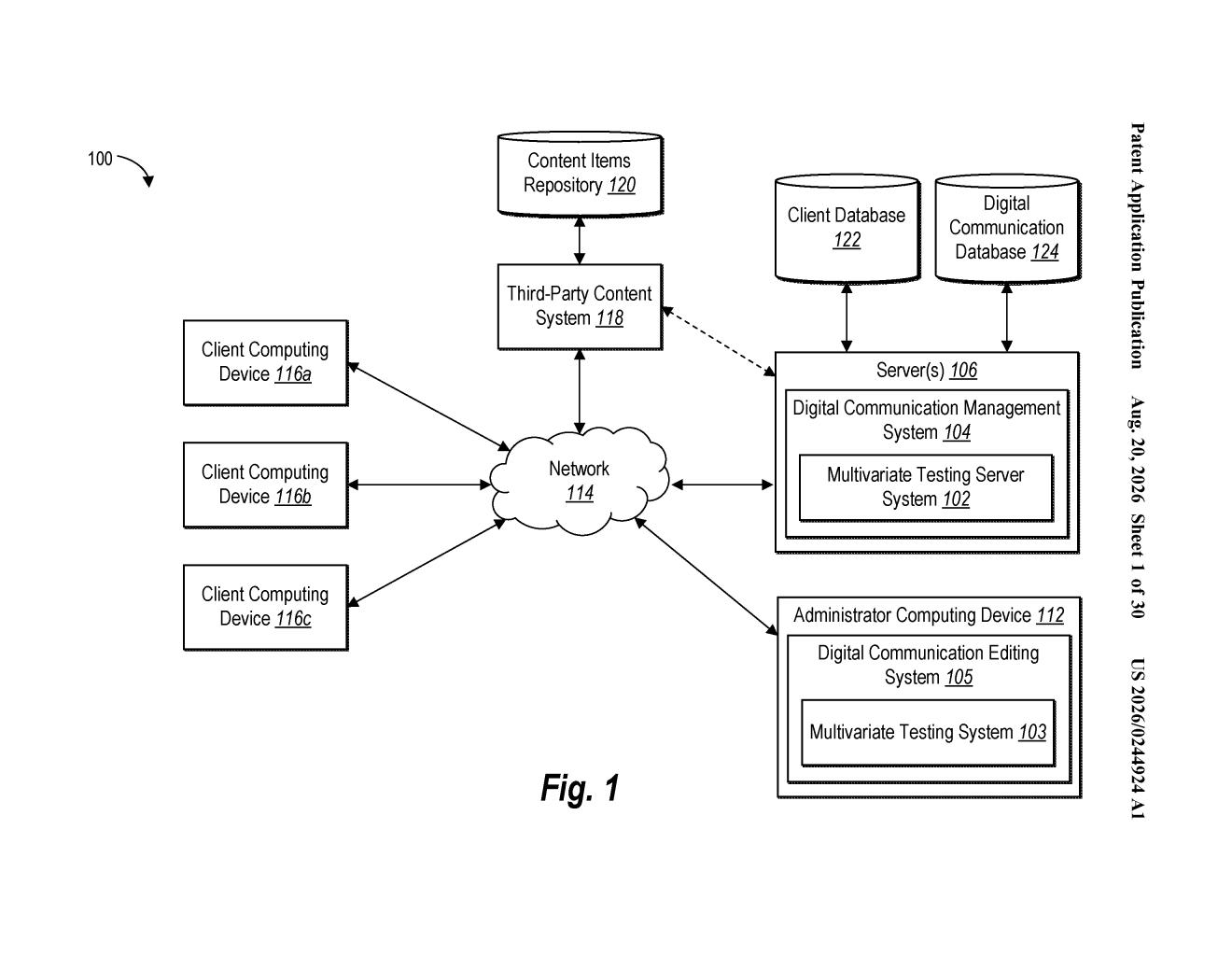
What Adobe's AI-assisted email builder actually does
Ever stared at a blank email editor wondering whether your subject line will land? Most marketers end up picking a layout by gut feel, running a few test versions, and hoping for the best. Adobe's new patent describes a system designed to replace that guesswork with data.
Here is how it works in plain terms. You open the editor and the tool shows you a list of email templates, each labeled with a predicted performance score based on your past campaigns and the profiles of the people you are mailing. Pick one, and as you build out each section, headline, image, call-to-action button, the system suggests multiple versions of that section, again ranked by predicted performance. You pick your favorites, and the system then tells you which combinations are the most useful to test against each other.
The goal is to shrink the number of test versions you need to run. Instead of throwing twenty variants at your audience and waiting weeks for results, the AI surfaces the four or five combinations that are most likely to tell you something meaningful.
… in response to a user interaction with a content fragment, providing, for display, a plurality of fragment variants for the content fragment according to predicted content fragment performance metrics for the plurality of fragment variants; …
Translation: Clicking a piece of content brings up alternative options ranked by predicted success.
How the system ranks templates, fragments, and test groups
The patent describes a multi-stage editorial interface for building and testing digital communications, with machine learning recommendations baked into each stage.
Stage one: template selection. The system displays a set of pre-built email layouts alongside predicted performance metrics (essentially a score estimating click rates, open rates, or another goal you care about). Those predictions draw on historical campaign data and recipient profile data (demographic and behavioral information about the people on your list).
Stage two: fragment-level editing. Once you pick a template, the email is broken into discrete content fragments, think of these as individually swappable blocks like a subject line, a hero image, or a footer. When you click any block, the system surfaces multiple fragment variants (alternative versions of that block), each labeled with its own predicted performance score.
Stage three: multivariate test planning. After you have selected your preferred variants across all the blocks, the system generates multivariate testing recommendations. Multivariate testing (running several variables at once to see which combination wins) usually produces an explosion of possible combinations. The patent's claim is that by pre-filtering variants using the model's predictions, the system narrows that list to only the statistically meaningful candidates, giving you cleaner results faster.
Ultimately, the disclosed systems generate multivariate testing recommendations incorporating selected fragment variants to intelligently narrow multivariate testing candidates and generate more meaningful and statistically significant multivariate testing results.
Translation: The system narrows down testing options so you get more meaningful results.
What this means for marketers running email campaigns
For anyone managing email campaigns at scale, the practical win here is time. Multivariate testing is theoretically powerful but practically painful: if you have three content blocks and four variants of each, you are looking at 64 possible combinations. Most teams never test that many, so they either skip testing or run underpowered experiments that produce ambiguous results. A system that prunes that list to the most promising combinations before the campaign launches could make rigorous testing accessible to smaller teams who do not have a data scientist on staff.
The deeper strategic angle is that Adobe is positioning its creative tools not just as a canvas but as an optimization layer. Embedding performance predictions into the editing UI ties the act of creating content directly to the act of measuring it, which is exactly the workflow its marketing cloud customers need. Adobe's ad-tech and content-optimization work sits alongside a broader wave of AI-assisted campaign tools covered among the newest Big Tech patents, and this filing shows the company pushing that work deeper into the design phase itself.
Adobe's 119th filing in everything we've tracked since May joins earlier applications on fixing AI database code and building images from multiple photos.
Surfacing a single ranked list of recommendations trades transparency for convenience, and the cost shows up when historical data skews toward one audience segment or content style without the marketer ever knowing it. That hidden shaping is a meaningful risk, and whether the tradeoff earns its keep depends entirely on how much Adobe exposes the scoring logic behind each suggestion. A confidence interval or a plain-language explanation of why a variant ranked well would close most of that gap.
There are more where this came from
We read every patent application Big Tech publishes and send you the ones worth knowing. Plain English, free, every week.
The drawings
30 drawing sheets from US 2026/0244924 A1 · click any drawing to enlarge


Want this weekly breakdown for a company we don't cover? Patentlyze Pro →
Be the first to weigh in