
Microsoft Patent Reveals Glasses Designed to Project Images Across a Wider Field
Getting a wide, clear image into a pair of slim AR glasses is one of the hardest optical problems in consumer electronics. Microsoft's latest patent tries to solve it by swapping one powerful projector for a coordinated grid of small ones.
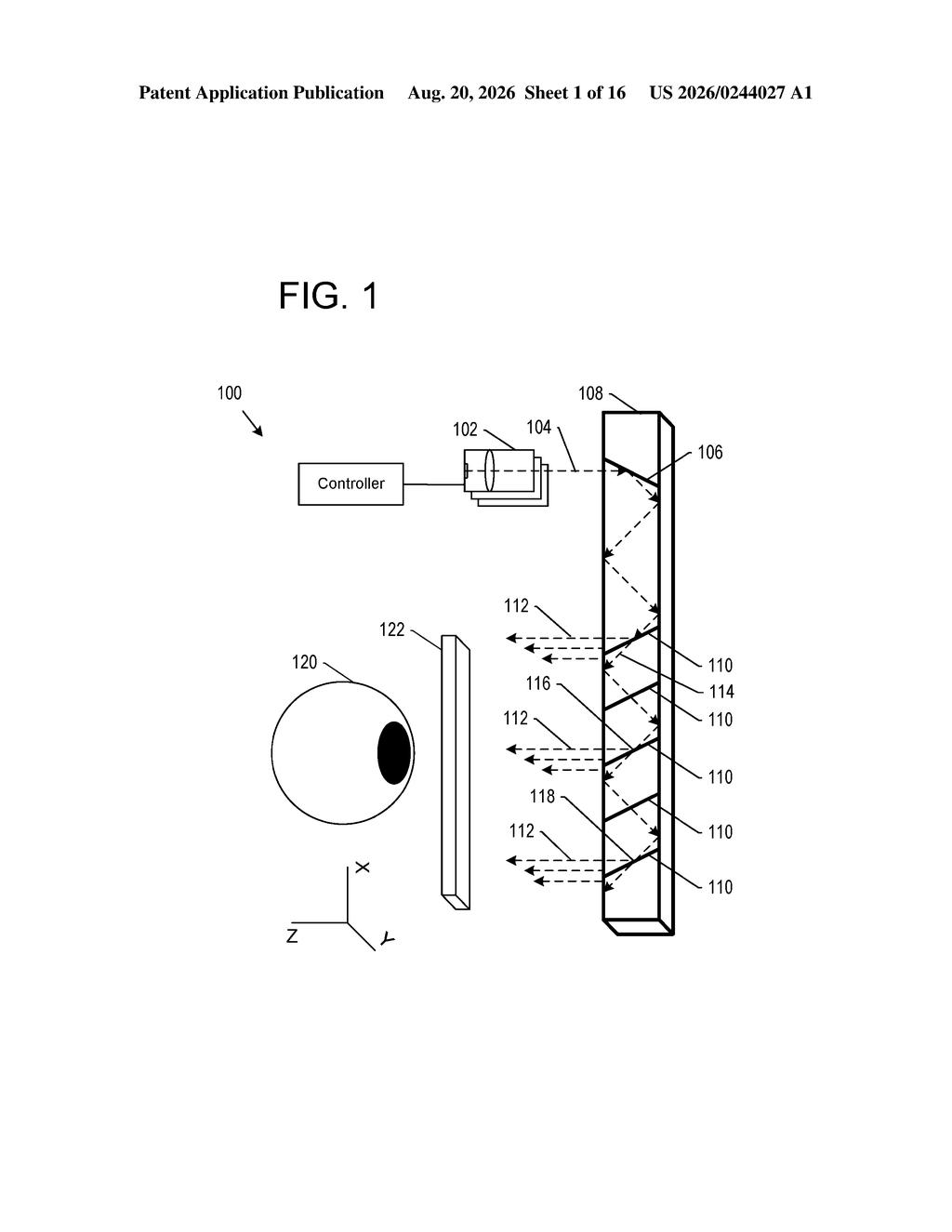
What Microsoft's multi-projector AR lens actually does
Every time a pair of AR glasses tries to show you something, a tiny projector has to fire light through a thin piece of glass and make it fill your whole field of view. That's a lot to ask of one small chip.
Microsoft's patent proposes using a whole array of tiny projectors working together instead. Each projector handles a slice of the image, and they're arranged in columns, with different sets handling different colors. The glass lens (called a waveguide) then catches all that light, bounces it around internally, and fans it out so it covers the width and height of your vision.
The practical payoff is that you could get a bigger, more uniform image without needing a single oversized projector bulging out of the frame. The glasses can stay slim while the image stays full.
… a waveguide comprising a first input coupler configured to in-couple the light outputted from the first set of projector displays into the waveguide; a second input coupler configured to in-couple the light outputted from the second set of projector displays into the waveguide …
Translation: The glasses use separate optical channels to feed different colors of projected light into the glass lens.
How the waveguide splits, routes, and expands the image
The system described in the patent centers on an array of projector displays arranged along one axis, feeding light into a waveguide, which is the thin, transparent slab that makes up the lens of AR glasses.
Instead of one projector trying to cover everything, the array is split into at least two sets. Each set handles a different wavelength range (think different color channels, like red, green, and blue). Each set gets its own input coupler, a small optical element that bends the incoming light so it enters the waveguide at the right angle and travels down it via total internal reflection (the same principle that keeps light inside a fiber-optic cable).
Once the light is bouncing inside the waveguide, an output coupler takes over. It does two things at once:
- Expands the image in a second direction (perpendicular to the first), so it fills the vertical dimension of your view
- Redirects the light out of the waveguide and toward your eye
The input couplers can be built from diffractive optics (etched grating patterns that bend light using interference) or reflective optics (tiny mirrors). This flexibility lets designers tune the system for different glass thicknesses or brightness targets.
Upon interaction with the output coupler, the image light is expanded in a second dimension transverse to the first dimension and is coupled out of the waveguide.
Translation: The lens spreads the projected light horizontally and vertically so your eyes see a complete, large picture.
What this means for the future of thin AR glasses
AR glasses live or die by the optical stack. The projector has to be bright enough to be visible in daylight, small enough to fit in a normal-looking frame, and efficient enough not to drain a battery in an hour. Splitting the job across an array of smaller projectors is one way to thread that needle: each unit is cheaper and lower-powered, and the array as a whole can be brighter than any single projector that would fit in the same space.
The color-separation approach (dedicated projector sets per wavelength) also avoids a common problem in waveguide displays where different colors spread at different angles and cause color fringing at the edges of the image. Microsoft's work here sits alongside a broader wave of new Big Tech patents reshaping how AR optics are engineered, from waveguide geometry to the light sources themselves.
Microsoft's sixth filing we've tracked in the AR glasses race since May builds on work like eye-based screen dimming and edge lighting fixes.
Using several small projectors instead of one creates real problems. More parts mean more things that can break, and every projector must line up perfectly with its neighbors or the picture shows ugly seams and color mismatches.
That alignment work is the true cost of this design. Whether it pays off depends on whether Microsoft can build thousands of these headsets with that same tight precision, every single time.
The reason to think it might work: the whole point of splitting the image across multiple projectors is to fix a color-bleeding problem that has haunted see-through headset screens for years. That is a real, known flaw being targeted directly. This looks like a careful engineering bet, not a hopeful guess.
Get our take in your Top Stories
Liked this breakdown? Add Patentlyze as a preferred source on Google, and our plain-English take shows up more often in your Top Stories the next time Microsoft patent news breaks.
There are more where this came from
We read every patent application Big Tech publishes and send you the ones worth knowing. Plain English, free, every week.
The drawings
16 drawing sheets from US 2026/0244027 A1 · click any drawing to enlarge


Show the other 8 sheets


Want this weekly breakdown for a company we don't cover? Patentlyze Pro →
Be the first to weigh in