
Sony Patents a Way to Split Game Scene Rendering Between a Server and Your Console
Sony has filed a patent that lets your console skip drawing the whole scene from scratch. Instead, it streams a pre-rendered background from a server and only draws the important objects locally, which could mean faster rendering with far less processing power.
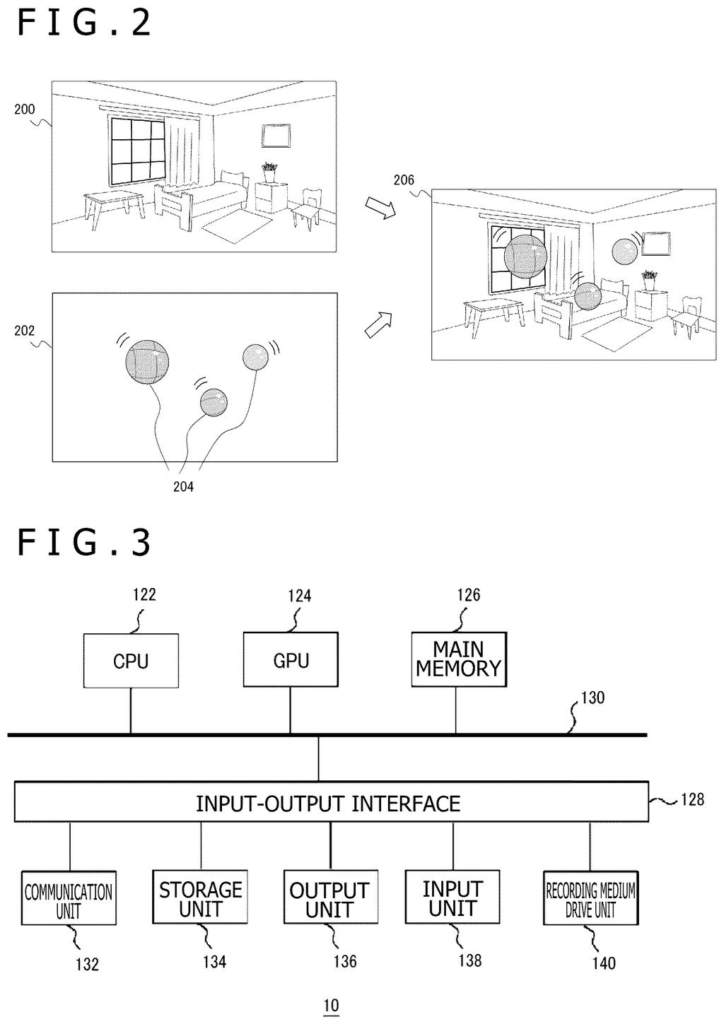
How Sony's background-streaming rendering trick works
Every time a game loads a new scene, your console is grinding through an enormous amount of work: drawing walls, floors, skies, distant buildings, and hundreds of other background details, all at once, all from your viewpoint. That adds up, especially in rich 3D environments.
Sony's patent describes a system where the heavy background work is handed off to a server. The server stores a ready-made image of the scene without the main characters or key objects. Your device downloads that background image, then draws only the specific objects that need to be interactive or animated locally, and layers them on top.
The result is that your console or device isn't rendering the entire world from scratch every frame. It just handles the parts that actually move or change, which is a much lighter job. Think of it like printing a stage backdrop on paper and only puppeteering the actors in front of it.
generating an image of a specific object defined by a predetermined criterion among objects existing in a space to be displayed, acquiring basic data of an image representing a state of the space not including the specific object from a server …
Translation: Your console renders just the important game objects while downloading the background from the cloud.
How the device combines server images with local 3D objects
The patent describes an image processing device (likely a game console or streaming client) that splits scene rendering into two separate jobs.
- Reference image acquisition: The device pulls a pre-rendered "reference image" from a content server. This image shows the scene as it would look with the main interactive object removed entirely, essentially a clean background plate.
- Entire image generation: Using that reference image as a base, the device constructs a full background view matched to the player's current viewpoint, adjusting for camera angle and position.
- Specific object image generation: Separately, the device generates full 3D geometry and a rendered image only for the "specific object," defined by a predetermined criterion (for example, it could be a player character, an enemy, or any object the developer flags as interactive).
- Combining and output: The background and the object image are composited together and sent to the display.
The key technical insight is that the background, which is largely static from frame to frame, doesn't need to be recomputed locally. Offloading it to a server that can pre-bake it once means the local processor only does the geometrically complex work for objects that actually change. This is sometimes called a layered or hybrid rendering approach.
An entire image generation unit 58 refers to the reference image and generates an entire image corresponding to a display viewpoint. A specific object image generation unit 62 generates three-dimensional information regarding the space to be displayed including the specific object …
Translation: The system builds the background view first and then places the main game elements into it.
What this means for streaming games and console workloads
For players, this could mean scenes load faster or run at higher visual quality on hardware that would otherwise struggle to render everything at once. The console's GPU focuses only on the characters and objects that need real-time physics and animation, while the background arrives pre-polished from a server with far more compute resources.
For Sony's cloud gaming and game-streaming ambitions, the approach fits neatly: offloading the static parts of a scene to a server is exactly the kind of architecture that makes streaming games more practical on thin clients like phones or budget hardware. It's an active area of Big Tech patent news, with several companies exploring how to divide rendering work between the cloud and local devices to improve visual quality without demanding more from the endpoint.
Sony's fourth filing we've tracked in the GPU rendering race since July builds on ideas like region-based video encoding and filling gaps with 3D data.
Claim 1 covers almost any system that draws a foreground object on your own device, pulls a background image from a remote server, and then stitches the two together on screen. That is a wide net. It leaves out details like what kind of object, how it is drawn, or what device you are using, which means it could apply to game consoles, VR headsets, phones, and more.
Whether this patent actually holds that much power depends on what older, similar inventions turn up during review. As written, though, it is a broad claim on a technique that sits at the heart of where cloud gaming is headed.
Get our take in your Top Stories
Liked this breakdown? Add Patentlyze as a preferred source on Google, and our plain-English take shows up more often in your Top Stories the next time Sony patent news breaks.
There are more where this came from
We read every patent application Big Tech publishes and send you the ones worth knowing. Plain English, free, every week.
The drawings
7 drawing sheets from US 2026/0245288 A1 · click any drawing to enlarge


Want this weekly breakdown for a company we don't cover? Patentlyze Pro →
Be the first to weigh in