
Samsung Patents a Way to Speed Up Shared AI Training Across 5G Networks
Training an AI model normally requires sending all your data to a central server. Samsung's new patent describes a way for phones to train AI together over a 5G network while keeping personal data local, and to do it faster by routing the math through smarter network hardware.
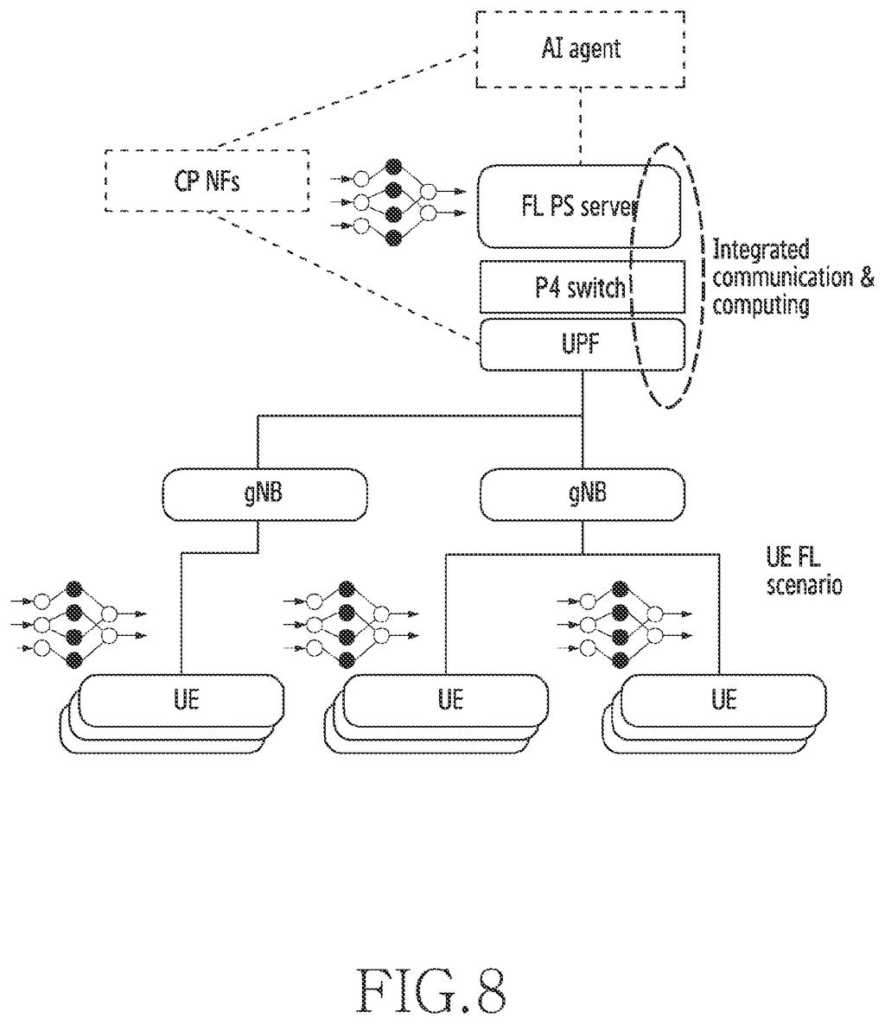
How Samsung wants phones to train AI together over 5G
A hospital on one side of a city and a clinic on the other are both trying to train the same AI model. Neither wants to share their patient records, but they still need to pool what they learn. That tension is exactly what this patent is designed to solve for phones on a 5G network.
Samsung's filing describes a method where a group of devices each train a local copy of an AI model, then share only the results of that training (numbers called gradients, not the underlying data) back to the network. The key twist is that the 5G network itself, specifically a component called the User Plane Function, handles the job of combining those results rather than a separate cloud server.
The system also checks whether specialized programmable switches are nearby to help with that combining step. If the network hardware can handle it, the math happens closer to your device. If not, a traditional server takes over as a fallback.
… selecting the UPF entity for the multiple terminals in the federated learning group, based on at least one of the first information and the second information, wherein, in case that the gradient aggregation performance is supported, gradient aggregation is performed in the UPF entity …
Translation: The system chooses a network gateway that can process AI data locally to speed up the training process.
How the network picks the fastest AI training route
The patent describes a protocol for a network component called the Session Management Function (SMF), think of it as the traffic controller inside a 5G core network. Its job here is to figure out the best way to support a group of devices doing federated learning (a technique where devices train AI models locally and share only weight updates, not raw data).
The SMF queries a Network Repository Function (NRF), which is essentially a directory of available network services, to gather two pieces of information:
- Whether a nearby User Plane Function (UPF) (the component that actually moves data packets) can handle gradient aggregation, meaning it can mathematically combine the AI updates from all the participating devices.
- Whether a programmable switch is positioned nearby to assist that UPF with the same task.
Gradient aggregation is the step where individual devices' training contributions get merged into one improved model. Normally a dedicated server handles this. This patent moves that work into the data-path hardware of the 5G network itself, using arithmetic or XOR (bitwise) calculations on the incoming gradients.
If the UPF supports aggregation natively, it does the job inline. If not, a traditional parameter server (PS) handles the fallback. The selection logic is automatic, based on what the network reports about its own capabilities.
The present disclosure relates to a 5G or 6G communication system for supporting a data transmission rate higher than that of a 4G communication system such as LTE. This operating method of an SMF for supporting federated learning in a wireless communication system comprises the steps of: acquiring information related to a plurality of terminals in a federated learning group …
Translation: Samsung is developing a way for 5G and 6G networks to coordinate groups of devices working together on AI tasks.
What this means for AI training on mobile networks
For anyone using a phone or IoT device that contributes to a shared AI model (think predictive text, health monitoring, or traffic prediction), the benefit is speed and privacy at the same time. Moving the aggregation step into the 5G data plane means fewer round-trips to distant cloud servers, which cuts the time each training cycle takes. The privacy angle is also real: because raw data never leaves the device, only the numeric weight updates do, this approach is more compatible with regulations like GDPR than traditional centralized training.
The filing is a fairly narrow infrastructure patent aimed squarely at telecom engineers building out 6G-era network cores, not a consumer product announcement. Still, the direction it points is meaningful: AI training increasingly needs to happen at the edge of the network, not just in hyperscale data centers, and Big Tech patent news across the wireless AI space consistently shows carriers and chipmakers racing to embed compute into the network fabric itself. Samsung, which makes both network equipment and consumer devices, is positioned to benefit from both sides of that shift.
Samsung's 16th filing we've tracked since June in our on-device AI privacy watch adds to a pattern that includes hiding personal info in 3D and scrubbing data before the blockchain.
The concrete payoff for a device user, if this architecture ships inside a real 5G network, would be faster AI model updates with less battery drain spent waiting on distant servers. That is a real improvement for use cases like on-device health AI or keyboard prediction that improve over time. The filing is narrow and deeply infrastructure-focused, meaning the reader would never see a toggle labeled 'federated learning' in their settings. But the failure it prevents is meaningful: without smarter network routing, shared AI training over mobile networks becomes a bandwidth bottleneck that slows every device in the group.
There are more where this came from
We read every patent application Big Tech publishes and send you the ones worth knowing. Plain English, free, every week.
The drawings
20 drawing sheets from US 2026/0247137 A1 · click any drawing to enlarge


Want this weekly breakdown for a company we don't cover? Patentlyze Pro →
Be the first to weigh in