
Samsung Patent Teaches Smart Home Devices to Separate Commands From Casual Talk
Every smart home speaker that misfire-activates on background conversation represents a solved-sounding problem that still isn't solved. Samsung is now patenting a way to cross-check your voice commands against physical events happening nearby, so the system knows when you're actually talking to a device and when you're just talking.
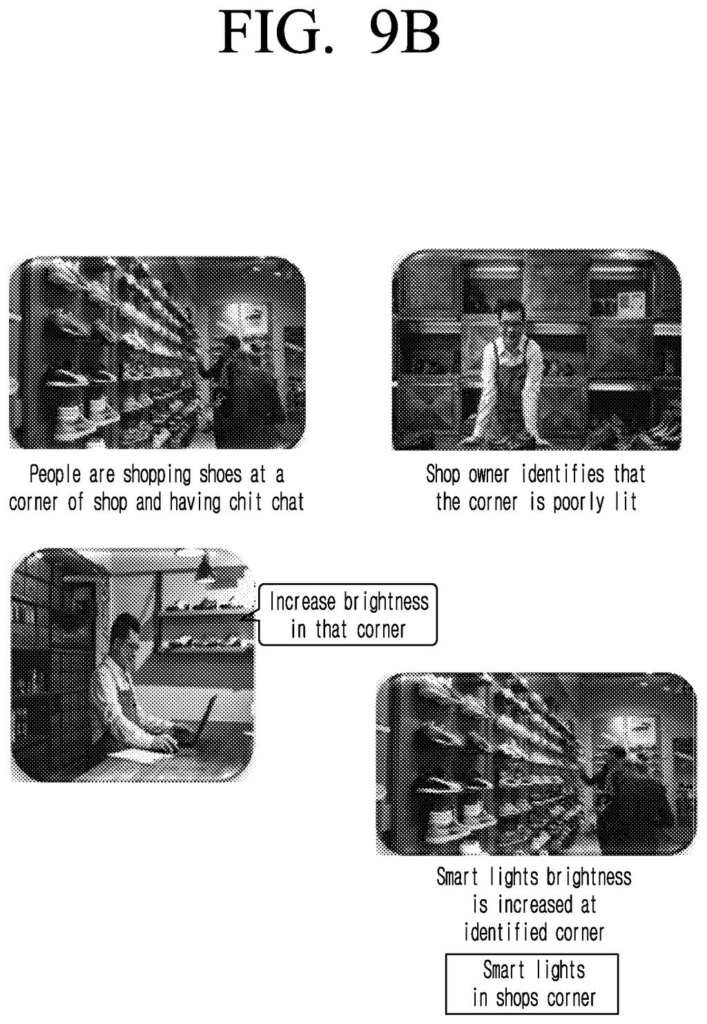
How Samsung's IoT system reads background noise to confirm voice commands
Right now, always-on smart devices have to guess whether you're giving them a command or just having a conversation near them. A phrase like "turn it off" could mean a lamp, a TV, or nothing at all, and most systems rely almost entirely on a wake word to decide.
Samsung's patent wants to layer in a second check: physical context. If your voice says "turn off the coffee maker" and a device near the coffee maker detects the sound of it running (or stopping, or beeping), the system uses that matching signal to confirm the command was real and intentional. The non-speech event, maybe a click, a hum, or a sensor reading, acts like a witness for your words.
The result is a network of devices that can triangulate meaning. Your voice input is no longer evaluated in isolation. What was happening near which device, at the moment you spoke, becomes part of the equation.
… determining, by at least one device among the plurality of devices, an ambient context associated with at least one non-speech event, wherein the at least one non-speech event occurs at a location associated with the at least one other device among the plurality of devices …
Translation: The system identifies background noises or activities happening near other smart devices in your home.
How non-speech events get matched to devices and voice inputs
The patent describes a method for a network of IoT devices (think smart speakers, sensors, cameras, and appliances) operating in what the filing calls a continuous listening environment, meaning microphones are always on, always capturing audio.
When a voice input arrives, the system does something beyond simple speech recognition. It scans for non-speech events, physical sounds or sensor readings captured by nearby devices in the network. These might be a smoke detector beeping, a refrigerator door closing, a TV turning on, or a motion sensor triggering.
The system then:
- Identifies where the non-speech event occurred (the event location)
- Determines which device is associated with that location
- Measures the correlation between the ambient context (what was happening physically) and the voice input (what was said)
- Uses that correlation to decide whether the voice input contains a real, intentional command, and which device it was directed at
This is essentially a confidence-scoring layer on top of speech recognition. Instead of just parsing words, the system asks: does the physical world around the targeted device support the interpretation that this command was meant for it?
… determining, by the at least one IoT device, a correlation between the ambient context and the at least one other IoT device based on an event location of the occurrence of the at least one non-speech event; and determining, by the at least one IoT device, presence of at least one voice command within the voice input based on the correlation.
Translation: The device uses these background events to figure out if you are actually giving a command or just talking to someone else.
What this means for always-on smart home microphones
For anyone living with a multi-device smart home setup, the practical payoff here is fewer phantom activations and fewer commands that land on the wrong device. If you say "play music in the kitchen" while standing near the living room TV, the system can use sensor context to route that correctly rather than guessing based on proximity to the microphone alone.
The broader push here is toward smart home systems that are contextually aware rather than purely voice-pattern dependent, which matters a lot as more households pack in multiple always-on devices from the same manufacturer. Samsung's ecosystem (Galaxy phones, SmartThings, Bixby-enabled appliances) is exactly the kind of environment where this kind of cross-device coordination would show up first, and it fits a pattern of new Big Tech patents focused on making ambient computing feel less accidental in the IoT space.
Samsung's sixth filing we've tracked on our AI agents that act for you watchlist since July builds on earlier applications like voice-to-action prompting and self-checking before acting.
The concrete payoff for the person using this system is straightforward: fewer moments where you say something near a device and it either ignores you or does the wrong thing. That failure happens constantly in multi-device homes, and it erodes trust in voice interfaces more than any single dramatic misfire would. Samsung is building a layer that makes the network think about physical context, not just acoustic patterns, which is a real change in how voice commands get validated, and one users would actually feel the difference from after a few days.
Get our take in your Top Stories
Liked this breakdown? Add Patentlyze as a preferred source on Google, and our plain-English take shows up more often in your Top Stories the next time Samsung patent news breaks.
There are more where this came from
We read every patent application Big Tech publishes and send you the ones worth knowing. Plain English, free, every week.
The drawings
14 drawing sheets from US 2026/0245553 A1 · click any drawing to enlarge


Want this weekly breakdown for a company we don't cover? Patentlyze Pro →
Be the first to weigh in