
Adobe Patents AI That Spots Patterns Across Records of How Customers Behave
Adobe is teaching an AI to sort through stacks of customer journey maps, find the ones that actually drove results, and answer plain-language questions about what they have in common. It's essentially a research assistant for the documents marketers spend weeks building.
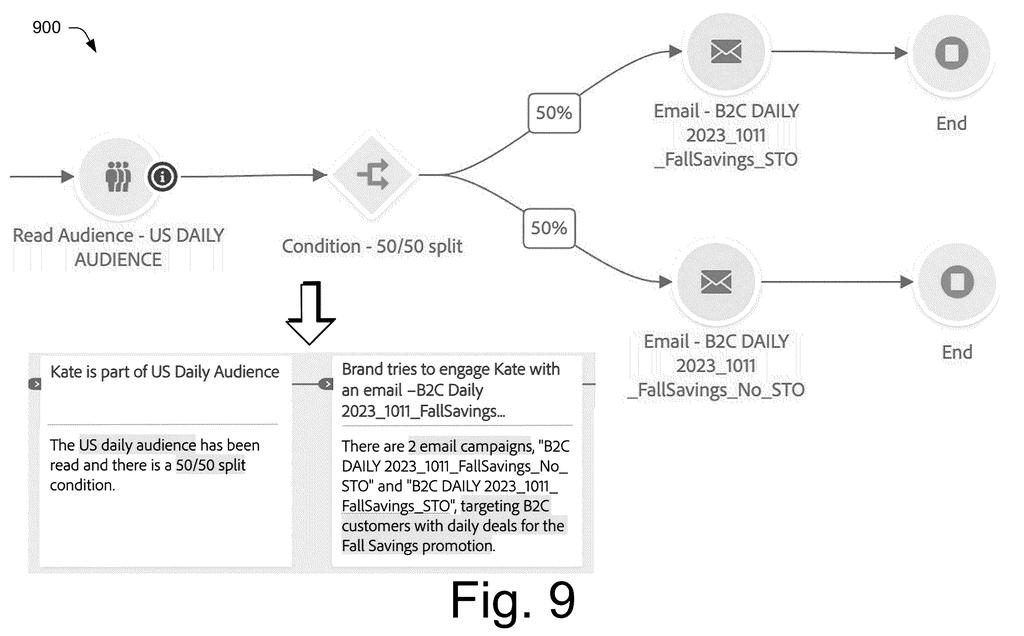
What Adobe's journey map AI actually analyzes
A marketing team spends months creating customer journey maps, those diagrams tracing every step a person takes from first hearing about a product to actually buying it. They end up with dozens of versions across campaigns. Then nobody can remember which ones worked.
Adobe's patent describes a system that reads through all those old journey maps automatically, groups similar ones together, checks which groups were tied to good business results, and picks the best examples from each group. When someone asks a question like 'What do our highest-converting maps have in common?', the system picks the most relevant example and uses an AI language model to write back a useful answer.
The goal is to stop valuable institutional knowledge from getting buried in folders nobody opens. Instead of a team member spending days reviewing past work, the system does that sifting and surfaces what matters.
assigning, using a machine-learning model, a plurality of category tags to a plurality of historical journey maps; generating, by a processing device, a plurality of clusters based on similarity of the plurality of historical journey maps, one to another; …
Translation: AI labels past customer journeys and groups similar ones together.
How the system clusters, scores, and queries maps
The system works in several stages, starting with category tagging. A machine-learning model reads each historical journey map and assigns labels, things like 'onboarding flow' or 'retail checkout,' so the system knows what type of experience each map describes.
Next, it runs clustering, grouping maps that resemble each other. Think of it like sorting a pile of recipes by cuisine before you start comparing them. Once the groups exist, the system checks performance indicator data (business metrics like conversion rates or customer retention scores) to see which clusters were actually associated with good outcomes.
From the highest-performing clusters, the system picks representative journey maps, the examples that best capture what made a cluster effective. These become the reference library for answering questions.
When a user submits a query, the system identifies:
- Which category the question is about
- How often maps in that category have been referenced before (recurring use)
- Which representative map to pull as the basis for an answer
Finally, a language model (the same family of technology behind tools like ChatGPT) reads the selected map and generates a written insight in response to the question.
Effectiveness of these clusters in performing an operation is determined by the journey map system using performance indicator data.
Translation: The system checks how well these grouped customer paths actually work based on performance data.
What this means for marketing analytics tools
For teams that work inside Adobe's Experience Cloud products, this kind of system would mean less time digging through archives and more time acting on past findings. Journey maps are expensive to produce and often discarded after a single campaign, so a retrieval layer that connects them to measurable outcomes could change how marketing teams treat that work.
The filing sits squarely in the growing area of AI applied to business process documentation, where the goal is turning static files into queryable knowledge bases. Adobe's approach here centers on outcome-aware search, meaning the AI weights its answers by what has historically performed well rather than treating all stored data as equally relevant. This patent joins a steady stream of interesting tech patents targeting AI retrieval in marketing analytics and enterprise documentation, where the recurring challenge is making AI assistants sensitive to business context rather than operating without it.
This is the fifth Adobe filing in the AI assistant and agent space we've tracked since May, joining one on self-explaining database queries and one on training with few examples.
Everything described here runs on software alone, so no new physical infrastructure has to exist before Adobe could ship it. The harder prerequisite is not the artificial intelligence.
Most companies keep their customer journey maps as slide decks or static files with no connection to actual business results, and building that structured foundation is what has to happen before the system has anything useful to learn from. The patent lays out a specific, narrow pipeline rather than a broad ambition, and that works in its favor: a tightly scoped system is faster to build, easier to protect legally, and easier for customers to recognize when it surfaces inside a product.
Get our take in your Top Stories
Liked this breakdown? Add Patentlyze as a preferred source on Google, and our plain-English take shows up more often in your Top Stories the next time Adobe patent news breaks.
There are more where this came from
We read every patent application Big Tech publishes and send you the ones worth knowing. Plain English, free, every week.
The drawings
11 drawing sheets from US 2026/0252998 A1 · click any drawing to enlarge


Want this weekly breakdown for a company we don't cover? Patentlyze Pro →
Be the first to weigh in