
Adobe Patents AI Method for Training Systems Using Minimal Learning Examples
AI assistants get better when they're shown a few relevant examples before answering your question. The problem is that finding the right examples is itself a hard task that requires a lot of training data. Adobe's new patent attacks that chicken-and-egg problem.
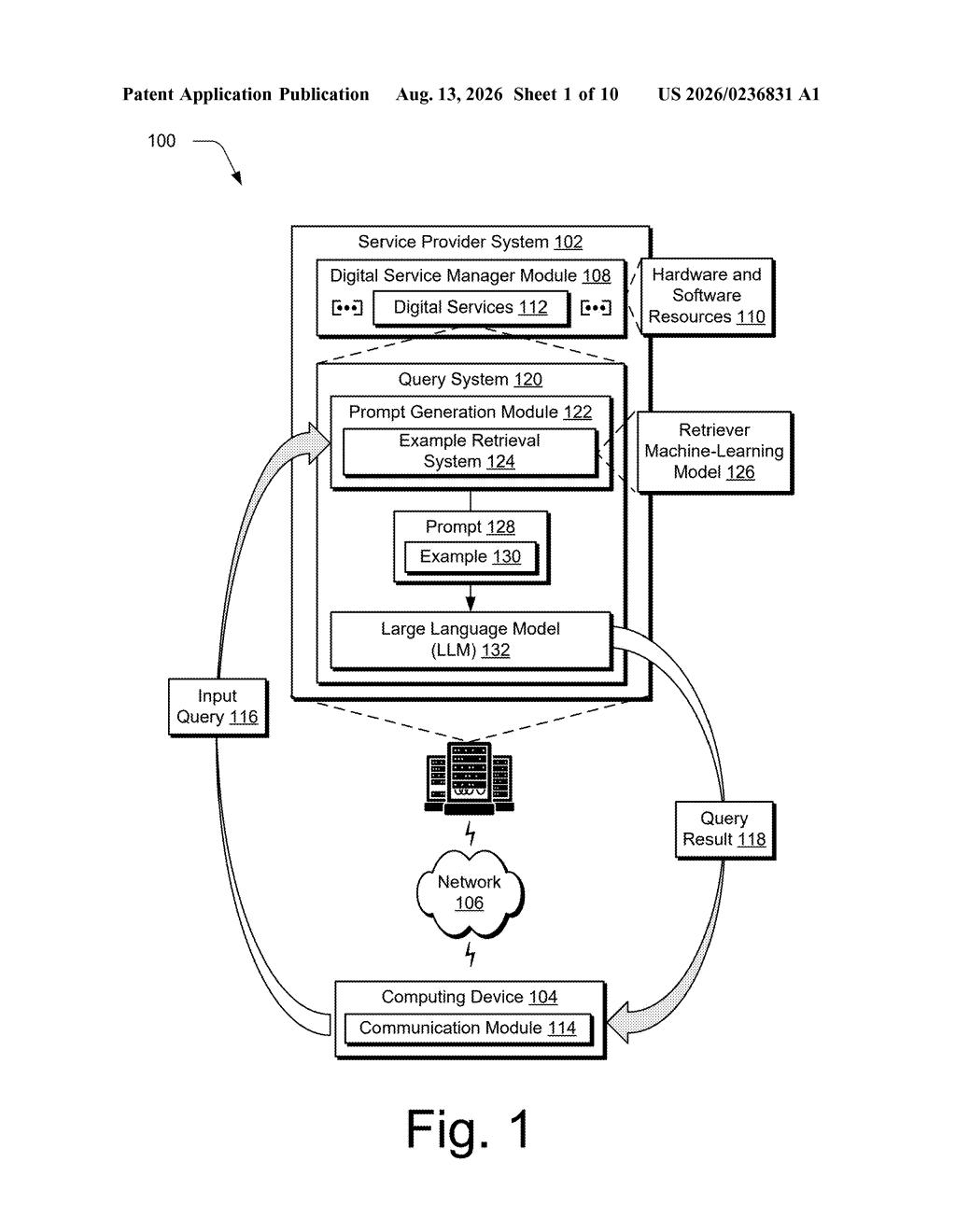
How Adobe's retrieval AI bootstraps itself from scratch
A student stares at a blank page, tasked with writing a legal brief, with no examples of what a good one looks like. That blank-page feeling is exactly what AI systems face when they're dropped into a new subject area.
Adobe's patent describes a way to train an AI to hunt down useful examples automatically, even when it's starting almost from scratch. The system borrows examples from a related topic where it does have data, then gradually folds those lessons into its understanding of the new topic. The two sides of the model keep teaching each other in rounds until they settle on a shared way of thinking about what counts as a "similar" example.
The practical payoff: an AI assistant powered by this approach could give you answers that are more relevant to your specific situation, and it could do that reliably even in subject areas where the company has only a thin library of past examples to draw on.
… merging the initial retriever machine-learning model with the auxiliary retriever machine-learning model to train the retriever machine-learning model to implement a shared representation embedding space.
Translation: The system combines two different training models into one unified system that understands how data relates to each other.
How the alternating-merge training loop actually runs
When a large language model answers a question, it often works best when it's shown a few related examples first. This technique is called in-context learning (ICL), meaning the model learns from examples placed directly inside the prompt, not from additional training. The tricky part is picking which examples to include. That selection job is handled by a separate model called a retriever.
The problem Adobe is solving is that training a good retriever requires a lot of labeled examples for each new topic area. If you're launching a new product category or expanding into a new language, you may have very few to work with. Adobe's patent describes an alternating minimization approach, a technique that breaks a hard optimization problem into two simpler problems solved back and forth in rounds:
- An initial retriever is trained on the small set of examples available for the target topic.
- An auxiliary retriever is trained in parallel on a richer, related dataset.
- After each round, the two models are merged, so each one benefits from what the other learned.
The merging step creates a shared embedding space (think of this as a common mental map of which concepts are close together and which are far apart) that works across both datasets. The patent also includes a mechanism to keep the retrieved examples diverse, so the model doesn't just grab five near-identical examples and overfit to a narrow pattern.
The query system, in one or more examples, implements an alternating minimization technique for example selection that enhances in-context learning (ICL) performance for resources having few initial examples, e.g., for an initial resource.
Translation: This method helps AI learn effectively even when it is only given a very small amount of starting information.
What this means for Adobe's AI tools in practice
For everyday users of Adobe's AI-powered tools, like the generative features in Acrobat or the AI assistant in Creative Cloud, this kind of work sits underneath the surface. When the system gives you a summary, a rewrite suggestion, or a data-extraction result, it often relies on picked examples to frame the task. A weaker retriever means generic or off-target answers. A better retriever means the AI's response actually fits your document, your workflow, and your context.
The cold-start angle is the important part here. Adobe sells tools into a huge range of industries, from legal to marketing to finance, and each domain has its own vocabulary and conventions. A retriever that can bootstrap itself from thin data lets Adobe extend AI assistance into those niches faster, without waiting years to accumulate enough examples. AI retrieval methods like this one are part of this week's Big Tech patents showing how companies are racing to make AI useful in specialized domains, not just general ones.
This patent solves a practical bottleneck that anyone building AI tools for niche domains runs into: you need data to train the model, but you can't collect good data without a working model. Adobe's alternating-merge approach is a concrete engineering answer to that loop, and the diversity mechanism on top of it addresses a second real failure mode where retrieved examples cluster too tightly and the AI essentially copies itself. Users who work with Adobe's AI in specialized or lower-volume subject areas are the ones most likely to feel the difference, in the form of answers that actually reflect their specific documents rather than a generic middle ground.
There are more where this came from
We read every patent application Big Tech publishes and send you the ones worth knowing. Plain English, free, every week.
The drawings
10 drawing sheets from US 2026/0236831 A1 · click any drawing to enlarge


Want this weekly breakdown for a company we don't cover? Patentlyze Pro →
Be the first to weigh in