
Microsoft Patents a Way to Route Database Queries Through a GPU
Microsoft has filed a patent describing a system that offloads database searches to a graphics chip, potentially speeding up data lookups without buying new infrastructure. The twist: the CPU does the prep work first, trimming the data down before the GPU ever touches it.
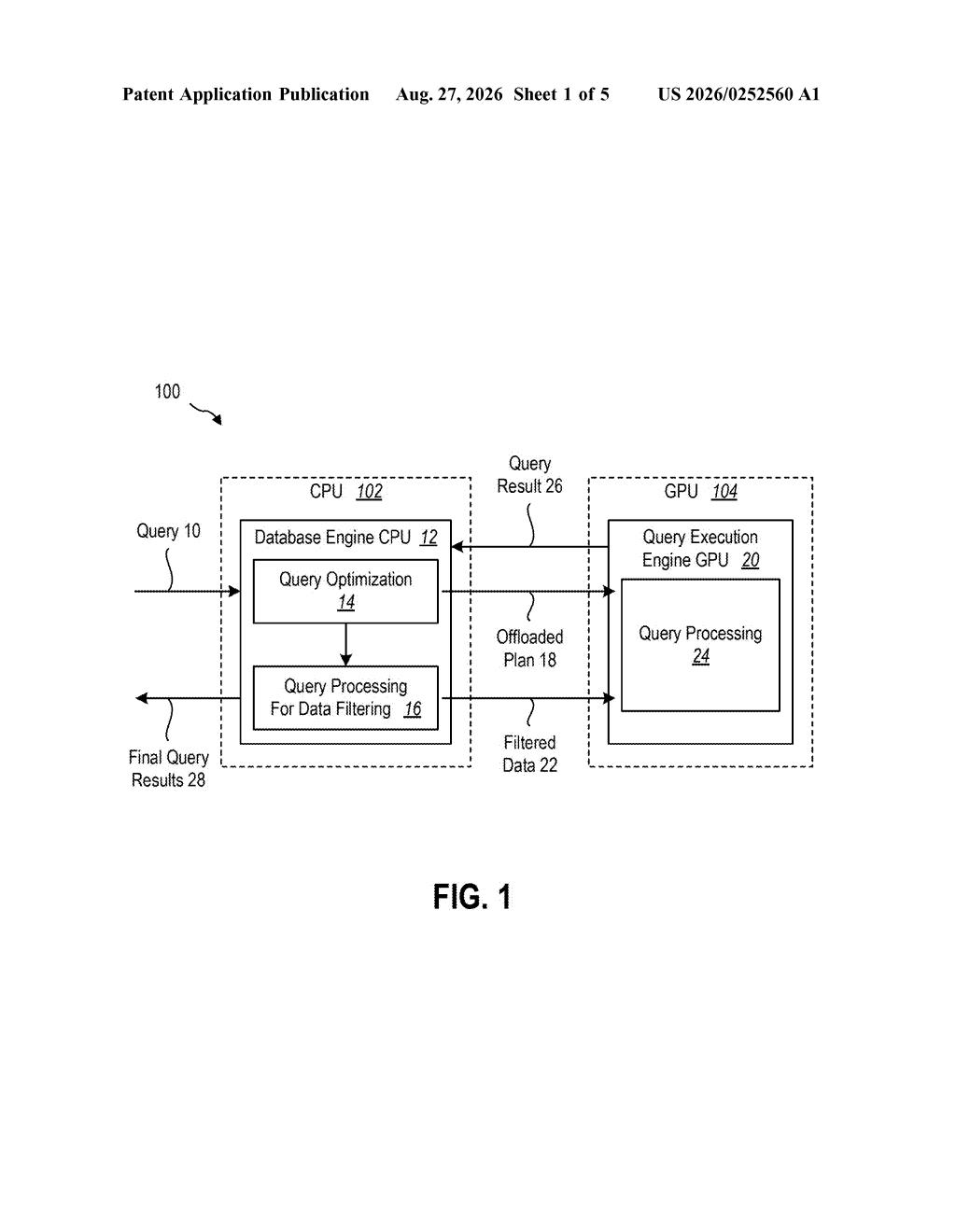
How Microsoft splits database work between CPU and GPU
Imagine you're running a search across a massive spreadsheet with millions of rows, and your computer is crawling. Microsoft's patent describes a way to split that job between two chips that are already inside most modern computers: the main processor (CPU) and the graphics chip (GPU).
The idea is that your CPU, which normally handles database searches on its own, first figures out exactly which rows of data are actually needed for your search. It filters out everything irrelevant, then hands that smaller, cleaner dataset over to the GPU. GPUs are built to process many things at once in parallel, so they can race through that filtered data much faster than the CPU could alone.
The result is that database queries could complete significantly faster, using hardware that already exists in servers and workstations. You wouldn't necessarily need to buy new equipment; the software would just get better at using what's already there.
… generate, for the offloaded query plan, a data filter plan that reduces the data not needed for a query result; output filtered data for the offloaded query plan in response to performing data filtering on the data using the data filter plan …
Translation: The system creates a plan to strip away unnecessary information before sending the remaining data to the graphics card.
How the CPU filters data before handing off to the GPU
The patent describes a hybrid query processing system that coordinates a CPU and a GPU to answer database queries together, rather than leaving all the work to the CPU.
When a query arrives (say, "find every transaction over $10,000 from last quarter"), the CPU's database engine runs a step called query optimization, which means it figures out the most efficient sequence of operations to get the answer. From that, it produces an offloaded query plan, a blueprint specifically designed to run on the GPU rather than the CPU.
Before shipping that plan to the GPU, the CPU applies a data filter plan. This is essentially a pre-screening step: it loads the relevant data from memory and strips out everything the query doesn't need, producing a smaller filtered dataset. Sending less data to the GPU means the GPU spends less time moving data around and more time computing.
The filtered data and the query plan are then transferred to a query execution engine running on the GPU. The GPU executes the plan in parallel across thousands of its cores (GPUs are designed to handle many calculations simultaneously, unlike CPUs, which handle fewer tasks but more complex ones). The GPU sends the final result back to the CPU, which returns it to the application or user that made the request.
The present disclosure relates to systems and methods that perform hybrid query processing using a central processing unit and a graphics processing unit. The systems and methods produce an offloaded query plan for processing by a graphics processing unit.
Translation: This technology describes a way to share database work between a computer's main processor and its graphics chip.
What this means for database speed without new hardware
Database speed is one of those problems that sounds boring until you're the company paying for cloud servers or the customer waiting for a report to load. Large organizations run thousands of queries per minute across enormous datasets, and the CPU has traditionally been the bottleneck. Offloading query execution to a GPU, which is already present in most modern server hardware, could meaningfully cut that bottleneck without a costly hardware upgrade.
The pre-filtering step is where Microsoft's approach shows real engineering discipline. Moving large amounts of raw data between a CPU and a GPU is itself slow, so trimming the data first is what makes the whole handoff worthwhile. Microsoft's investment in database infrastructure, visible across new Big Tech patents in the database and chip-acceleration space, signals that GPU-assisted query processing is becoming a serious engineering priority, not just a research concept.
This is the eighth Microsoft filing we've tracked since July in our AI chip wars watchlist, building on one splitting training data and one splitting inferencing tasks.
Slow database queries cost real money. Every time an enterprise dashboard stalls, a report takes minutes instead of seconds, or a cloud bill spikes because a search across billions of records chewed through compute time, someone is paying for that delay in dollars and lost productivity.
Microsoft's approach here matches the scale of that problem by attacking its most expensive moment: the point where data moves between processors. Filtering data down before that handoff means less wasted work, which translates directly into faster results and lower costs at cloud scale.
For anyone building software that touches large datasets, the performance gains this enables are not cosmetic. They show up as applications that stay responsive under load, infrastructure that serves more users without proportionally more hardware, and cloud bills that grow slower than the business does.
Get our take in your Top Stories
Liked this breakdown? Add Patentlyze as a preferred source on Google, and our plain-English take shows up more often in your Top Stories the next time Microsoft patent news breaks.
There are more where this came from
We read every patent application Big Tech publishes and send you the ones worth knowing. Plain English, free, every week.
The drawings
5 drawing sheets from US 2026/0252560 A1 · click any drawing to enlarge


Want this weekly breakdown for a company we don't cover? Patentlyze Pro →
Be the first to weigh in