
Microsoft Patent Splits AI Inferencing Tasks Between Local Device and Cloud Faster
Running a full AI model on a tiny local chip is often impossible, but sending everything to a remote server is slow and bandwidth-hungry. Microsoft's new patent describes a dedicated networking chip that stitches the two approaches together, making them act like one.
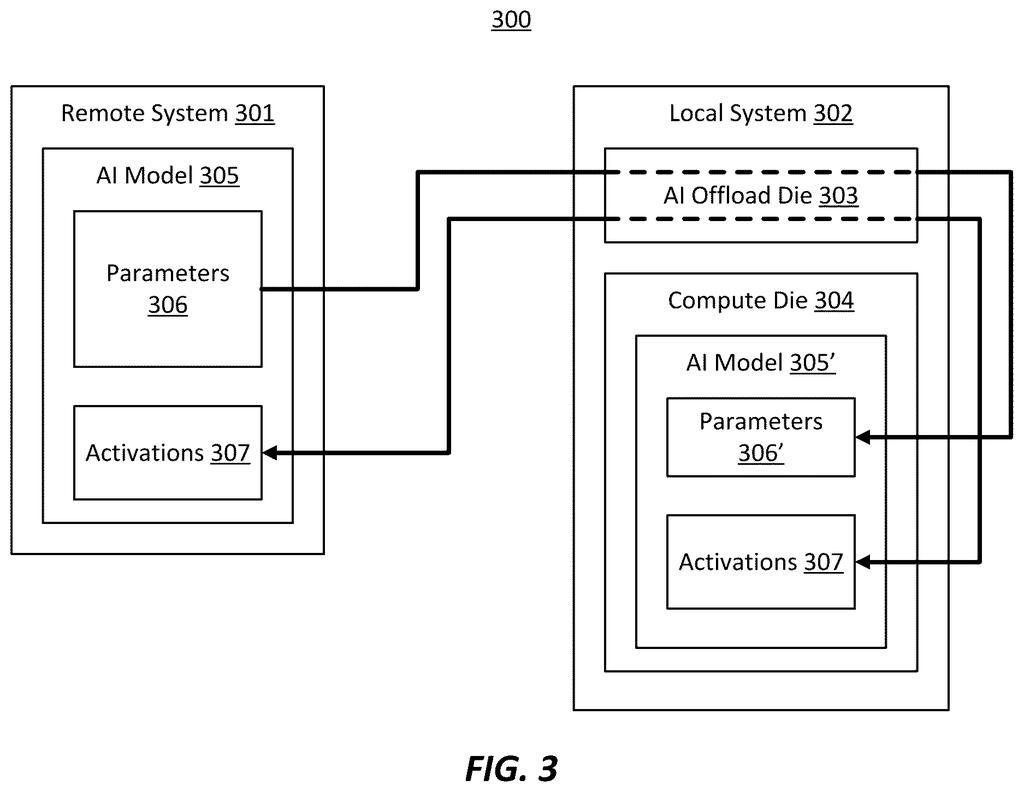
How Microsoft's chip-and-cloud AI split actually works
You're asking an AI assistant on your laptop to do something complex, and the chip inside simply doesn't have enough horsepower to handle the whole job on its own. Today, that usually means either a sluggish on-device result or shipping your entire request to a data center and waiting.
Microsoft's patent describes a small, specialized chip called an AI offload die that lives inside the same package as your main processor. Its only job is to manage the handoff: it figures out which parts of the AI model your local chip can handle, fetches those parts from a remote server over a network, and keeps both sides in sync so they're working on the same problem at the same time.
The result is a kind of relay race for AI tasks: your device does what it can, the server handles the rest, and the offload die acts as the baton-passer between them. You get faster, more capable AI responses without needing a massive chip in your device or a constant full-speed internet connection to a cloud server.
… using the network controller, fetching the portion of the AI model from the remote computing system; communicating the portion of the AI model to the compute die; and using the network controller, synchronizing AI model inferencing state between the compute die and the remote computing system.
Translation: The chip handles downloading parts of the AI and keeping the local and cloud versions in sync while they work together.
Inside the AI offload die's role as traffic coordinator
The patent centers on a hardware component called an AI offload die, which sits inside a system-in-a-package (a modern packaging approach that bundles multiple chips into one tight unit, like several tools in a single Swiss Army knife). Inside that package there's also a compute die, which is the chip doing the actual local AI computation.
The offload die contains a built-in network controller (essentially a smart modem for chip-to-cloud communication). That controller is responsible for three things:
- Identifying which layers or segments of an AI model are suitable for the local compute die to run
- Fetching those model segments from a remote computing system (a cloud server or edge node) over a network connection
- Synchronizing state between the local chip and the remote system, meaning it keeps both sides aware of where the AI inference (the process of generating a result from a model) currently stands
The synchronization step is the technically tricky part. AI inference isn't always a simple pipeline; intermediate results from one stage feed into the next. The offload die has to pass those intermediate outputs back and forth accurately so neither side produces a wrong answer because it missed context from the other.
The patent describes this as hybrid inferencing: neither purely local nor purely cloud-based, but a coordinated split that adapts based on what the local chip can handle at a given moment.
This approach facilitates efficient distribution and execution of AI tasks between the compute die and the remote computing system, enhancing computational performance and resource utilization.
Translation: This method improves speed and efficiency by splitting AI work between your local device and a remote server.
What this means for on-device AI without big chips
The practical pressure here is real. AI models keep growing, and chip budgets inside laptops, tablets, or small edge devices don't scale at the same pace. Today's workaround is usually an awkward either/or: run a cut-down model locally and accept weaker results, or offload everything to the cloud and accept latency and data-privacy costs. Microsoft's approach carves out a middle path that keeps the two working together rather than choosing one.
The dedicated offload die is an interesting design bet: adding a chip whose only purpose is coordination adds cost and physical space, but it also means the main processor stays free to do its own work rather than babysitting network traffic. That tradeoff makes most sense in professional or enterprise hardware where performance per watt and reliability matter more than penny-pinching on component count. For those following interesting tech patents in the on-device AI chip space, this filing sits alongside a broader wave of silicon designs trying to close the gap between what edge hardware can do alone and what cloud infrastructure can do at scale.
The design commits fully to a dedicated coordination layer, and that choice has a real cost: the offload die consumes area, power, and manufacturing budget that could have gone toward more raw compute. The bet only pays off if the hybrid split actually outperforms a better local chip running a smaller model, which depends heavily on network conditions outside Microsoft's control. For enterprise hardware where network reliability can be assumed and AI tasks are heavy enough to overwhelm any reasonably priced local chip, the tradeoff reads as defensible engineering rather than wishful architecture.
There are more where this came from
We read every patent application Big Tech publishes and send you the ones worth knowing. Plain English, free, every week.
The drawings
4 drawing sheets from US 2026/0236325 A1 · click any drawing to enlarge


Want this weekly breakdown for a company we don't cover? Patentlyze Pro →
Be the first to weigh in