Intel
Intel · Chip · Filed Jun 27, 2025 · USPTO published Aug 27, 2026 · Aug 27 release
Intel Patents a Chip That Handles Four Number-Crunching Tasks Simultaneously
Matrix multiplication is the engine behind nearly every AI calculation running today, and Intel just patented a way to do four of those calculations at the same time inside a single processor instruction.
- Publication number
- US 2026/0252662 A1(US20260252662A1)
- Applicant
- Intel Corporation
- Filed · Published
- Jun 27, 2025 · Aug 27, 2026
- Inventors
- Alexander Heinecke, Amit Gradstein, Simon Rubanovich, Raanan Sade, Michael Espig, Dan Baum, Stephen Robinson, Wing Shek Wong, Evangelos Georganas, Yuval Yosef, Dror Markovich, Christopher J. Hughes
- Status when we published
- Waiting for an examiner
- Document
- 19 claims
- US classification
- 708/607
- Parent application
- Claims priority from a provisional application 63762578 (filed Feb 24, 2025)
What Intel's parallel matrix multiplication chip actually does
Imagine you're running a massive AI model and the computer has to multiply two giant tables of numbers together. Normally, it works through those calculations in steps. Intel's new patent describes a chip that can take two tables, split each one in half, and multiply every possible pair of halves at the same time, producing four results in one shot.
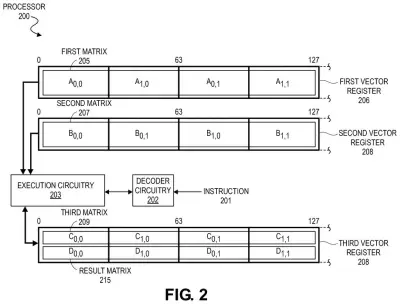
The trick is in how the chip stores and reads data. Each half-table lives in a dedicated memory slot inside the processor (called a vector register), and a single instruction tells the chip to combine them all at once. That's four multiplications for the price of one fetch-and-execute cycle.
For you as a user, this doesn't change anything visible on screen. But it could mean AI tools, video rendering, or scientific simulations finish faster without needing more power or more chips to do it.
multiply the first sub-matrix of the first source matrix and the first sub-matrix of the second source matrix to generate a first sub-matrix of the result matrix; multiply the first sub-matrix of the first source matrix and the second sub-matrix of the second source matrix to generate a second sub-matrix of the result matrix; …
Translation: The chip performs four distinct multiplication steps at once to build pieces of the final data set.
How the processor packs four multiplications into one instruction
The patent describes a processor built around a new instruction called a cross-product matrix multiply instruction. Instead of asking the chip to multiply one pair of matrices at a time, this instruction tells it to multiply every combination of sub-matrix pairs from two source matrices simultaneously.
Here's how the pieces fit together:
- Vector registers (fast on-chip memory slots) each hold two sub-matrices, the smaller blocks that make up a full matrix.
- A decoder reads the instruction and figures out which registers to pull from and what operation to perform.
- Execution circuitry then runs all four multiplications in parallel: first-with-first, first-with-second, second-with-first, and second-with-second.
- All four results land in a third vector register as sub-matrices of the final output matrix.
In standard matrix multiplication, you'd typically issue multiple instructions to cover all four combinations. Here, one instruction handles the full cross-product (meaning every possible pairing), which reduces the overhead of fetching and decoding repeated commands.
This is particularly relevant for deep learning inference and training, where matrix multiplications make up the bulk of compute time. Cutting the instruction count for those operations directly reduces how long the processor spends on bookkeeping versus actual math.
The execution circuitry multiplies each combination of sub-matrices from the two source matrices-first with first, first with second, second with first, and second with second—to generate four corresponding sub-matrices of a result matrix, which are stored in a third vector register.
Translation: The processor calculates four different parts of a matrix result simultaneously and saves them in a single storage area.
What this means for AI chip performance at scale
Matrix multiplication sits at the center of how AI models think. Every time a large language model generates a word, or a recommendation engine ranks a list, the underlying math is dominated by matrix operations. Making those operations faster per instruction is one of the most direct ways to improve AI throughput without simply adding more silicon.
Intel is competing with Nvidia, AMD, and a growing field of custom AI chip makers, all of whom are tuning their hardware for exactly this workload. A single instruction that replaces four separate ones is the kind of incremental but measurable gain that compounds across billions of operations per second. Chip-level patents like this one sit alongside a steady stream of new Big Tech patents pushing the boundaries of what AI accelerators can do per watt and per clock cycle.
That makes this Intel's 32nd filing we've tracked since May in the AI chip wars watchlist, joining one on faster parallel matrix math and one on memory spying defense.
Source: US 2026/0252662 A1 at the USPTO (PDF). Full patent text and figures are in the official publication.
Get our take in your Top Stories
Liked this breakdown? Add Patentlyze as a preferred source on Google, and our plain-English take shows up more often in your Top Stories the next time Intel patent news breaks.
Add Patentlyze on Google
One click.
There are more where this came from
We read the new patents from Big Tech, carmakers and more and send you the ones worth knowing. Plain English, free, every week.
The drawings · 31 sheets
31 drawing sheets from US 2026/0252662 A1 · click any drawing to enlarge


Show the other 23 sheets


More from Intel
All 199 Intel patents →
More in Chip
All 651 Chip patents →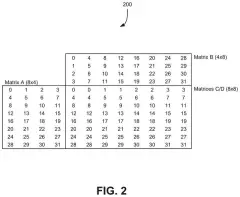
Nvidia
Nvidia Patents a Circuit Design That Splits Complex Math Across Specialized Chip Hardware
Apple
Apple Patents a Three-Chip Wake-Up System to Cut Photo Lag on Its Headset
Microsoft
Microsoft Patents a Way to Route Database Queries Through a GPU
Samsung