
Google Patents Radar Gesture Detection That Works Without Touching Anything
Google is patenting a way for smart devices to recognize hand gestures from up to two meters away using radar, with no screen, no camera, and no accidental activations. The system is designed for "ambient computing", the idea that your devices respond to you without you ever having to look at them.
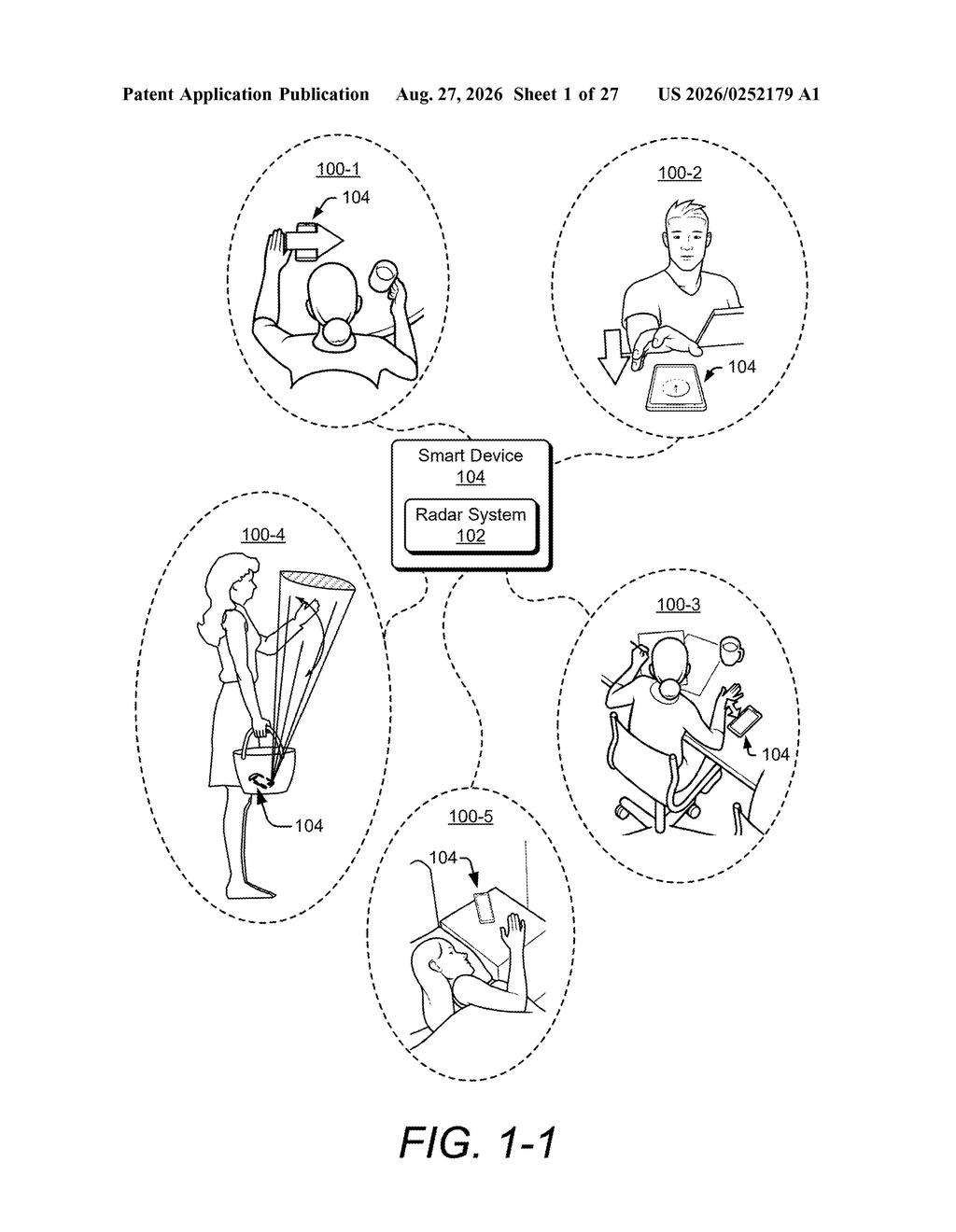
How Google's radar reads your hand wave from across the room
Every time you tap your phone awake just to pause a song or check the time, you're doing something slightly annoying that nobody has really fixed yet. Google's new patent is aimed at that problem.
The idea is that a smart device with a built-in radar sensor could watch for hand gestures in the room and respond to them, no touching required. Wave your hand a certain way and the music pauses. Make another gesture and the volume drops. The system is designed to work from up to six feet away, even if you're not looking at the device.
To make sure it doesn't trigger every time you scratch your nose, the patent describes a filtering system that checks how confident the device is about a gesture across several radar readings in a row before acting on it. No single glance at a screen required, that's the whole point.
… processing the complex radar data using a machine-learned module, the machine-learned module having been trained, using supervised learning, to generate probabilities associated with multiple gestures …
Translation: An artificial intelligence system analyzes radar data to calculate the likelihood of different hand movements.
How the debouncer filters out accidental gesture triggers
The system uses a radar sensor built into a smart device to emit radio waves and capture the reflections bouncing back from a person's body. Those reflections are turned into complex radar data, essentially a detailed snapshot of movement in the room.
That data is fed into a machine-learned module (think of it as a trained AI that has seen thousands of hand gestures and learned to tell them apart). The model outputs a probability score for each gesture it knows about: a finger snap, a hand swipe, a pinch, and so on. The gesture with the highest probability score is the candidate.
Before the device acts, though, a second layer called a gesture debouncer checks that score against a threshold. If the probability clears the threshold across one or more back-to-back radar frames (meaning the signal is consistent, not just a one-frame fluke), the device confirms the gesture and fires an event.
The threshold itself is calibrated to balance two competing problems:
- False positives, the device thinks you gestured when you didn't
- Recall failures, the device misses a gesture you actually made
The patent describes the system as working at distances of at least two meters, which is far enough to cover most living rooms or bedrooms.
To improve the false positive rate, a gesture debouncer evaluates class probabilities generated by the ambient-computing machine-learned module.
Translation: A secondary filter checks the AI results to prevent the device from reacting to accidental motions.
What this means for hands-free smart home control
Smart speakers and displays already respond to voice, but voice commands require you to speak clearly and at a reasonable volume, which is awkward in shared spaces, at night, or when you're on a call. A radar gesture system sidesteps all of that. You could adjust your TV volume, skip a track, or dismiss a timer with a hand motion from the couch, with no voice, no app, and no screen.
The debouncer approach is the detail worth watching here. Gesture recognition systems have historically struggled with false triggers, and this patent's answer is a probabilistic filter that demands sustained confidence rather than a single strong reading. Whether that threshold tuning proves reliable enough in real households, full of pets and kids and random arm movements, is exactly the kind of question field performance answers, not a patent. Radar-based gesture control sits alongside other sensor-driven input experiments in the latest Big Tech patents, where companies are working out what replaces the touchscreen in always-on home devices.
That makes this Google's 22nd filing in our Display coverage since May, joining hidden antennas in screen borders and gesture reading via cameras among the patents we've tracked.
Radar sees motion from across a room but can't resolve fine detail, so the gesture vocabulary stays limited to broad, distinct movements. That's the first cost: you're waving, not pointing or drawing.
The debouncer compounds this by requiring a gesture to hold above a confidence threshold across several readings before acting on it. Slower confirmation means less satisfying responses, and in a living room that delay is noticeable.
The trade reads as reasonable for the specific job. Missing a wave is annoying; having your lights cut out because you scratched your nose is worse. For infrequent, low-stakes commands in a calm space, prioritizing accuracy over speed is probably the right call.
Get our take in your Top Stories
Liked this breakdown? Add Patentlyze as a preferred source on Google, and our plain-English take shows up more often in your Top Stories the next time Google patent news breaks.
There are more where this came from
We read every patent application Big Tech publishes and send you the ones worth knowing. Plain English, free, every week.
The drawings
27 drawing sheets from US 2026/0252179 A1 · click any drawing to enlarge


Want this weekly breakdown for a company we don't cover? Patentlyze Pro →
Be the first to weigh in