
Google Patents a Dual-Sensor Camera That Sharpens Only the Moving Parts
Google has filed a patent for a camera system that uses two sensors working as a team: a fast, low-resolution lookout that spots motion, and a high-resolution main sensor that reacts by sharpening only the pixels where something is actually moving.
What Google's motion-triggered shutter actually does
A security camera stares at an empty hallway all night. Most of those frames are wasted on absolutely nothing. Your phone's camera has a similar problem when you try to shoot a fast-moving subject.
Google's patent describes a system where two image sensors share the same view. One sensor runs at high speed but low detail, constantly watching for motion. The moment it spots a moving object, it tells the main sensor exactly where to look and how fast the object is going. The main sensor then cranks up its shutter speed only for that part of the frame, leaving the background to be captured normally.
The result is a photo where your kid mid-sprint or a car flying through the frame stays sharp, while the camera isn't burning extra power processing pixels that aren't doing anything interesting. It's targeted effort rather than blanket effort, applied to every pixel whether it needs it or not.
… based on the motion information determined by the second image sensor, increasing a shutter speed and readout of the first image sensor for the region of interest within the field of view to provide additional image data for the region of interest …
Translation: The camera speeds up its main sensor only where movement is detected.
How the companion sensor tells the main sensor what to do
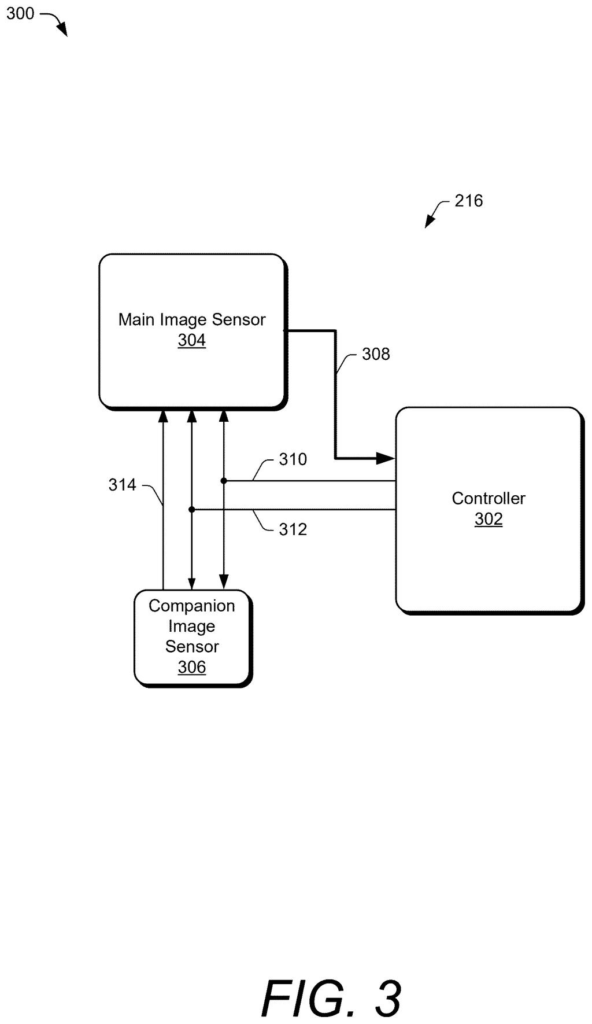
The system pairs two image sensors that share a field of view and are kept in sync by a microcontroller. The two sensors have different jobs:
- Companion sensor: runs at a high frame rate (many frames per second) but captures at low resolution. Its only job is to watch for motion and report back.
- Main sensor: runs at standard speed and full resolution. It captures the actual photo you'll see.
When the companion sensor detects a moving object, it calculates a region of interest (the area of the frame containing the moving thing) and the object's speed. It passes that data to the main sensor.
The main sensor then activates dedicated analog-to-digital converter (ADC) circuitry (the hardware that turns raw light signals into digital image data) specifically for pixels inside that region. By giving those pixels their own processing lane, the sensor can increase its shutter speed (shortening the time each pixel is exposed to light, which freezes motion) and read out the data faster, only where it matters.
The final image is assembled from the normal data for the static parts of the scene and the high-speed data for the moving part, producing a single output with sharp action and no unnecessary processing overhead.
The companion sensor, running at a higher frame rate and a lower resolution than the main sensor, detects motion and provides motion information (e.g., area of motion and velocity of a moving object) to the main image sensor.
Translation: A fast, low detail secondary sensor watches for motion to guide the main camera.
What this means for phone cameras shooting fast action
Motion blur and rolling shutter (the wobbly, skewed distortion that happens when a sensor reads out rows one at a time while the subject is moving) are the two most persistent complaints about phone cameras. Software can partially fix both after the fact, but correcting them in post adds processing time and can introduce its own artifacts. This patent attacks both problems at the source, in the hardware, before a single pixel reaches software.
For photographers and casual phone users alike, the practical payoff is cleaner action shots without having to manually switch modes or understand what rolling shutter even is. The coverage of camera-focused new tech patents from Google and its peers shows a consistent push toward sensor-level intelligence, where the hardware itself decides what level of effort each part of the frame deserves, rather than applying a single global setting to everything.
Google's 38th filing we've tracked since May in the AI photo editing race builds on teaching AI from examples and editing looks sans face changes.
The moments this targets are exactly the ones people reshoot three times and still delete: the birthday candle blown out in a blur, the dog caught mid-leap, the toddler who never holds still. By detecting motion in hardware and applying fast shutter only where the frame actually needs it, the system delivers sharper captures of those scenes without burning extra power on the parts of the image that were never moving. That combination of fewer blown shots and longer battery life is something a person would feel on a busy day of shooting before they ever read a spec sheet.
There are more where this came from
We read every patent application Big Tech publishes and send you the ones worth knowing. Plain English, free, every week.
The drawings
9 drawing sheets from US 2026/0247014 A1 · click any drawing to enlarge


Want this weekly breakdown for a company we don't cover? Patentlyze Pro →
Be the first to weigh in