
IBM Patents a Way to Give AI Models Built-In Security Clearances
IBM has filed a patent for an AI architecture that enforces security rules from the inside out, replacing unauthorized knowledge modules on the fly rather than filtering answers after the fact.
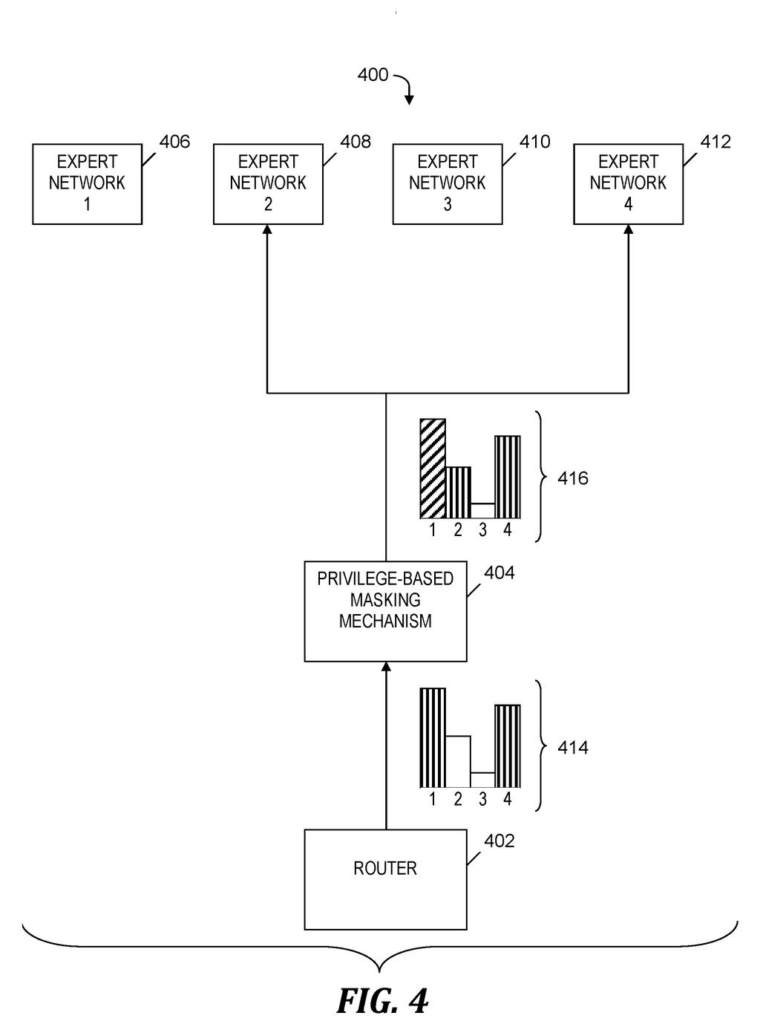
How IBM's AI access-control system actually works
You're asking your company's AI assistant a question, and the system decides whether you're allowed to receive that answer based on your job role, not on what you type.
That's the core idea here. IBM's design splits an AI model into specialized mini-experts, each trained on a particular slice of knowledge. When you send a question, a traffic-cop layer called a router picks the most relevant experts to answer it. If one of those experts holds information you're not cleared to access, a masking layer yanks it out and swaps in the next-best qualified expert you are allowed to use.
The result is that access control happens inside the model's reasoning process, not as a blunt filter bolted on afterward. Different employees could ask the same AI the same question and receive appropriately different answers, based on their permissions, without the system ever exposing restricted material in the first place.
… each expert being correlated with one or more domains in a dataset or one or more access control list (ACL) privilege groups.
Translation: Every neural network specialist is linked to specific data types or security clearance levels.
How the router swaps out unauthorized experts in real time
The patent describes a modified version of an architecture called Mixture of Experts (MoE), a design already used in several large AI models where, instead of one monolithic network answering every question, dozens of smaller specialized sub-networks (the "experts") divide the work. Only a few experts are activated per query, which keeps things efficient.
IBM's twist is correlating each expert with specific knowledge domains and with access control list (ACL) groups, essentially the same permission lists companies already use for file servers and email. When a router selects a set of experts to handle an incoming query, a new masking mechanism checks whether the requesting user (or system) holds the privilege required to engage that expert.
If an expert fails the privilege check, it is masked out, meaning the router treats it as if it were never selected, and the next-highest-probability expert is evaluated instead. That replacement expert is then checked for permissions too. The process repeats until the active expert set contains only modules the requester is authorized to use.
- Experts are trained and labeled per domain and per permission group during the model-tuning phase.
- At inference time (when a user sends a query), the router ranks experts by relevance probability.
- The masking layer filters that ranked list by privilege, substituting unauthorized experts with authorized alternatives.
- The final response is generated only from the cleared expert set.
A masking mechanism masks out the identified expert from the selected set of experts and identifies a previously unselected expert that has a next greatest probability of being relevant to the data point.
Translation: The security filter blocks unauthorized specialists and replaces them with the next most qualified option.
What this means for AI in regulated industries
For any organization running AI over data that carries legal or compliance restrictions, this approach is more trustworthy than post-hoc filtering. Post-hoc filtering means the AI first retrieves sensitive information and then tries to scrub it before showing the user, a process that can leak details in subtle ways. IBM's design prevents the unauthorized knowledge from entering the reasoning process at all, which is a structurally cleaner guarantee.
This filing sits squarely in the emerging effort to make AI systems enterprise-ready without stripping away their capability, and it is part of the broader wave of interesting tech patents addressing how AI handles sensitive corporate and government data responsibly. Whether IBM can ship this as a practical product depends on whether the MoE tuning pipeline scales without blowing up training costs, a non-trivial engineering problem the patent does not fully solve.
This is the 44th IBM filing we've tracked since May in the AI guardrails race, adding to work like one catching nonsense output and one catching hallucinated facts.
Getting this from patent to product requires no new hardware, which matters. The whole system runs in software, meaning a team with an existing AI setup could start building toward this without waiting on specialized chips or infrastructure.
The harder prerequisite is organizational: before the AI can enforce who sees what, someone has to carefully sort the training data by permission level in the first place. Legal documents, HR records, and financial data all need to be cleanly separated and labeled before the model ever learns from them.
For IBM's customers in banking, healthcare, and government, an AI that enforces clearance rules from inside its own decision-making is a real selling point in procurement conversations. The engineering work to get there is substantial, but the destination is clear and the demand is obvious.
Get our take in your Top Stories
Liked this breakdown? Add Patentlyze as a preferred source on Google, and our plain-English take shows up more often in your Top Stories the next time IBM patent news breaks.
There are more where this came from
We read every patent application Big Tech publishes and send you the ones worth knowing. Plain English, free, every week.
The drawings
3 drawing sheets from US 2026/0252875 A1 · click any drawing to enlarge


Want this weekly breakdown for a company we don't cover? Patentlyze Pro →
Be the first to weigh in