IBM
IBM · AI / ML · Filed Feb 25, 2025 · USPTO published Aug 27, 2026 · Aug 27 release
IBM Patents a Way to Catch When Its AI Language Tools Stop Making Sense
AI language tools get worse over time as the world changes around them. IBM is patenting a system that catches this decay automatically, and can even tell you what kind of problem you're dealing with.
- Publication number
- US 2026/0252813 A1(US20260252813A1)
- Applicant
- INTERNATIONAL BUSINESS MACHINES CORPORATION
- Filed · Published
- Feb 25, 2025 · Aug 27, 2026
- Inventors
- Erika Agostinelli, Edward James Biddle, Stefan A. G. Van Der Stockt, Sourav Mazumder
- Status when we published
- Waiting for an examiner
- Document
- 20 claims
- US classification
- 704/9
- Examiner
- SHIN, SEONG-AH A (Art Unit 2659)
What IBM's language drift detector actually catches
Imagine you trained an AI assistant to answer customer questions about your products in 2023, and without anyone noticing, it starts giving subtly wrong answers in 2025 because the words customers use have shifted. That kind of slow, invisible failure is called "drift," and it is one of the most frustrating problems in real-world AI.
IBM's new patent describes a system that keeps watch for exactly this. It works by teaching a language model using a richer-than-usual set of examples, then measuring how far any new question or phrase falls from what the model already knows. If that distance gets too large, the system raises an alarm. It does not just say something is wrong; it tries to figure out what kind of wrong, so the people managing the AI know where to look.
Think of it like a spell-checker for the AI itself, one that runs in the background and notices when the tool is drifting into territory it was never trained to handle.
… computing a distance between the enriched language model embedding and a nearest embedding within the EES; detecting, based on the distance, whether the enriched language model is affected by drift; and responsive to detecting the enriched language model is affected by drift, diagnosing a type of the drift.
Translation: The system measures how far a user's input strays from known data to spot when the AI starts losing its accuracy.
How the enriched embedding space measures model drift
The patent centers on what IBM calls an Enriched Embedding Space (EES). An embedding space is a kind of map where words and phrases get plotted as points based on their meaning. Words with similar meanings cluster together; unusual or unknown phrases land far from any cluster.
To build this richer map, IBM trains an enriched language model on an expanded ground truth (a broader-than-usual training set that deliberately includes paraphrases, synonyms, and edge-case language). This gives the map more coverage than a standard training run.
When a user submits a query, the system:
- Converts that query into a point on the EES map
- Finds the nearest known point (the closest thing the model was trained on)
- Measures the gap between them
- Decides whether the gap is large enough to signal drift
If drift is confirmed, the system goes a step further and diagnoses the type of drift. Drift can mean several different things: the vocabulary users are reaching for has changed, the topic domain has shifted, or the model's own representations have decayed. Knowing which type is happening tells engineers where to intervene, rather than forcing a full retraining from scratch.
Detection of natural language data drift includes training an enriched language model using on an expanded ground truth. The enriched language model is trained to perform natural language processing (NLP) using a natural language vocabulary converted to embeddings comprising vectorial representations within an Enriched Embedding Space (EES).
Translation: IBM creates a map of language meanings to help the AI understand if its training data is becoming outdated.
What self-diagnosing AI means for business software
Drift is one of those problems that sounds technical but has very real costs. A customer service bot that slowly loses accuracy erodes user trust. A medical coding tool that drifts toward outdated terminology can produce billing errors. A document-classification system that no longer understands new jargon just silently misfires. The problem is not rare; it is essentially guaranteed to happen whenever language keeps evolving and the AI does not keep up.
What IBM is filing here is a monitoring layer, the kind of infrastructure that makes AI deployments easier to manage long after launch. For the Big Tech patent news beat covering AI governance and enterprise tooling, IBM's focus on drift classification is a sign that the industry is taking the "AI maintenance" problem as seriously as the initial build. Whether this becomes a product feature or stays as foundational research, the filing reflects a genuine need that every organization running language AI in production eventually runs into.
That makes this IBM's 43rd filing we've tracked since May in the AI guardrails race, following their work on catching made-up facts in summaries and blocking restricted users from AI answers.
Source: US 2026/0252813 A1 at the USPTO (PDF). Full patent text and figures are in the official publication.
Get our take in your Top Stories
Liked this breakdown? Add Patentlyze as a preferred source on Google, and our plain-English take shows up more often in your Top Stories the next time IBM patent news breaks.
Add Patentlyze on Google
One click.
There are more where this came from
We read the new patents from Big Tech, carmakers and more and send you the ones worth knowing. Plain English, free, every week.
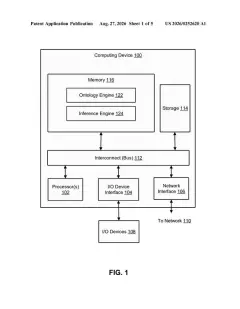
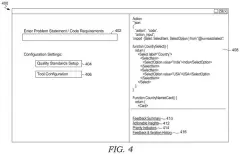
The drawings · 8 sheets
8 drawing sheets from US 2026/0252813 A1 · click any drawing to enlarge


More from IBM
All 481 IBM patents →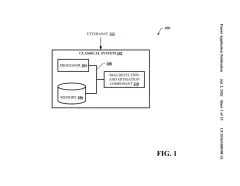
More in AI / ML
All 2,745 AI / ML patents →
Qualcomm
Qualcomm Patents an AI Processing System That Rates Its Own Accuracy Per Task
Google
Google Patents a Mid-Generation Router That Picks the Right AI Model on the Fly
Disney
Disney Patents an AI System That Tags Its Own Movies and Shows Automatically
Nvidia