
Samsung Patents a Projector That Adjusts Its Brightness Based on Room Light
Most projectors either blast too much light in a dark room or wash out in a bright one. Samsung's new patent describes a projector that switches between two different brightness strategies depending on how much ambient light the room has.
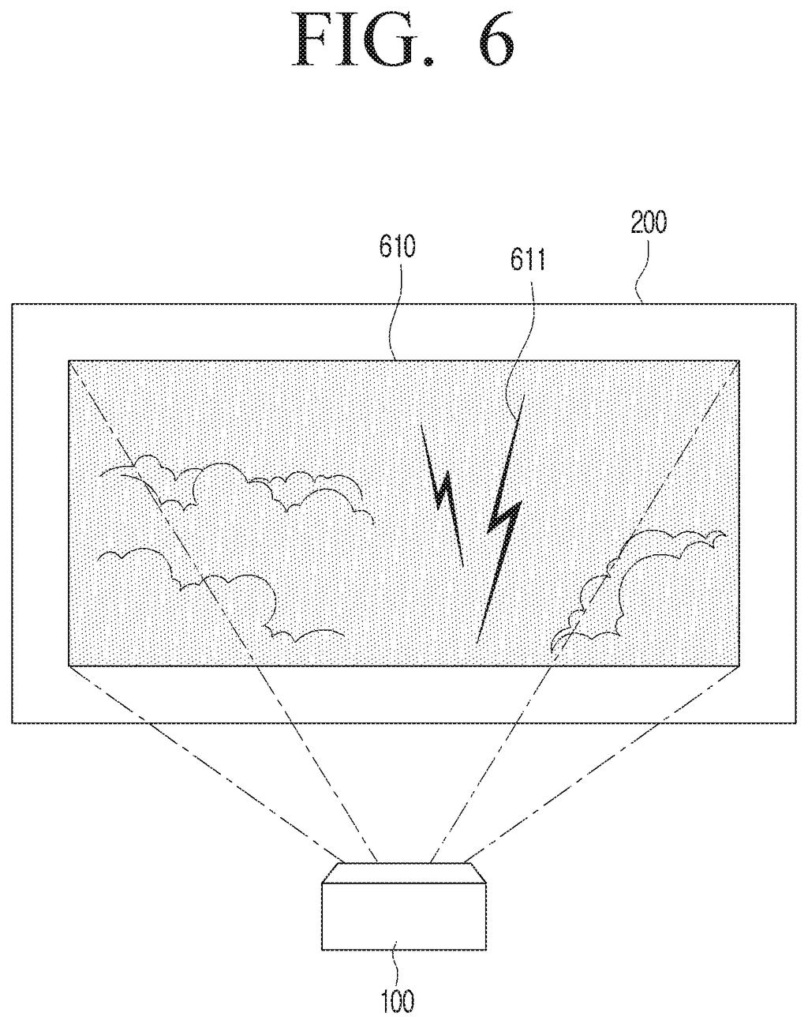
What Samsung's dual-sensor brightness system actually does
Ever tried watching a movie on a projector when someone walks in and flips on the lights? The picture suddenly looks washed out, flat, and hard to see. Getting a projector to automatically fix that, without overcorrecting in the dark, is harder than it sounds.
Samsung's patent covers a projector with two sensors working together: one that reads the ambient light in the room, and one (a small camera) that looks directly at the projected image on the wall. The key idea is that the projector doesn't use both sensors all the time. In a dark room, it relies mostly on what the camera sees in the projected image to fine-tune brightness. When the room is bright, it combines the ambient light reading and the camera data to make a better call.
The result is a projector that picks the right tool for the job depending on conditions, rather than applying one blunt rule across every situation.
… adjust an amount of light output from the projection unit based on image-capture data related to the captured image obtained from the image sensor based on a sensed illuminance value of the sensed illuminance being less than the reference illuminance value …
Translation: It changes the brightness using camera feedback when the room is darker than a preset baseline.
How the projector switches between two adjustment methods
The patent describes a projector with four main components working in concert: a projection unit (the light source and optics), an illuminance sensor (measures ambient room brightness), an image sensor (a camera pointed at the projection surface), and a processor that decides how to use all of the above.
The central logic is a threshold comparison. The processor checks the ambient light reading against a stored reference illuminance value (a brightness level saved in memory that defines the boundary between "dark room" and "bright room").
- Below the threshold (dark room): The processor adjusts light output using only image-capture data from the camera sensor. This makes sense because in a very dark room, the ambient sensor has little useful information to offer.
- At or above the threshold (bright room): The processor combines both the ambient illuminance reading and the camera data to calculate the adjustment. More inputs mean a more accurate correction when competing light sources are in play.
This two-mode approach means the system avoids over-engineering the adjustment in simple conditions while still having the full data picture available when the environment is complex.
What this means for projector picture quality at home
For anyone who uses a projector as a primary TV replacement or in a living space where lighting changes throughout the day, a system like this could mean less fiddling with brightness settings manually. The image stays readable without you having to pause and dig into menus every time a cloud moves or a lamp turns on.
Samsung's run of display-technology filings suggests the company is thinking carefully about projectors as consumer products rather than niche conference-room gear. Whether this specific feature appears in a shipping product is an open question, but the direction is toward projectors that behave more like self-correcting TVs.
This is the 91st Samsung filing we've tracked on display technology since May, following work on a fingerprint color tweak and invisible tiled seams.
Claim 1 is doing something specific: it doesn't just cover "automatic brightness adjustment" broadly. It patents a conditional switching logic where the method of adjustment changes depending on whether ambient light is above or below a stored threshold. That is a narrower claim than it might first appear.
In practice, that means a competing projector could potentially sidestep this by using a different triggering mechanism, such as continuous blending of both sensor inputs at all times, rather than a hard threshold switch. The claim's strength lies in how clearly it defines the two-mode behavior, but that same specificity is a ceiling on how much it could block.
For consumers, the underlying idea is sensible engineering. Projectors have historically handled auto-brightness poorly, and using a camera to look at the actual projected output is a more direct feedback loop than relying on ambient sensors alone. Whether this patent translates into a product that noticeably performs better is the real test.
Get our take in your Top Stories
Liked this breakdown? Add Patentlyze as a preferred source on Google, and our plain-English take shows up more often in your Top Stories the next time Samsung patent news breaks.
There are more where this came from
We read every patent application Big Tech publishes and send you the ones worth knowing. Plain English, free, every week.
The drawings
11 drawing sheets from US 2026/0261638 A1 · click any drawing to enlarge


Show the other 3 sheets


Want this weekly breakdown for a company we don't cover? Patentlyze Pro →
Be the first to weigh in