Samsung
Samsung · Display · Filed Dec 4, 2025 · USPTO published Aug 20, 2026 · Aug 20 release
Samsung Patents a Noise-Blocking Layer That Makes Touchscreens More Accurate
Every touchscreen is fighting a small war between the display underneath it and the sensors trying to detect your finger on top, and Samsung just filed a patent for a thin shield line designed to stop the display from corrupting that signal.
- Publication number
- US 2026/0244290 A1(US20260244290A1)
- Applicant
- Samsung Display Co., Ltd.
- Filed · Published
- Dec 4, 2025 · Aug 20, 2026
- Inventors
- HWAN-HEE JEONG, GYEONGNAM BANG
- Status when we published
- Waiting for an examiner
- Document
- 20 claims
- US classification
- 345/174
- Examiner
- CHOWDHURY, AFROZA Y (Art Unit 2628)
What Samsung's touchscreen shield line actually does
A touchscreen wages two tasks at once: it shows you a picture and it tracks where your finger lands. The problem is that the electronics driving the picture can interfere with the electronics doing the tracking.
Samsung's patent describes a sensor layer with three sets of electrodes, think of them as tiny antennas arranged in a grid, plus a dedicated shield line. That shield sits between the part of the sensor that carries a special looping wire and the display below it, blocking electrical noise the display would otherwise inject into the touch signal.
The practical result is that the touchscreen can read your input more cleanly, even when the display is doing intense work like showing a bright video. You probably won't notice it working, but you'd notice if it weren't there, touches that feel slightly off or slow to register.
… a loop trace line comprising: a first line portion extending in the first direction; and a protruding portion protruding and extending from the first line portion toward the plurality of third electrodes, and electrically connected to the plurality of third electrodes; and a shield line between the protruding portion and the display layer.
Translation: The device uses a specialized wire structure and a protective shield to isolate the touchscreen sensors from interference.
How the shield line separates signal from display noise
The patent covers a stacked structure inside a display panel. At the bottom is the display layer, which generates the actual image. On top sits a sensor layer that detects touch input through three separate arrays of electrodes:
- First electrodes run horizontally (along the first direction).
- Second electrodes run vertically, crossing the first set to form a grid capable of pinpointing a touch location.
- Third electrodes also run horizontally and appear to handle a secondary sensing function, possibly related to a specific touch technology like mutual-capacitance scanning (where electrodes send and receive a tiny electrical field between them).
A loop trace line connects to those third electrodes. It has two parts: a main segment running horizontally and a protruding arm that reaches toward the third electrodes. This loop structure is common in touch panels that need to carry a reference or guard signal around the sensor area.
The key addition here is the shield line, which sits between that protruding arm and the display layer below it. Its job is to intercept electromagnetic interference (electrical noise that bleeds upward from the display circuits), preventing it from corrupting the touch-sensing signal carried in the loop trace. The shield line acts as an electrical barrier, similar to how a shielded cable keeps radio interference out of an audio wire.
An electronic device includes: a display layer to display an image; and a sensor layer on the display layer, and to sense an external input. The sensor layer includes: a plurality of first electrodes along a first direction; a plurality of second electrodes along a second direction crossing the first direction; a plurality of third electrodes along the first direction …
Translation: The screen is built with layers of electrodes arranged in a grid to detect where and when a user touches the display.
What this means for future Samsung display panels
For anyone buying a phone, tablet, or laptop with a Samsung display panel, cleaner touch sensing means fewer misread taps and more consistent stylus precision. The design is also relevant to high-refresh-rate screens, where the display hardware works harder and generates more interference that can degrade touch accuracy.
Samsung Display supplies panels to a wide range of device makers, so a structural improvement at the panel level can ripple across many product lines without those brands doing anything differently. The shield-line approach fits a broader pattern of display and touch integration work that shows up regularly among interesting tech patents in the display and sensor engineering space.
Samsung's 84th filing we've tracked in Samsung's display technology since May adds to a body of work that includes one on laser LED placement and one on region-by-region power.
Source: US 2026/0244290 A1 at the USPTO (PDF). Full patent text and figures are in the official publication.
Get our take in your Top Stories
Liked this breakdown? Add Patentlyze as a preferred source on Google, and our plain-English take shows up more often in your Top Stories the next time Samsung patent news breaks.
Add Patentlyze on Google
One click.
There are more where this came from
We read the new patents from Big Tech, carmakers and more and send you the ones worth knowing. Plain English, free, every week.
The drawings · 28 sheets
28 drawing sheets from US 2026/0244290 A1 · click any drawing to enlarge


Show the other 20 sheets


More from Samsung
All 1,662 Samsung patents →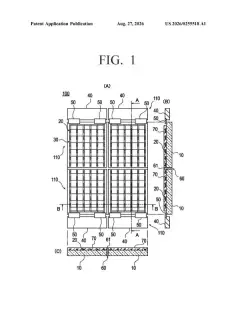
More in Display
All 746 Display patents →
Samsung
Samsung Patents a Display Circuit That Feeds Each Color Pixel a Different Voltage
Samsung
Samsung Patents a Shaped Ink-Spreading Blade for Cleaner Display Edges
Samsung
Samsung Patents a Display That Hides Personal Info in 3D Depth
Samsung