
Samsung Patents a Way to Make the Seams in Giant Tiled Displays Nearly Invisible
Giant video walls are built by snapping many smaller display panels together, and the lines between them are the biggest visual flaw. Samsung's latest patent filing attacks that problem at the material level, using a precisely matched filler resin to make those joints nearly disappear.
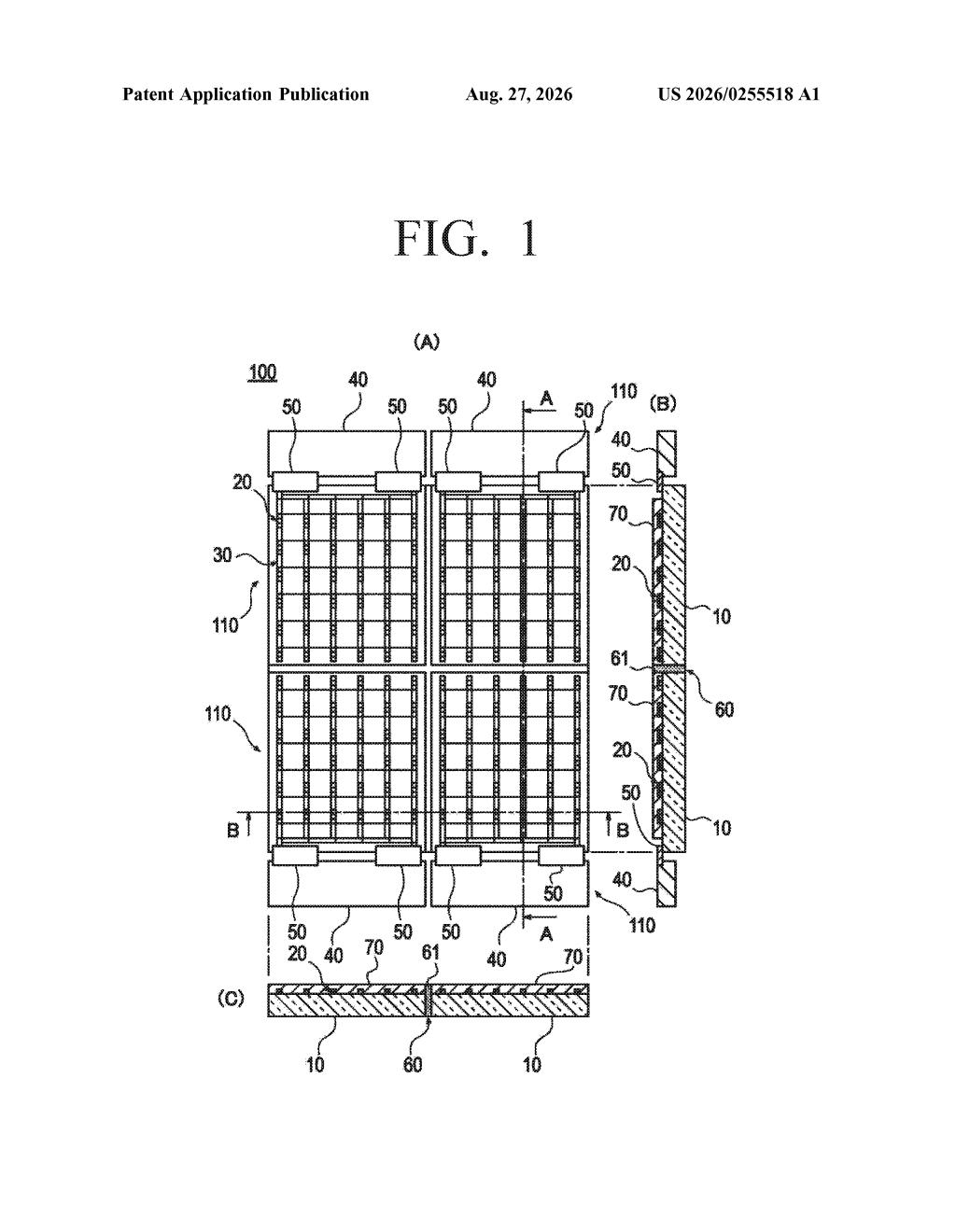
How Samsung wants to hide the grid lines in big modular screens
Imagine sitting in an airport or a sports arena, looking up at a massive video screen, and noticing a faint grid pattern across the whole image. Those lines are the seams between the individual display panels that make up the wall. They exist because the glass of each panel and any material filling the gap between them bend light differently, making the joint visible.
Samsung's patent covers a way to fix that by filling the gap with a resin whose optical properties are tuned to match the glass almost exactly. When two materials have the same light-bending index, light passes through the boundary without scattering or reflecting, so your eye can't see where one panel ends and the next begins.
The patent also sets a limit on how stiff that filler can be. A more flexible seam means the display can handle small shifts or stresses without cracking at the joints, which matters a lot for large installations that are assembled and disassembled.
… a seam between the modules adjacent to each other includes: resin, a difference ΔRI between a refractive index of the substrate and a refractive index of the resin in a visible light region is in a range of −0.01≤ΔRI≤0.01 …
Translation: The gap between screens is filled with a special resin that matches the light-bending properties of the display glass.
How the resin index-match kills the seam's light signature
The patent covers a tiled display built from multiple self-contained modules. Each module has a substrate (the base layer, typically glass), light-emitting elements on top of it, and electrodes that feed voltage to those elements to produce light.
The critical innovation sits in the seam between adjacent modules. Samsung's design fills that gap with a resin chosen to satisfy two specific engineering conditions:
- Refractive index match: The refractive index (a measure of how much a material bends light) of the resin must be within ±0.01 of the substrate's refractive index across visible wavelengths. That is an extremely tight tolerance, most optical cements used in cameras and lenses aim for similar precision. At that level of match, light traveling from the glass into the resin barely notices the boundary, so no bright or dark line forms at the seam.
- Bending elastic modulus cap: The bending elastic modulus (a measure of stiffness, roughly how much force it takes to flex a material) of the filled seam must be 35,500 MPa or lower. For comparison, typical rigid epoxies can exceed 3,000-4,000 MPa; the cap here allows for softer, more flexible formulations. A more compliant seam absorbs mechanical stress rather than transmitting it as a crack.
Together these two constraints define a material window: soft enough not to crack under mechanical stress, yet optically transparent enough to vanish to the viewer's eye.
… the difference ΔRI between a refractive index of the substrate and a refractive index of the resin in a visible light region is in a range of −0.01≤ΔRI≤0.01, and the bending elastic modulus of the seam is 35,500 MPa or less.
Translation: The resin used to hide the seams is carefully calibrated to be both optically invisible and physically flexible.
What this means for large-venue display walls
Large modular display walls, whether in stadiums, control rooms, retail environments, or high-end home theaters, have always carried an inherent visual compromise: the bigger the screen, the more seams, and the more distracting the grid. A resin that matches the substrate's optics within 0.01 index units could eliminate that trade-off without requiring thinner bezels or more expensive panel manufacturing.
The claim is narrow enough to be practical but broad enough to matter. It does not specify a particular resin chemistry, a particular substrate material, or a particular display type, which means it could apply to LED, micro-LED, or OLED tile configurations. Samsung's display division competes directly in the high-brightness modular LED wall market, and this kind of interesting tech patents covering display-joining materials shows how much engineering effort is going into the invisible infrastructure that makes big screens look like a single unbroken image.
This is the 89th Samsung filing we've tracked since May in our display technology watchlist, following work on a glare-cutting screen coating and a wrist-angle notification screen.
Claim 1 is both specific and broad in a useful way. It names two hard numbers, a refractive index delta of no more than ±0.01 and a stiffness ceiling of 35,500 MPa, without locking in any particular resin compound or manufacturing process. That means the claim covers the outcome, not the recipe, which is a stronger position to hold. In practice, if granted, the claim could put pressure on any competitor building tiled displays who reaches for the same material strategy.
Matching a substrate's refractive index to within 0.01 across the full visible spectrum is difficult enough that there aren't many obvious workarounds. A rival would need either a fundamentally different seam-hiding approach or a substrate with unusual optical properties that simply don't require filling. The stiffness clause is less flashy but probably just as important commercially.
Tiled walls in rental and staging markets get assembled and torn down repeatedly. A seam material that is optically perfect but brittle is a liability. Pairing the two requirements in a single claim ties optical quality and mechanical durability together, which reflects how real installations actually fail.
Get our take in your Top Stories
Liked this breakdown? Add Patentlyze as a preferred source on Google, and our plain-English take shows up more often in your Top Stories the next time Samsung patent news breaks.
There are more where this came from
We read every patent application Big Tech publishes and send you the ones worth knowing. Plain English, free, every week.
The drawings
1 drawing sheets from US 2026/0255518 A1 · click any drawing to enlarge

Want this weekly breakdown for a company we don't cover? Patentlyze Pro →
Be the first to weigh in