
Samsung Patents a Shaped Ink-Spreading Blade for Cleaner Display Edges
The bezel around your phone screen is painted on with an ink-printing process, and getting that ink to sit perfectly where a flat panel meets a thinner edge is harder than it sounds. Samsung's new patent fixes that with a squeegee blade that has a built-in wedge at its tip.
What Samsung's screen-edge ink problem actually is
Ever noticed how the dark border around a phone screen looks perfectly uniform right up to the curved or thinned edge? That consistency is not accidental, it requires precise ink printing, and the thinned edges of modern display glass make it genuinely tricky to get right.
Samsung's patent describes a printing tool called a squeegee (basically a rubber blade, like a windshield wiper, used to push ink through a stencil) that has a special wedge-shaped tip. When the blade reaches the thinner edge of the glass panel, that angled tip adjusts how much pressure and ink gets applied, so the border stays clean instead of pooling or missing spots.
The result, in theory, is a more consistent light-blocking border printed right onto the glass window that sits over your phone's display. It is a manufacturing process patent, not a new screen technology, but cleaner printing means fewer defective panels and tighter quality control at scale.
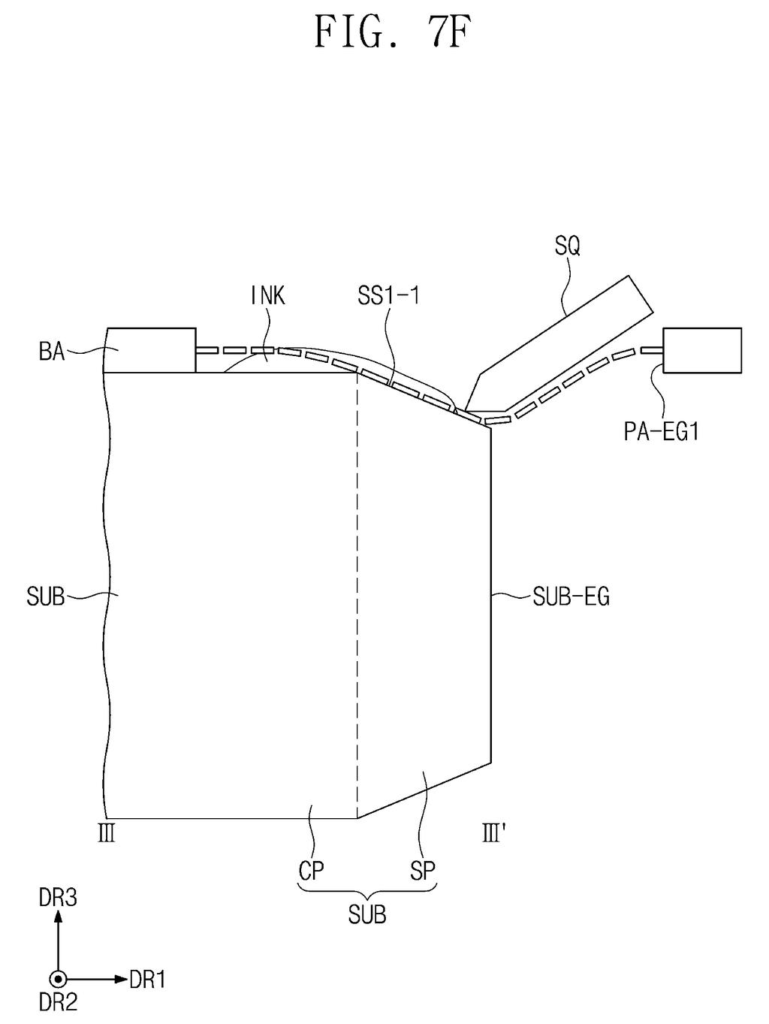
… printing the ink on the substrate by using a squeegee which includes a body portion and a protruding portion having a slope surface inclined from one surface of the body portion and having a smaller thickness than the body portion …
Translation: Samsung uses a specially shaped blade to spread the ink evenly across the screen edges.
How the angled squeegee tip controls ink at the edge
The patent covers a screen-printing method for applying a light-blocking ink pattern (the dark border that masks the display's internal wiring and frame) to a glass substrate used as a phone or device screen cover.
The glass substrate in question is not flat all the way across. It has a thicker central portion and a thinner side portion along its edges. That thickness change is the problem: a standard flat squeegee blade rides across the glass and leaves inconsistent ink coverage right where the thickness steps down.
Samsung's solution is a squeegee with two zones:
- A standard body portion that handles the flat, thicker central area
- A protruding portion with a sloped (inclined) surface that is thinner than the body and angles downward to follow the thinner edge zone
The printing also uses a mesh-pattern mask (a stencil with tiny holes that controls where ink passes through), designed so the open printing area covers both the thin edge and part of the central area, while a solid blocking area covers the rest of the center. Together, the shaped blade and the zoned mask control ink flow across that tricky thickness boundary.
… a mask which includes a printing region with a plurality of mesh patterns corresponding to the side portion and a portion of the central portion and a blocking region corresponding to a remaining portion of the central portion …
Translation: A patterned screen controls exactly where the ink lands on the glass substrate.
What this means for thin-edge display manufacturing
Display manufacturing yield is one of the biggest cost levers in the smartphone industry. A defective ink border does not just look bad, it can mean a panel fails quality inspection and gets scrapped. A printing method that handles thickness variations more reliably means fewer wasted panels per production run, which adds up fast at Samsung's volumes.
This is a relatively narrow process patent, but it sits inside the broader push to produce thinner, edge-to-edge displays with tighter cosmetic tolerances. It joins a stream of interesting tech patents covering display manufacturing precision, where small tooling changes can have outsized effects on factory economics.
Samsung's 81st filing we've tracked in Samsung display technology since May builds on earlier work like one on per-color pixel voltages and one on heat-triggered screen dimming.
Uneven ink where display glass changes thickness is a small defect with a large price tag. It turns working screens into waste before they ever reach a finished product, and that waste adds up fast across a full production run.
A squeegee tip with a reshaped edge costs almost nothing to produce. The yield it saves far outweighs that cost, which is exactly what makes it a smart fix for a well-understood factory problem.
There are more where this came from
We read every patent application Big Tech publishes and send you the ones worth knowing. Plain English, free, every week.
The drawings
14 drawing sheets from US 2026/0243924 A1 · click any drawing to enlarge


Want this weekly breakdown for a company we don't cover? Patentlyze Pro →
Be the first to weigh in