
Microsoft Patents an AI That Converts Fuzzy Date Phrases Into Exact Calendar Dates
When you type 'show me files from last quarter' into a search bar, a computer has to figure out what 'last quarter' actually means on a calendar. Microsoft has filed a patent for an AI system designed to do exactly that, automatically and accurately.
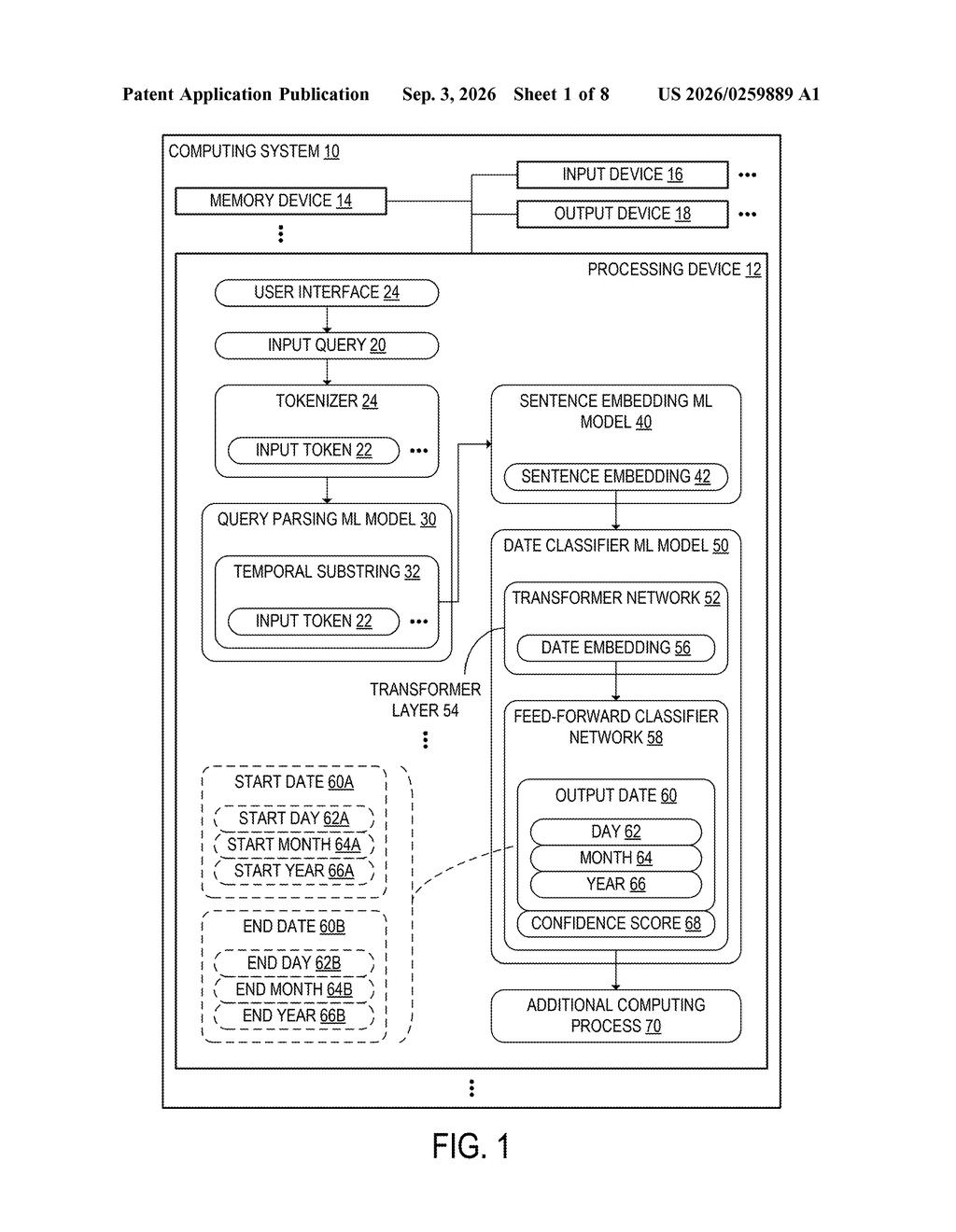
What Microsoft's date-reading AI actually does
Imagine typing 'meetings from the week before the holiday' into your company's search tool. A human knows what that means. A computer, until recently, mostly didn't.
Microsoft's patent describes a three-step AI system that reads the date-related words in your search, figures out what they mean in context, and converts them into a specific day, month, and year. It handles fuzzy, natural phrases like 'next Monday,' 'early spring,' or 'two weeks ago' and turns them into something a database can actually use.
The system works by first spotting the date-related part of your question, then computing the meaning of that phrase, and finally classifying it into a precise calendar date. The output gets passed along to whatever search or scheduling tool needs it.
… extract a temporal substring from the input query; at a sentence embedding ML model, compute a sentence embedding of the temporal substring; at a date classifier ML model: compute a date embedding based at least in part on the sentence embedding …
Translation: The system pulls a date phrase out of text and converts it into a mathematical format.
How the model maps language to a day, month, and year
The patent describes a pipeline of three machine learning models working in sequence.
Step one is a query parsing model that reads your full input and picks out the part that refers to time. So from 'show me invoices from late January,' it would extract 'late January' as the relevant fragment.
Step two is a sentence embedding model (a system that converts words into a dense grid of numbers that captures meaning). This model turns the extracted date phrase into a numerical representation the next model can work with.
Step three is the core invention: a date classifier model that takes that numerical representation and expands the part of it that encodes date-related meaning, a process the patent calls 'upscaling an embedding space region.' Think of it like zooming in on the section of a map that covers the territory you care about. After that zoom, the model runs classification (essentially a structured multiple-choice decision) to pin down a specific day, month, and year.
The final output, a fully resolved calendar date, gets passed to whatever downstream system needs it: a search index, a calendar app, a scheduling tool.
… perform classification on the date embedding to identify an output date including a day, a month, and a year indicated by the temporal substring.
Translation: The AI analyzes that math to figure out the exact day, month, and year being referred to.
What this means for search and scheduling tools
For everyday users, this is the difference between a search bar that understands you and one that makes you remember to type '01/20/2025' instead of 'last Martin Luther King Day.' If this system works well, tools like Microsoft 365's search, Outlook, or Teams would handle vague date references the way a helpful assistant would.
Microsoft's ongoing push into natural-language search The harder question is whether the system generalizes across cultures and languages, where date references are wildly different. 'Diwali week,' 'Golden Week,' or 'the fiscal year-end' mean different things depending on where you are. The patent doesn't specifically address localization, which is where this approach would face its biggest real-world test.
Microsoft's 51st filing in the Language AI work we've tracked since May adds to a run that includes one turning prompts into layered art and one writing chart code from scratch.
The core design trade-off here is specificity versus flexibility. The model is trained to output a precise date: a day, a month, a year. That precision is useful downstream, but it forces the system to commit even when the input phrase is genuinely ambiguous. 'Early spring' in a business context might mean a date range, not a single day, and collapsing it to one calendar point could produce wrong results without any visible error.
The 'upscaling' step, where the model zooms in on the date-relevant portion of the word embedding, is the genuinely interesting design choice. It suggests the team found that general-purpose language models spread their attention too thin on date semantics, and that forcing focus on that region improves accuracy. That's a reasonable engineering bet, but it also means the model is being tuned narrowly, which could make it brittle against unusual phrasing or non-Western calendar references.
For a company that runs productivity software used by hundreds of millions of people, getting date parsing right is important and genuinely underserved. This filing reads as a practical, infrastructure-level fix rather than a flashpoint invention.
Get our take in your Top Stories
Liked this breakdown? Add Patentlyze as a preferred source on Google, and our plain-English take shows up more often in your Top Stories the next time Microsoft patent news breaks.
There are more where this came from
We read every patent application Big Tech publishes and send you the ones worth knowing. Plain English, free, every week.
The drawings
8 drawing sheets from US 2026/0259889 A1 · click any drawing to enlarge


Want this weekly breakdown for a company we don't cover? Patentlyze Pro →
Be the first to weigh in