Nvidia
Nvidia · AI / ML · Filed Feb 24, 2025 · USPTO published Aug 27, 2026 · Aug 27 release
Nvidia Patents an AI System That Turns a Script Into a Full Storyboard
Turning a written script into a storyboard normally takes a team of artists days or weeks. Nvidia's latest patent describes an AI that does it automatically, from text input to rough animated preview, without a human artist touching a single frame.
- Publication number
- US 2026/0253280 A1(US20260253280A1)
- Applicant
- NVIDIA Corporation
- Filed · Published
- Feb 24, 2025 · Aug 27, 2026
- Inventors
- Aditya Karra, Amruta Lonkar, Vikas Tomar, Neeraj Kumar, Ashish Sachdev, Piyush Sharma
- Status when we published
- Waiting for an examiner
- Document
- 20 claims
- US classification
- 345/619
- Examiner
- AHMAD, NAUMAN UDDIN (Art Unit 2611)
How Nvidia's storyboard AI reads a script and draws the scenes
Ever tried to explain a movie idea to someone who can't picture it from words alone? That gap between a script and a visual plan is exactly what this patent is designed to close.
Nvidia's system takes a written story (or even spoken audio) and uses AI to read it, chop it into individual scenes, and then generate an image for each scene along with notes on camera angles, lighting, and shot composition. The result is a storyboard, the grid of drawings that directors and animators use to plan how a film or video will look before anyone picks up a camera.
The system can also generate the frames in between key scenes, producing a rough moving preview called an animatic. Think of it as a slide-show sketch of your film, animated just enough to show pacing and flow. What used to take a production team days could potentially take minutes.
… generating, based at least on the scene information, image data representing one or more images depicting one or more visual representations corresponding to the one or more scenes; generating one or more storyboard frames corresponding to the one or more scenes …
Translation: The system creates visual images for each part of the story and combines them into a series of storyboard frames.
How the AI breaks a narrative into scenes and builds each frame
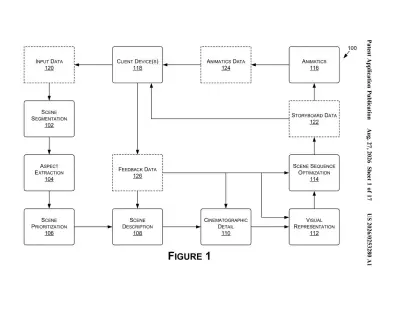
The patent describes a pipeline with several distinct AI stages working in sequence.
- Scene segmentation: One or more language models (AI text processors similar to the kind that power chatbots) read the input narrative and divide it into a list of discrete scenes, each tied to a specific portion of the text.
- Scene description generation: A second set of language models then analyzes each scene's text and writes out detailed descriptions, covering not just what is happening but cinematographic details (that is, camera choices like close-up versus wide shot, implied lighting, mood, and character placement).
- Image generation: Those descriptions are fed into an image-generation model, which produces one or more pictures for each scene, visualizing what the camera would see.
- Storyboard assembly: Each scene's image and its text description are combined into a storyboard frame. The frames are packaged into a complete storyboard and sent back to the user's device.
Beyond static storyboards, the patent also describes animatic generation. Here the AI performs extrapolation (filling in invented intermediate frames between the key storyboard images) to produce a rough animated sequence that shows how the scenes would flow together in motion.
The whole system is described as a client-server setup, meaning the heavy AI processing happens on Nvidia's infrastructure while the user just submits text and receives results.
In various examples, generative AI-based systems and applications may be used to automatically transform basic storylines into comprehensive storyboards, as well as to automatically generate animatics based on the storyboards.
Translation: The software can turn a simple written script into a full visual storyboard and even create animated sequences.
What this means for filmmakers and animation studios
For anyone trying to get a film, ad, or animated project off the ground, the storyboard phase is a real bottleneck. Hiring a storyboard artist, briefing them, revising their work, and waiting for finals can eat weeks and significant budget, especially for independent filmmakers or small studios. An AI that can produce a first-pass storyboard in minutes from a script could make early-stage visual planning far more accessible.
The animatic feature is arguably the more telling detail. Animatics are used by studios to test pacing and timing before committing to expensive production. Automating them would let creators iterate on story structure much faster, catching problems earlier. Nvidia occupies an obvious strategic position here: the company makes the GPUs (graphics processors) that run AI image generation, so building a creative tool like this directly demonstrates the value of its own hardware stack. This filing sits alongside a growing wave of interesting tech patents pushing AI into professional creative workflows, where the question is no longer whether AI can generate images but whether it can reason about story structure well enough to be genuinely useful.
That makes this Nvidia's 20th filing we've tracked since May in our text-to-3D character work, which has covered efforts like turning 3D scans into digital models and sign language call avatars.
Source: US 2026/0253280 A1 at the USPTO (PDF). Full patent text and figures are in the official publication.
Get our take in your Top Stories
Liked this breakdown? Add Patentlyze as a preferred source on Google, and our plain-English take shows up more often in your Top Stories the next time Nvidia patent news breaks.
Add Patentlyze on Google
One click.
There are more where this came from
We read the new patents from Big Tech, carmakers and more and send you the ones worth knowing. Plain English, free, every week.
The drawings · 17 sheets
17 drawing sheets from US 2026/0253280 A1 · click any drawing to enlarge


Show the other 9 sheets


More from Nvidia
All 665 Nvidia patents →
More in AI / ML
All 2,745 AI / ML patents →
IBM
IBM Patents a System That Catches Two Types of AI Lies in Summaries
Adobe
Adobe Patents a System That Shows You Where an AI's Answer Came From
IBM
IBM Patents AI System That Translates Legacy Business Code Automatically
Microsoft