IBM
IBM · AI / ML · Filed Feb 24, 2025 · USPTO published Aug 27, 2026 · Aug 27 release
IBM Patents a System That Pits Multiple AI Models Against Each Other to Find the Best Answer
Instead of trusting one AI model to answer your question, IBM's new patent describes a system that sends your prompt to several AI models at once, has them grade each other's work, and delivers only the top-ranked result. It's a built-in quality filter, automated and invisible to the user.
- Publication number
- US 2026/0252812 A1(US20260252812A1)
- Applicant
- INTERNATIONAL BUSINESS MACHINES CORPORATION
- Filed · Published
- Feb 24, 2025 · Aug 27, 2026
- Inventors
- Gennaro Anthony Cuomo, Blaine H. Dolph, Luis Fernando Munoz
- Status when we published
- Waiting for an examiner
- Document
- 20 claims
- US classification
- 704/9
- Examiner
- BLANKENAGEL, BRYAN S (Art Unit 2658)
How IBM's AI competition picks the strongest response
Imagine you ask an AI assistant an important question at work and it gives you a confident, well-written answer that turns out to be wrong. There's no warning, no asterisk, no second opinion. That's the gap IBM's new patent is designed to close.
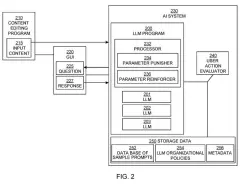
The system sends your question to several AI models at the same time. Each model writes its own answer, then all of them evaluate every response against a set of quality criteria. They vote on which answer is best. The system tallies those votes, picks the top-ranked response, and tells you which AI model won.
You get the best answer the group could produce, along with credit given to the model that produced it. It's closer to asking a panel of experts than trusting a single voice.
… distributing, in parallel and simultaneously, the prompt and the one or more evaluation criteria to the contestant LLMs; generating and evaluating the responses to the prompt and based on the one or more evaluation criteria, generating rankings of the responses …
Translation: The system sends the user's request to several AI models at once and has them grade each other's work.
How the contestant AIs judge, rank, and settle a winner
IBM's patent describes a pipeline with several distinct stages, all automated:
- Pre-processing: Your prompt is cleaned, tokenized (broken into structured units the models can parse), and standardized so every contestant AI receives an identical, compatible input.
- Criteria setting: The system determines one or more evaluation criteria relevant to your question, things like factual accuracy, relevance, or completeness. These criteria travel with the prompt to every model.
- Parallel distribution: The standardized prompt and its criteria are sent simultaneously to all contestant large language models (LLMs), which are the large AI systems like those powering today's chatbots.
- Peer evaluation and ranking: Each model generates its own answer and scores the answers produced by the other models, using the shared criteria. Rankings are aggregated across all contestants to identify the top-performing response.
- Result delivery: The winning answer and the identity of the model that produced it are returned to the user.
The key architectural choice is that the models act as both competitors and judges simultaneously. No separate grading layer is required; the peer-review mechanism is baked into the same pool of models answering the question.
A top-ranked response is determined by aggregating the rankings. A winning LLM is identified among the LLMs based on the winning LLM having generated the top-ranked response. The top-ranked response and an identification of the winning LLM are sent to the user.
Translation: The system picks the best answer from the group and tells the user which AI model provided it.
What this means for businesses relying on AI answers
Enterprise AI deployments live or die on answer quality, and most organizations currently have no automated way to validate a model's output before it reaches a user. IBM's system builds that validation directly into the response pipeline, which matters most in regulated industries like finance, healthcare, and legal services, where a wrong AI answer carries real liability.
IBM has long positioned itself as an AI vendor for large institutions rather than consumers, and this patent fits that strategy. The approach adds compute overhead, running several models at once costs more than running one, but it also offers something a single-model system cannot: a built-in audit trail that names the winning model, which is useful for compliance and accountability. AI answer quality sits at the center of a lot of new Big Tech patents right now, and IBM's peer-competition design is one of the more structurally direct attempts to address it.
That makes this IBM's 40th filing we've tracked since May on our AI guardrails watchlist, joining one on conflicting documents and one on training data leaks.
Source: US 2026/0252812 A1 at the USPTO (PDF). Full patent text and figures are in the official publication.
Get our take in your Top Stories
Liked this breakdown? Add Patentlyze as a preferred source on Google, and our plain-English take shows up more often in your Top Stories the next time IBM patent news breaks.
Add Patentlyze on Google
One click.
There are more where this came from
We read the new patents from Big Tech, carmakers and more and send you the ones worth knowing. Plain English, free, every week.
The drawings · 10 sheets
10 drawing sheets from US 2026/0252812 A1 · click any drawing to enlarge


Show the other 2 sheets


More from IBM
All 481 IBM patents →
More in AI / ML
All 2,745 AI / ML patents →
Nvidia
A New Nvidia Patent Tackles AI Prompt Complexity Before Models Process Them
IBM
IBM Patents a System for Scoring AI Bias Toward Protected Groups
Microsoft
Microsoft Patents an AI That Focuses Only on the Parts of a Document That Matter

Microsoft