
Apple Patents a Curve-Based Method for Generating HDR Gain Maps
Apple is filing patents around one of the quieter but genuinely tricky problems in modern photography: how do you let an HDR image display beautifully on both a dazzling Pro Display XDR and a five-year-old laptop screen at the same time? The answer is a gain map — and this patent is about generating one automatically.
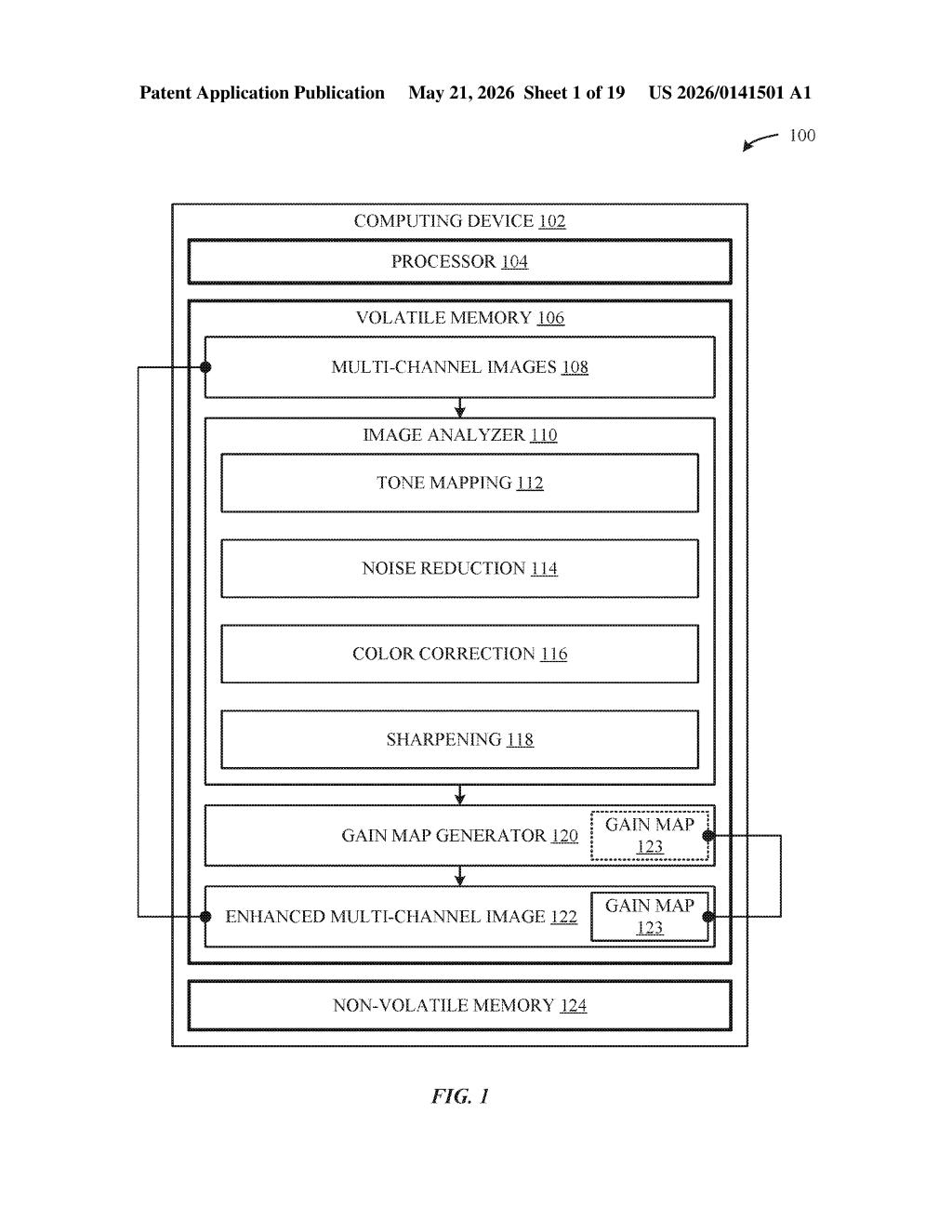
What Apple's gain map generation actually does
Imagine you take a photo on your iPhone in HDR mode. The file captures a huge range of light — deep shadows and blazing highlights all at once. But when you send that photo to someone on an older screen that can't show all that brightness, it can look washed out or weird. The solution is something called a gain map — a hidden layer baked into the photo file that tells each screen how to tone-map the image to look its best.
The tricky part is making that gain map. Normally, a camera might produce both an HDR and a standard-dynamic-range (SDR) version of the same shot. Apple's patent describes a way to compare those two images pixel by pixel, plot the relationship between them on a graph, fit a smooth curve to that data, and use that curve to produce the gain map automatically.
The result gets embedded directly into the HDR image file. Any compatible app or screen can then read that gain map and render the photo appropriately — full brightness on a capable display, tastefully dialed-back on a standard one — all from a single file.
How Apple plots pixels to build the gain map curve
The patent describes a multi-step process for deriving a gain map from an HDR/SDR image pair:
- Pixel plotting: For every pixel shared between the HDR and SDR versions of a photo, the system plots a point on a 2D graph — SDR value on the X-axis, HDR value on the Y-axis. This creates a scatter plot representing the tonal relationship between the two images.
- Curve fitting: The system then fits a smooth first curve to that scatter plot — essentially an approximation of how HDR brightness maps to SDR brightness across the whole image.
- Curve inversion: That first curve is inverted to create a second curve. Inversion here means flipping the mathematical relationship, so you can go from SDR values back to a residual gain value rather than the other way around.
- Replotting and gain map generation: The second curve is applied to the original pixel data to produce replotted pixels — effectively the per-pixel gain values. Those values are assembled into the final gain map, which is then embedded into the HDR image file itself.
The gain map format Apple is referencing is consistent with the ISO 21496-1 standard and Apple's own Adaptive HDR (formerly called HDR gain map) spec, which is already supported in iOS, macOS, and formats like HEIC and JPEG-XL.
What this means for HDR photo compatibility on Apple devices
Gain maps are already baked into how Apple handles HDR photos across its ecosystem — iPhones shoot them, Photos.app displays them, and Safari renders them on the web. The interesting thing about this patent is that it describes a way to generate a gain map from an existing HDR/SDR pair, rather than having the camera produce one at capture time. That's relevant for software pipelines: think photo editors, RAW processors, or server-side tools that need to produce gain-map-compliant output from legacy images.
For you as a user, this is mostly invisible plumbing. But it points to Apple wanting tighter, more automated HDR workflows — where any tool in the pipeline can produce a correctly formatted, display-adaptive image without manual tone-mapping work.
This is solid, unglamorous infrastructure work. Gain maps are genuinely useful — they're one of the better solutions to the HDR-on-mixed-screens problem — and automating their generation from existing image pairs has real value for processing pipelines. It's not a consumer-facing feature anyone will notice directly, but it's the kind of thing that quietly makes Apple's photo ecosystem more coherent.
Get our take in your Top Stories
Liked this breakdown? Add Patentlyze as a preferred source on Google, and our plain-English take shows up more often in your Top Stories the next time Apple patent news breaks.
There are more where this came from
We read every patent application Big Tech publishes and send you the ones worth knowing. Plain English, free, every week.
Want this weekly breakdown for a company we don't cover? Patentlyze Pro →