
Apple Patents a Display Scaling System That Reads Image Edges Before Sharpening Them
Every time a screen blows up a lower-resolution image to fill more pixels, it has to invent detail that wasn't there. Apple's new patent describes a smarter way to do that inventing, by first figuring out which direction an edge is running before filling in the gaps.
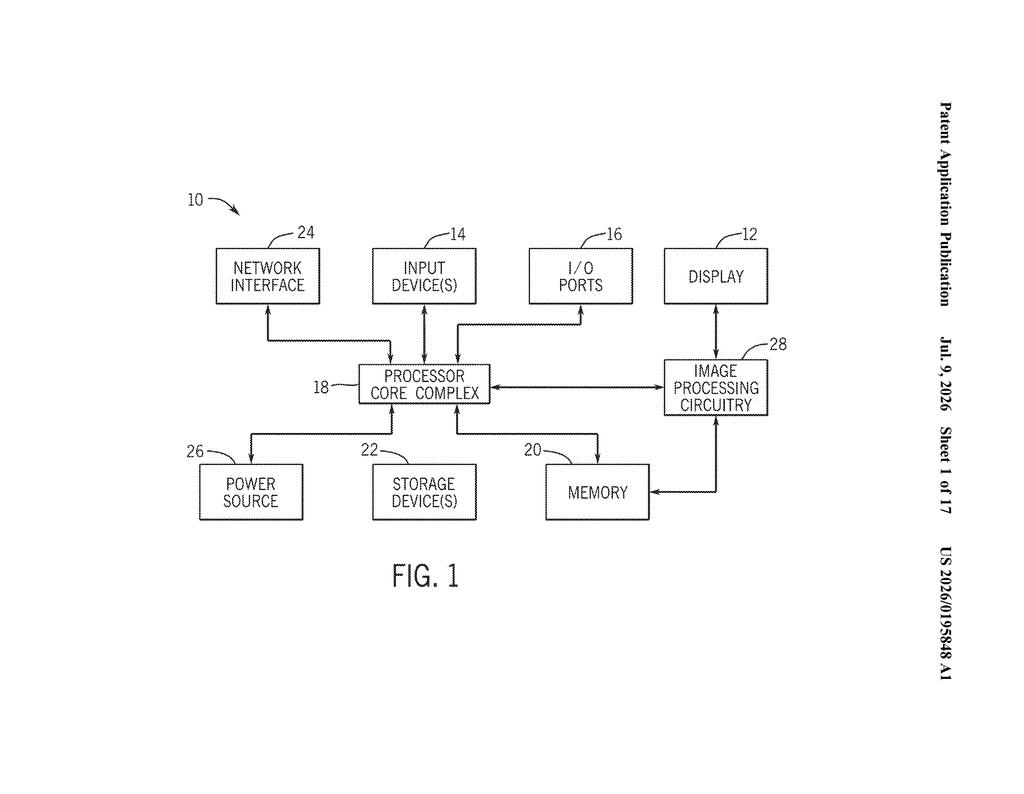
What Apple's angle-aware image scaling actually does
Imagine you take a photo and view it on a screen with far more pixels than the photo originally had. The screen has to fill in the extra pixels somehow, and usually it just averages nearby colors together. That works okay for flat areas, but diagonal lines and curved edges come out blurry or stepped, like a staircase instead of a smooth slope.
Apple's patent describes circuitry that first figures out the angle of edges in the image before deciding how to fill in missing pixels. Instead of blending straight across rows and columns, it samples colors along the actual direction the edge is traveling, so a diagonal line stays diagonal rather than turning into a jagged blur.
The result is that when your display upscales an image, sharp lines in the original stay sharper in the enlarged version. That matters any time a screen shows content at a different resolution than it was made for, which covers everything from apps on a higher-res display to older video on a modern TV.
How the circuit samples along detected edge angles
The patent describes image processing circuitry built into a device alongside its electronic display. When the screen needs to upscale an image from a lower resolution to a higher one, this circuitry handles the calculation of each new pixel.
For every new pixel it needs to create, the system does two things before doing any blending:
- It finds the relative position of the new pixel among the existing original pixels.
- It estimates an angle corresponding to the image content at that spot, essentially detecting the direction any edge or line is running through that area.
Armed with that angle, the circuitry then interpolates (meaning it calculates in-between values) in two passes. First it computes intermediate horizontal values at positions between existing pixels along the horizontal axis, tilted to match the detected angle. Then it does the same vertically. The final pixel value is derived from combining both sets of in-between values.
This two-pass, angle-aware approach is fundamentally different from conventional scaling, which samples pixels in fixed horizontal and vertical grids regardless of what the image actually looks like at that spot. By aligning the sampling direction to the content, the method avoids the blurring and aliasing (staircase artifacts) that standard upscaling produces on diagonal edges.
What this means for Apple displays and upscaling quality
Display upscaling is a constant background task on almost every screen Apple makes. IPhones render UI elements at different scales, Macs run apps in non-native resolutions, and the Vision Pro has to map content onto curved displays. Any improvement to how the hardware handles that translation shows up as visibly crisper images across the whole product line, without requiring the original content to change.
The fact that this is implemented in dedicated image processing circuitry rather than software matters too. Doing it in hardware means the scaling can happen at display refresh rates without draining the CPU or battery. If Apple bakes this into a future display controller or Apple Silicon chip, every frame on every screen could benefit automatically.
This is a real, concrete improvement to a problem every screen faces, and Apple has the chip design chops to actually ship it in silicon. It won't show up in a press release, but if it lands in a future display controller, users will notice crisper text and cleaner edges in upscaled content without knowing why.
Get our take in your Top Stories
Liked this breakdown? Add Patentlyze as a preferred source on Google, and our plain-English take shows up more often in your Top Stories the next time Apple patent news breaks.
There are more where this came from
We read every patent application Big Tech publishes and send you the ones worth knowing. Plain English, free, every week.
Want this weekly breakdown for a company we don't cover? Patentlyze Pro →