
Zoox Patents a System That Does Route Math in the Cloud So Its Cars Don't Have To
Instead of flooding every car in a fleet with live traffic feeds, Zoox wants a central server to do the heavy math first and ship each vehicle a simple score it can act on immediately.
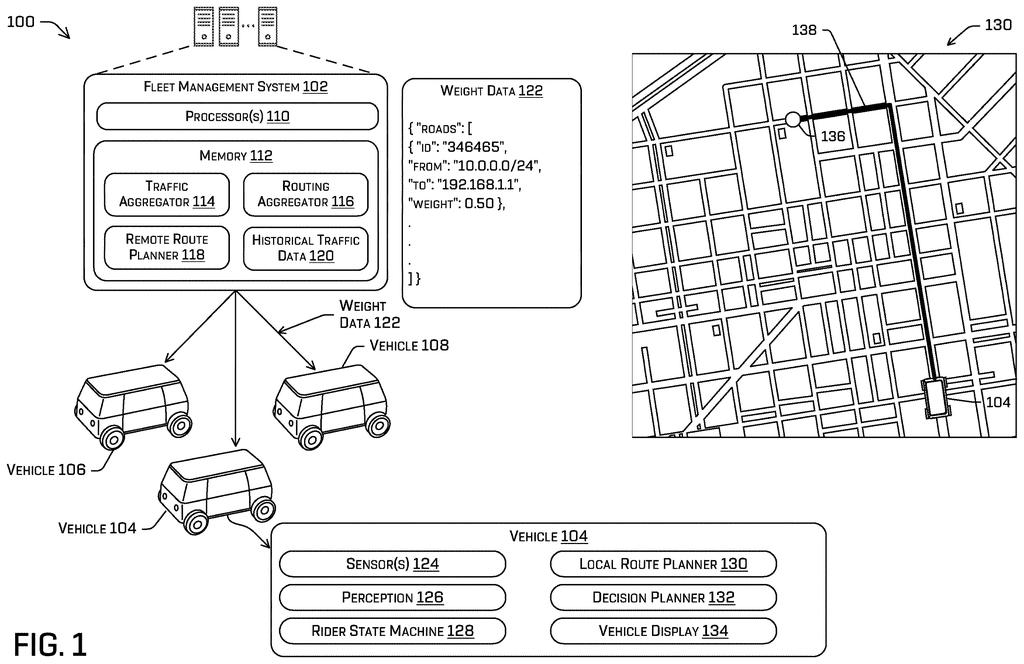
How Zoox's central server cuts work for each car
Every time a self-driving car needs to pick a route, it has to weigh dozens of factors: traffic, road conditions, construction, weather. Doing all of that on a computer inside the car, for every car in a fleet at once, is expensive and slow.
Zoox's approach shifts most of that work to a remote server. The server crunches all the raw data and turns it into a single road weight, a pre-calculated score for each road segment that tells the car how attractive or unattractive that road is right now. The car gets the score, not the raw data dump.
Here's the part that makes this more than just an optimization: the server can send different scores for the same road to different vehicles. That means the fleet manager can steer one car away from a stretch of road while another car uses it normally, all without any car knowing about the others.
… PROVIDING THOSE PRE-CALCULATED WEIGHTS TO VEHICLES TO SIMPLIFY ONBOARD ROUTE PLANNING …
Translation: The cloud computes route data ahead of time so the car's computer doesn't have to work as hard.
How road weights replace raw traffic data in the car
The system has two main parts: a remote fleet management server that processes traffic, road condition, and other environmental data, and lightweight vehicle computing devices that receive pre-processed outputs and use them for local route decisions.
The server converts raw data into road weights (think of a weight as a single number that summarizes how good or bad a road segment is to travel right now). Instead of transmitting full traffic datasets to each car, the server sends only these compact scores, which cuts bandwidth and the processing burden on each vehicle.
The critical detail in the patent's first claim is that the server can compute different weights for the same road and send them to different vehicles simultaneously. This means routing behavior across a fleet can be individualized or deliberately staggered, without vehicles needing to coordinate with each other directly.
- Server ingests raw road and traffic data
- Calculates one or more weights per road segment
- Transmits tailored weights to individual vehicles
- Each vehicle uses its received weights to plan and execute its own route
… transmitting the first weight to a first vehicle computing device associated with a first vehicle, to enable the first vehicle computing device to determine a route for traversing a road network comprising the first road based on the first weight, and control the first vehicle based on the route …
Translation: The system sends the calculated score to the car so it can figure out where to drive and steer itself.
What this means for autonomous fleet efficiency
For a company like Zoox operating a paid robotaxi fleet, bandwidth and compute costs add up fast across hundreds of vehicles. Pushing route calculations to the cloud and sending only condensed scores reduces what each car needs to process in real time, which can improve reliability and lower operating costs per trip.
The fleet-level angle is the more interesting implication for everyday riders. A central server that sends different weights to different cars can spread traffic across a city more deliberately, reduce the chance that every robotaxi floods the same road at once, and adapt to local incidents without requiring cars to share data with each other. From a passenger's perspective, that should translate to more consistent pickup and drop-off times.
That makes this Amazon's 72nd filing we've tracked in our Amazon coverage since May, a corpus that spans work like fixing radar speed errors and building 3D models from one photo.
Claim 1 covers any system where a central server collects road data, calculates scores for individual road segments, and sends different scores to different vehicles. The patent explicitly says "autonomous or otherwise," so a logistics company routing human-driven delivery vans through a central office computer sits squarely inside that definition.
That scope is commercially significant because the core behavior being claimed, a server doing the road math and pushing tailored results to each vehicle separately, describes how many modern fleet routing tools already operate.
If the claim survives examination without narrowing, any competing company building software that calculates per-vehicle road scores on a central server would need to reckon with this patent, giving Amazon leverage across a wide category of fleet management products far beyond self-driving vehicles.
There are more where this came from
We read every patent application Big Tech publishes and send you the ones worth knowing. Plain English, free, every week.
The drawings
5 drawing sheets from US 2026/0276396 A1 · click any drawing to enlarge


Want this weekly breakdown for a company we don't cover? Patentlyze Pro →
Be the first to weigh in