
Zoox Files Patent for AI That Forecasts Where Nearby Objects Are Headed
A self-driving car that can't guess where other vehicles are going is a car that can't drive safely. Zoox has filed a patent for an AI model that predicts the future path of nearby objects, step by step, by anchoring each guess to the direction of the lane the object is in.
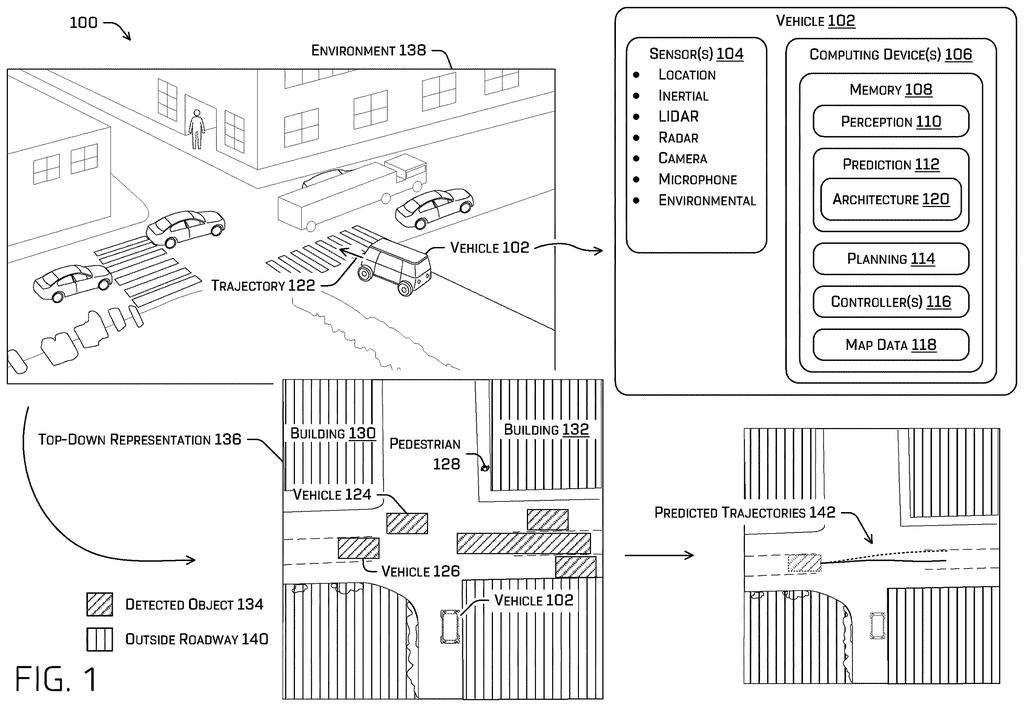
How Zoox's lane-aware trajectory prediction works
Every time a robotaxi rolls through an intersection, its computers are racing to answer one question: where is every other car, bike, and pedestrian going next? Getting that wrong by even a fraction of a second can mean a near-miss or worse.
Zoox's patent describes an AI model that builds a predicted path for each nearby object one pose at a time. A pose is just a snapshot: where the object is and which way it's pointing. The model chains these snapshots together into a predicted future path.
The key detail is that the model doesn't just guess blindly. It looks at the direction of the nearest lane to the object's current or most recent predicted position, and uses that lane orientation to guide the next prediction. It's a way of baking in real road structure so the AI doesn't predict a car will suddenly veer off into a building.
… iteratively predict a series of predicted poses (positions and orientations) of the object over time. The machine-learned model may condition these predictions on a lane orientation of nearest target pose to a predicted pose or last predicted pose of the object.
Translation: The artificial intelligence guesses where a nearby thing will move next by looking at how lanes are shaped.
How the model uses lane direction to guide each pose forecast
The patent describes a machine-learned model (an AI trained on data rather than hand-coded rules) that predicts the future trajectory of an object near an autonomous vehicle. A trajectory is a sequence of predicted poses across time, where each pose captures both position (where the object is) and orientation (which way it's facing).
The model works iteratively, meaning it generates predictions one step at a time rather than producing the whole path in a single pass. At each step, it conditions its next prediction on the lane orientation of the nearest lane to either the most recent predicted pose or the last known real pose of the object. Conditioning (using a piece of context to shape an output) here means the model is effectively saying: "Given that this car is near a lane pointing northeast, its next position should respect that direction."
This approach ties the AI's guesses to actual road geometry, which helps prevent physically implausible predictions like a car drifting through a median. The architecture is designed to be applied to any object type, whether a vehicle, cyclist, or pedestrian near a road.
What this means for self-driving car safety decisions
Self-driving systems depend on prediction accuracy to plan safe maneuvers. If the AI guesses that a car ahead will go straight when it's actually about to turn, the robotaxi's response will be wrong, and wrong responses at speed are dangerous. Anchoring predictions to lane direction is a practical way to constrain the model's output space so it stays physically plausible.
For riders and pedestrians sharing the road with Zoox vehicles, better trajectory prediction translates directly into smoother, more cautious driving behavior. Zoox has been filing around autonomous vehicle perception and prediction since at least 2022, and this patent fits a consistent focus on making the AI's world model match the real structure of roads rather than treating the environment as open space.
Amazon's 27th filing we've tracked in self-driving sensing since May adds to earlier Zoox work on radar speed fixes and color-coded lane maps.
Claim 1 has been canceled, meaning Amazon voluntarily surrendered the broadest version of this patent before it ever granted. That matters because the lead claim is typically where a patent does its heaviest lifting, covering the widest possible version of an idea so that everything narrower flows from it.
What that lead claim would have protected is a method for repeatedly predicting where a moving object will be, step by step, by checking how the nearest road lane is angled relative to where the object just was. That is a specific but broadly applicable idea, relevant to any self-driving system trying to guess where a car or pedestrian is heading.
Without seeing the surviving dependent claims, there is no way to know what this filing can actually enforce. A canceled claim 1 is a real reduction in reach, and what remains is almost certainly more limited in scope.
There are more where this came from
We read every patent application Big Tech publishes and send you the ones worth knowing. Plain English, free, every week.
The drawings
8 drawing sheets from US 2026/0285327 A1 · click any drawing to enlarge


Want this weekly breakdown for a company we don't cover? Patentlyze Pro →
Be the first to weigh in