
Apple Patents a Faster, Leaner Method for Delivering Immersive Surround Sound
Recording sound in three dimensions produces enormous amounts of data describing exactly where every noise is coming from. Apple's new patent is about squeezing that directional data down to a fraction of its original size without making the audio sound worse.
What Apple's spatial audio compression actually does
You're wearing a headset and the audio around you shifts as you turn your head, every sound anchored to a point in space. That kind of audio, called spatial or 3D audio, sounds natural because it tracks hundreds of directions at once, but all that directional information takes up a lot of storage and bandwidth.
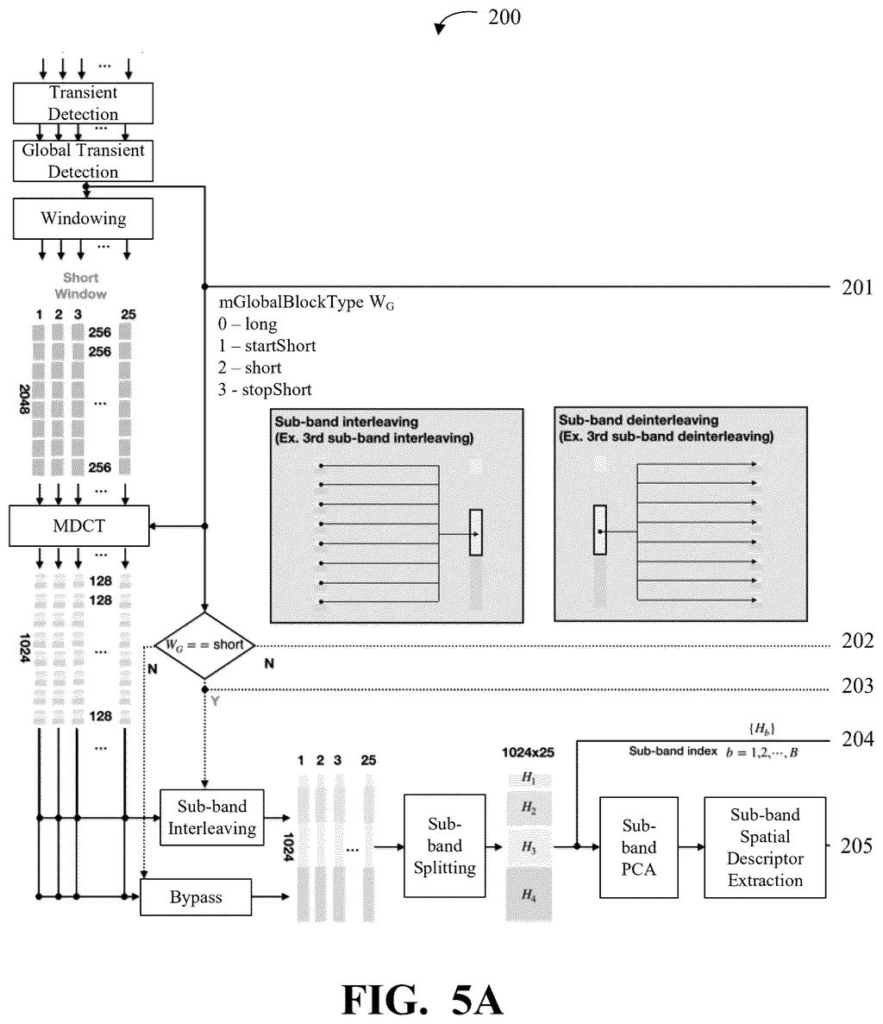
Apple's patent describes a way to compress the directional data that makes spatial audio work. Instead of storing every directional snapshot in full, the system finds the average direction across many frames, strips it out, groups similar directions together, and encodes what's left using standard lossless techniques. On playback, the process runs in reverse to reconstruct the original audio.
The goal is to let high-quality 3D audio travel over tighter connections or fit inside smaller files, which matters any time you're streaming audio to headphones, sending a recording over a network, or storing hours of spatial content on a device.
… multiplying the k-dimensional transformed SD by the inverse of the unitary transform to produce an output k-dimensional SD to reconstruct HOA data.
Translation: It multiplies the processed data by the inverse of a math matrix to rebuild the full 3D sound field.
How the encoder shrinks directional audio vectors
The patent centers on a format called Higher Order Ambisonics (HOA), a way of encoding sound that captures audio coming from every direction in a sphere around the listener. HOA is used in VR, spatial audio headphones, and professional broadcast.
HOA data includes what the patent calls spatial descriptors (SDs): compact vectors (think of them as arrows pointing in specific directions) that tell the decoder where sounds are coming from at each moment in time. The problem is that storing these vectors for every audio frame adds up fast.
The compression pipeline the patent describes works in several steps:
- Mean subtraction: the system computes an average direction vector across many frames and subtracts it, so only the variation from average needs to be stored.
- Unitary transform: a mathematical rotation (similar in spirit to the transforms used in JPEG image compression) is applied to the remaining vectors, concentrating the important information into fewer numbers.
- Clustering: similar directions are grouped together, so the encoder only has to store one representative value per cluster rather than every individual vector.
- Lossless encoding: the result is compressed further using standard bitwise techniques, producing the final bitstream.
Decoding reverses each step: lossless decoding, cluster lookup, applying the inverse transform, and adding the mean vector back, to reconstruct the original directional data.
Encoding, decoding, and processing spatial descriptors (SD) produced from higher order ambisonics (HOA) data for purposes of bitrate reduction is described.
Translation: The patent describes ways to shrink the size of advanced surround sound data files so they load faster.
What this means for high-quality 3D audio on Apple devices
Spatial audio is already built into AirPods and Apple Vision Pro, and the quality of that experience depends partly on how efficiently directional data can be moved around. A compression scheme that shrinks that data without audible loss means you could get better spatial audio over lower-bandwidth connections, or longer recordings in the same storage space.
Apple's interest in spatial audio compression shows up across multiple areas of its audio and headset work. This particular patent is focused on the codec layer, the infrastructure underneath the listening experience, which is the kind of work that has to be done before higher-level features can get better.
Apple's 11th audio filing we've tracked since May builds on earlier work like one on compressing spatial audio and one on matching room acoustics, adding to a growing Apple audio patents picture.
This patent describes a compression method for spatial audio, three-dimensional sound that makes headphones feel like a real space around you. It runs entirely in software, which means no new chips or hardware are required to put it to work.
The shortest route to a product runs through coordination, not engineering. Streaming services and device makers need to agree on how audio gets compressed and unpacked before any one company's method becomes something listeners actually hear.
If that alignment happens, the practical result is 3D audio that loads faster, stutters less, and travels more efficiently over a wireless connection. Quiet infrastructure, but real progress toward something people would notice.
There are more where this came from
We read every patent application Big Tech publishes and send you the ones worth knowing. Plain English, free, every week.
The drawings
10 drawing sheets from US 2026/0279361 A1 · click any drawing to enlarge


Want this weekly breakdown for a company we don't cover? Patentlyze Pro →
Be the first to weigh in