
Apple Patents a More Efficient Way to Compress 3D Spatial Audio
Spatial audio sounds impressive until you have to store or stream it, at which point the file sizes become a real problem. Apple is filing patents on a smarter compression approach that could make rich 3D sound practical at much lower bitrates.
What Apple's spatial audio compression actually does
Imagine you're watching a movie on your Apple Vision Pro and a helicopter swoops overhead from left to right, the sound moving perfectly with the picture. That kind of 360-degree audio, called spatial audio, requires capturing and storing sound from every direction at once, and the data involved is enormous.
Apple's patent tackles the storage and streaming problem. It describes a method for compressing that spatial audio data far more aggressively, without throwing away the information that makes the sound feel three-dimensional. Think of it like a smart zip file that knows which parts of the audio experience your ears will notice most.
The technique involves analyzing the audio, grouping its spatial components, and then deciding how precisely to encode each group based on how important it is. High-priority sounds get finer detail; less critical ones get smaller, rougher descriptions. The result is a much smaller file that still delivers the full sense of sound in space.
analyzing an input HOA matrix to produce a first SD group that comprises a plurality of first SD components, wherein the plurality of first SD components cover a plurality of first sub-bands, respectively, and a second SD group that comprises a plurality of second SD components …
Translation: It splits 3D audio data into different groups so they can be processed separately.
How the encoder splits and shrinks spatial audio data
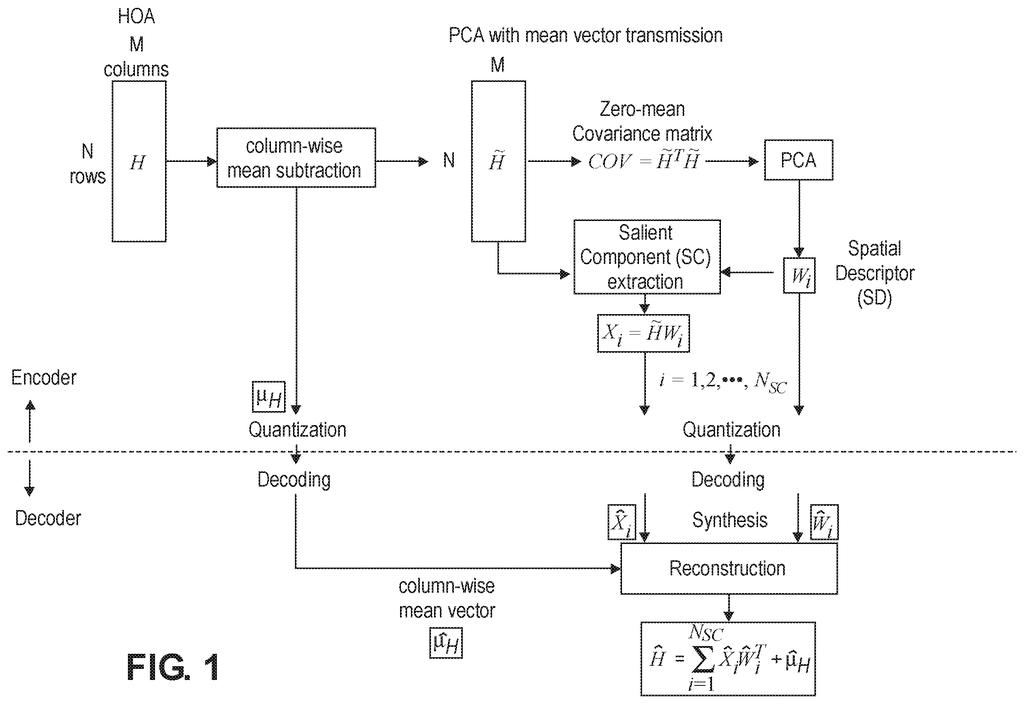
The patent covers a compression system for Higher Order Ambisonics (HOA), a format that represents sound as a sphere of audio information around the listener rather than as a fixed set of speaker channels like stereo or 5.1 surround.
The core idea is to analyze the incoming HOA audio matrix using principal components analysis (PCA), a mathematical technique that finds the most important patterns in a large dataset and discards redundancy. Applied to audio, PCA identifies which spatial directions carry the most meaningful sound energy. These become Spatial Descriptors (SDs), a compact representation of where sound is coming from and how it behaves over time.
Here is where the patent's specific contribution comes in: it splits those descriptors into groups and assigns them different sub-band bandwidths. Sub-bands are slices of the audio frequency range, low tones, mid tones, high tones and so on. More important descriptors (lower index numbers, representing the dominant spatial directions) get finer frequency resolution. Less important ones get coarser, wider sub-bands. This variable-width approach avoids wasting bits on spatial information the listener is unlikely to perceive.
- Analyze the HOA audio matrix to find dominant spatial directions
- Assign each direction a Spatial Descriptor, grouped by importance
- Encode higher-priority groups with narrower, more precise frequency sub-bands
- Pack the result into a compressed bitstream for storage or streaming
Encoding and decoding of higher order ambisonics, HOA, data for purposes of bitrate reduction.
Translation: It compresses spatial audio data so it takes up less bandwidth.
What this means for spatial audio on Apple devices
For everyday listeners, the payoff is spatial audio that streams or downloads more quickly without sounding worse. Formats like HOA are already used in music, VR, and cinematic audio, but their file sizes make wide deployment on consumer devices or cellular networks difficult. A more efficient encoder could make immersive audio as common as stereo.
For Apple specifically, this fits directly into the ecosystem around Vision Pro and spatial audio playback on AirPods. Streaming high-quality 3D audio to a headset in real time is a bandwidth-intensive task. If Apple can cut the data requirement significantly while preserving the perceptual experience, that removes one of the practical barriers to making spatial audio a default, not a premium feature.
Apple files its tenth audio application we've tracked since May, adding to a set that includes one on matching room sound and one on detecting device direction in our audio patent coverage.
Apple's spatial audio compression work described here is essentially a software problem, which is the shortest possible path to a shipping feature. No new chips or hardware are required; the method refines how a processor decides which parts of a three-dimensional soundscape deserve the most detail when compressing audio.
The main ingredient that has to exist first is the broader spatial audio pipeline itself, and Apple already ships products built around exactly that. Once the surrounding plumbing is in place, a compression improvement like this arrives as a software update rather than waiting for a new device.
That makes this patent feel close to the finish line. The engineering challenge is tuning, not invention, and tuning tends to move quickly.
There are more where this came from
We read every patent application Big Tech publishes and send you the ones worth knowing. Plain English, free, every week.
The drawings
16 drawing sheets from US 2026/0279367 A1 · click any drawing to enlarge


Want this weekly breakdown for a company we don't cover? Patentlyze Pro →