
Qualcomm Patents a System That Spots Objects and Measures Their Depth at the Same Time
Most computer-vision systems treat object recognition and distance measurement as separate problems. Qualcomm's new patent fuses them into a single pass, so a device can simultaneously draw a precise outline around an object and know how far away it is.
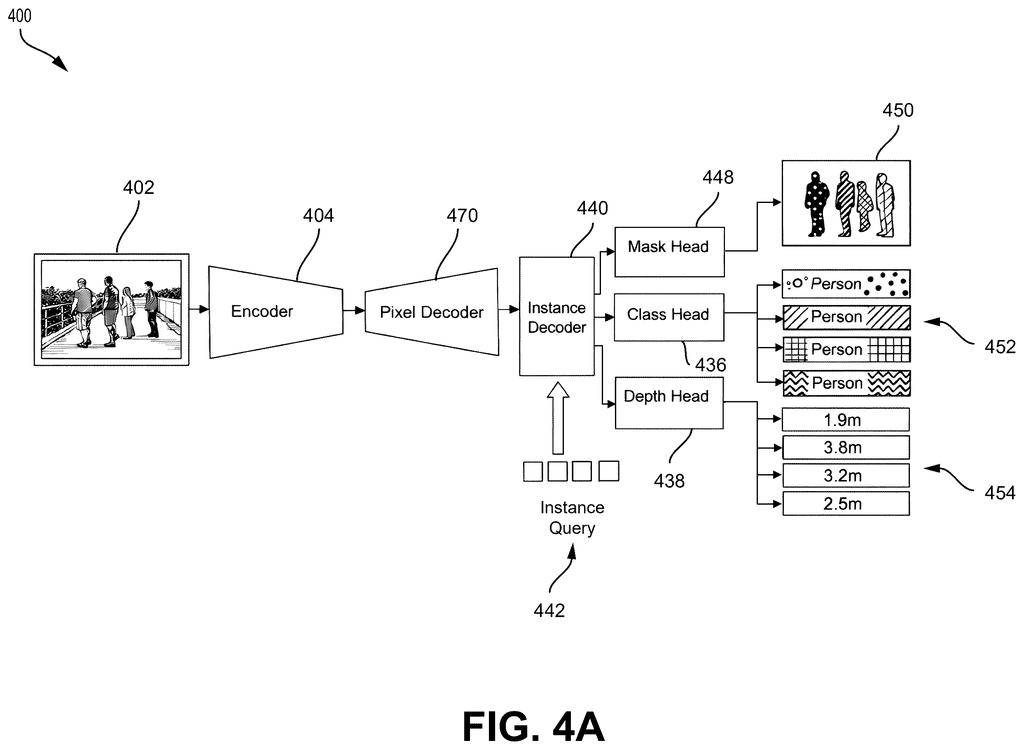
How Qualcomm's depth-and-outline trick actually works
Ever watched a self-driving car clip a curb, or seen an AR filter drift off someone's face? A lot of that comes down to a gap between two tasks computers handle separately: knowing what an object is and knowing how far away it is.
Qualcomm's patent describes a system that closes that gap. Feed it a photo or camera frame, and it produces two things at once: a precise outline (called a mask) around each object in the scene, and a distance reading tied directly to that specific object, not just to a region of the image. Your phone's camera, a drone, or a pair of AR glasses could use this to simultaneously understand both shape and depth without running two separate programs.
The practical payoff is speed and consistency. When the outline and the depth come from the same calculation, they can't disagree with each other, which is a common headache when two separate models are stitched together after the fact.
process an image using one or more convolutional layers and one or more transformer blocks to generate a set of weights; generate, based on the set of weights, an instance mask for an object in the image and a depth for the object …
Translation: It analyzes a picture with neural networks to figure out what an object is and how far away it sits.
How the model ties each outline to a depth reading
The system runs an image through two types of processing layers working together: convolutional layers (which scan the image for local patterns like edges and textures, the way your eye notices a sharp boundary) and transformer blocks (which look at the whole image at once to understand broader context, like knowing a blob of pixels is a person because of surrounding clues).
Together, those layers produce a set of weights, essentially a scored map of which parts of the image belong to which object and how important each pixel is. From those weights, the system does two things simultaneously:
- Generates an instance mask: a pixel-by-pixel outline that isolates one specific object (not just the category "car," but this exact car in this frame)
- Estimates a depth value for that object, and crucially, links that depth reading to the same mask rather than treating it as a free-floating number
The binding of depth to mask is the key technical move. It means the distance estimate is guaranteed to correspond to the object the outline describes, eliminating ambiguity when multiple objects overlap or sit at different distances. The output is a paired result: outline plus depth, one per detected object.
What this means for cameras, robots, and AR
For you as a consumer, this could show up in phone cameras that more accurately blur backgrounds (because the phone knows both the shape and the distance of every subject), AR experiences that anchor virtual objects to real surfaces more reliably, or driver-assistance systems that respond faster because they're not waiting for two separate calculations to finish and agree.
The patent is also relevant to any device running perception tasks on a tight power budget, which is the pattern in Qualcomm's on-device AI filings. Doing object detection and depth estimation in a single model pass is cheaper than running two models, which matters on a phone chip or a lightweight autonomous sensor where every milliwatt counts.
Qualcomm's 38th filing we've tracked since July in the self-driving sensing race follows one on self-correcting car cameras and one ranking dangerous objects first, adding to the company's work on how cars sense the road.
Claim 1 covers any computing device that runs an image through a specific two-part processing structure, convolutional layers plus transformer blocks, to produce weights, and then uses those weights to deliver an object outline and a distance measurement as one paired output. No particular industry, product, or use case is named, which makes the claim unusually wide.
The paired output is the legal heart of the claim. The distance reading must be attached to the same outline, delivered together as one answer. That specific linkage is what separates this from simply detecting objects or measuring depth as independent steps.
In practice, that scope reaches across phones, vehicles, and robots. Any product that follows this processing structure and delivers that combined result would fall inside the claim. A company building depth-aware object detection this way would need to account for this patent before shipping a product.
There are more where this came from
We read every patent application Big Tech publishes and send you the ones worth knowing. Plain English, free, every week.
The drawings
13 drawing sheets from US 2026/0278817 A1 · click any drawing to enlarge


Want this weekly breakdown for a company we don't cover? Patentlyze Pro →