
Adobe's New Patent Lets Users Build Automated Job Processes by Typing Plain English
Setting up a business workflow today means clicking through menus, picking conditions, and mapping data fields by hand. Adobe is patenting a system that lets you just describe what you want in plain English and have the AI build the whole thing for you.
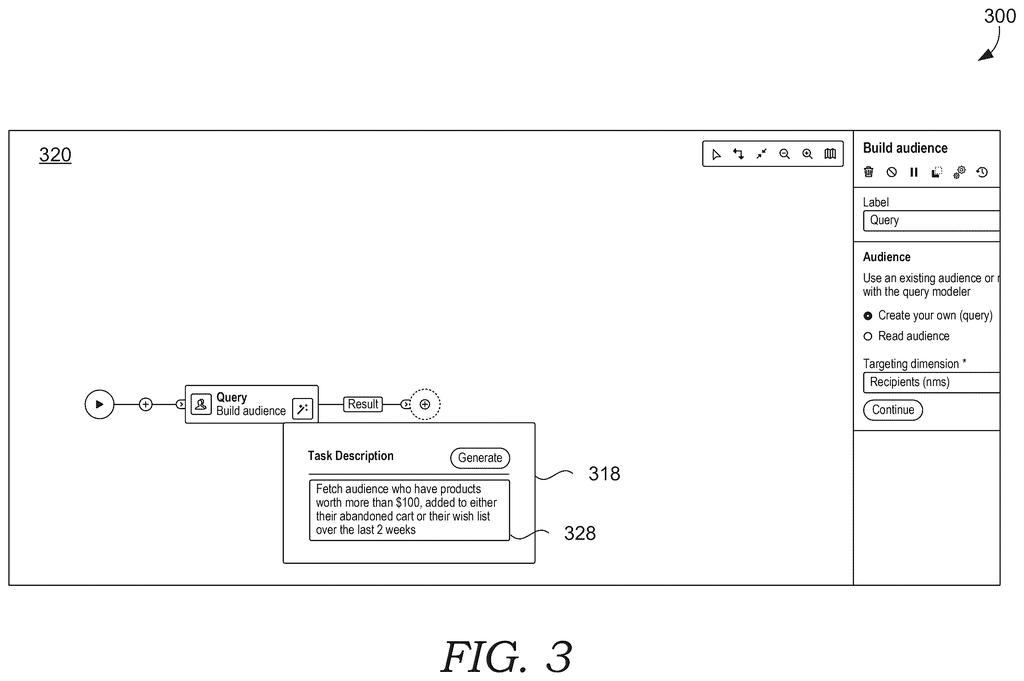
How Adobe's AI turns a plain request into a workflow
Right now, building an automated workflow in business software is a manual job. You pick a trigger, define conditions, connect data sources, and configure each step yourself. It's slow, and if you don't know the software well, it's easy to get wrong.
Adobe's patent describes an AI assistant baked into an application that takes your plain-language description, like "send a discount offer to customers who haven't bought anything in 90 days," and translates it into a working, executable workflow behind the scenes. The AI figures out the relevant tasks, breaks them into sub-steps, finds the right data tables, and assembles everything into a format the application can actually run.
You type what you want. The system handles the technical construction. That's the core idea.
… the user input including at least a natural language description of the workflow activity to be generated by the workflow assistant tool, the workflow activity generated by the machine learning model by at least: causing the machine learning model, based on the user input, to generate a set of segments …
Translation: The system builds automated tasks directly from typed sentences.
How the system matches your words to the right data tables
The system works in several layered steps.
First, when you type a natural-language description, a machine learning model breaks it into segments (the main tasks) and conditions (the sub-tasks or rules within each task). Think of segments as the chapters of a workflow and conditions as the rules inside each chapter.
Next, the system compares your input against a library of database tables using semantic vector embeddings (a technique where text is converted into numerical patterns that capture meaning, so "purchase history" and "transaction records" are understood as related). It finds the data tables most relevant to what you described, filtering out the noise.
The model then generates a structured description of those segments, and the system converts that description into a domain-specific language object (a formatted, machine-readable file the application knows how to execute directly). The patent also describes a Retrieval-Augmented Generation (RAG) pipeline, a method where the AI pulls in real context from the company's own data before generating output, plus validation steps that check and correct the result before it runs.
The relevant data tables are stored in a dedicated data store, pre-annotated and pre-converted into those numerical patterns so the matching can happen quickly.
… a multistep Retrieval-Augmented Generation-based prompt engineering pipeline in addition to schema filtering, segment and condition generation, and validation and correction mechanisms to generate workflow activities based on natural language inputs from a user.
Translation: It uses advanced AI pipelines and data filtering to turn typed text into working app tasks.
What this means for business software and automation tools
For anyone who manages marketing campaigns, customer data pipelines, or other rule-based business processes inside Adobe's software, this kind of tool could cut the time to build and modify workflows from hours to seconds. You would not need to know the application's data structure or configuration language to get results.
Adobe's long bet on generative AI inside creative and business tools shows up clearly here. Claim 1 covers the end-to-end loop: natural language in, executable workflow out, with the schema-matching step included. That's a broad claim. If granted as written, it could give Adobe a strong position over any competing business-software tool that does something similar inside a single integrated application.
Adobe's third filing we've tracked since August in our AI agents that act for you theme follows earlier applications on a query-explaining assistant and voice-driven graphic design.
Claim 1 here is genuinely wide. It covers the full pipeline: accept natural language, generate segments and conditions, match relevant data schemas using embedding comparison, build a structured executable object. That's not a narrow claim about one clever trick; it's a claim on the whole method.
In practice, that breadth matters because the same basic loop (describe a business rule in plain English, get a runnable automation) is exactly what every enterprise software company is building right now. A granted patent this broad would give Adobe real leverage over competitors working in the same space, assuming the claim survives examination.
The honest caveat: most broad AI-process claims get narrowed during patent examination, and prior art in this specific area is deep. Whether Claim 1 survives in its current form is the real question. As a signal of where Adobe is directing its AI engineering, though, the filing is clear.
There are more where this came from
We read every patent application Big Tech publishes and send you the ones worth knowing. Plain English, free, every week.
The drawings
9 drawing sheets from US 2026/0278505 A1 · click any drawing to enlarge


Want this weekly breakdown for a company we don't cover? Patentlyze Pro →
Be the first to weigh in