
Samsung Patents a Tri-Fold Phone That Changes Its Screen Layout Based on Nearby Devices
Samsung is working on a three-panel foldable phone that automatically rearranges its screen the moment it detects what gadget you have connected to it. Unfold it with a Bluetooth keyboard nearby and you get one layout; unfold it alone and you get something else entirely.
What Samsung's tri-fold screen-switching actually does
Every time you fully open a foldable phone, the screen just... opens. It shows whatever it was showing before, and you have to manually adjust from there. That's a small but constant friction point, especially when you're trying to get something done quickly.
Samsung's patent describes a phone with three separate panels, all connected by hinges, that behaves differently depending on what other devices are near it. When you unfold it past a certain angle, the phone checks whether a keyboard, stylus, or some other input device is connected over Bluetooth or Wi-Fi. Based on what it finds, it automatically picks a screen layout suited to that situation.
So if you unfold the phone while a wireless keyboard is paired, you might get a laptop-style layout across all three panels. Unfold it alone and it might default to something more like a widescreen media view. The idea is that you shouldn't have to tell it what you're doing every single time.
detect a change of a state of the electronic device from a first state or a second state to a third state in which the second housing is unfolded about the hinge unit at a designated angle or more from the first housing and the third housing, through the at least one sensor; …
Translation: Sensors track when the three housing parts open up past a specific angle.
How the phone detects fold state and connected device type
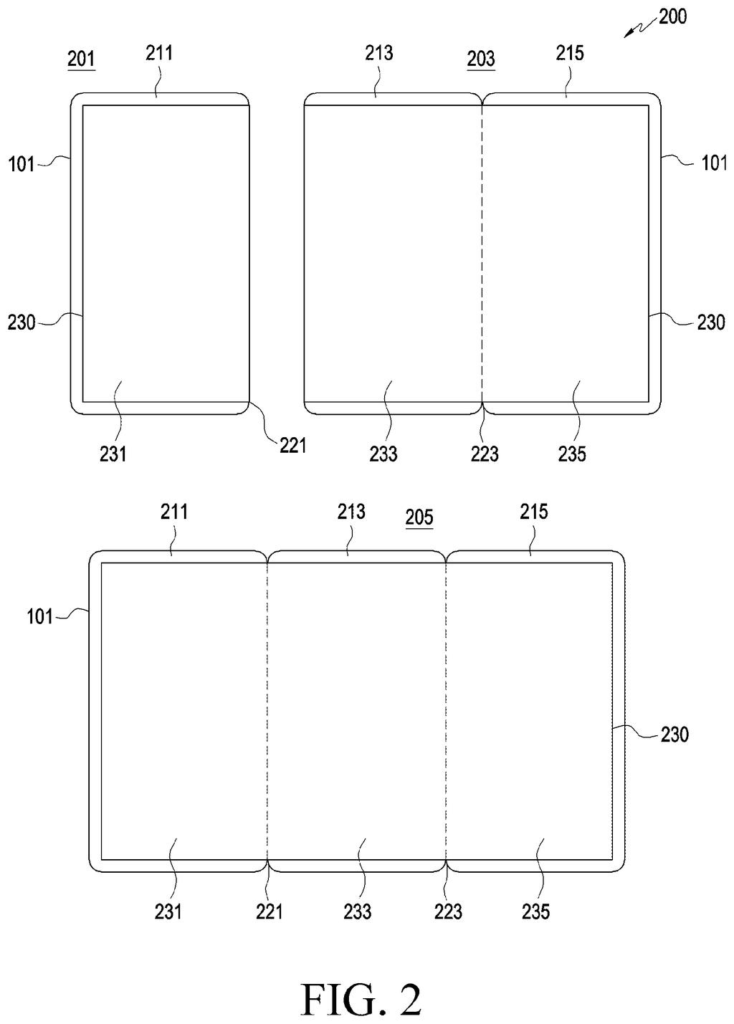
The device described in the patent has three housing sections joined by two hinges, each section carrying its own portion of a continuous flexible display. The phone tracks which of several possible physical states it is in, whether folded flat, partially open, or fully expanded past a set angle.
When the phone crosses that angle threshold into the fully open state, it triggers an automatic check via its communication module. The processor looks for any external input device that is already connected or available to connect, things like a Bluetooth keyboard, a stylus, or potentially a game controller.
- First type of input device: triggers "first mode," a specific layout spread across all three display areas.
- Second type of input device: triggers "second mode," a different layout across the same three areas.
- No device detected: the patent implies a default behavior, though the claim focuses on the connected-device scenarios.
The processor uses the type of the connected device, not just its presence, to decide which mode to load. That distinction matters because a keyboard suggests a productivity context, while a game controller suggests something entirely different, and the same three-panel screen real estate should logically be organized differently for each.
… identify, through the communication module, whether an external electronic device has established communication with or is capable of establishing communication with the electronic device when it is detected that the state of the electronic device is changed to the third state; …
Translation: The phone checks for nearby connected devices once it is unfolded.
What this means for people who use phones with keyboards or tablets
For anyone who has ever opened a tablet or laptop and waited for the software to catch up with what they intended to do, this is a step toward removing that gap. A three-panel foldable already has a lot of screen to manage, and doing it manually each time erases much of the convenience gain from having that much space.
The practical payoff is modest but real: you pick up the phone, unfold it, and it's already in the right mode because it noticed your keyboard was nearby. Samsung keeps filing on foldable display interaction That kind of automatic context-switching is exactly the kind of thing that makes a device feel polished rather than just technically impressive.
Samsung's latest application is the 72nd we've tracked on our foldable phone patents since May, adding to work like vibration tuned to fold angle and split cover screen windows.
Three-panel foldable phones ask a lot of the person holding them. You have unfolded something unusual, and the screen needs to decide immediately what you are trying to do with it, whether you are sitting at a desk with a keyboard, standing with a stylus, or just reading with your hands.
The specific bet Samsung is making here is that the phone reads what kind of device is attached before you do anything. That single moment, when you plug something in and the layout just works, is the whole value proposition. It saves you from hunting through settings while your coffee gets cold.
The honest risk is that a wrong guess at that moment creates more frustration than doing nothing at all. A screen that confidently arranges itself for the wrong situation is harder to fix than a blank one. Samsung has to get that detection right nearly every time for this to feel like help rather than interference.
There are more where this came from
We read every patent application Big Tech publishes and send you the ones worth knowing. Plain English, free, every week.
The drawings
16 drawing sheets from US 2026/0281231 A1 · click any drawing to enlarge


Want this weekly breakdown for a company we don't cover? Patentlyze Pro →