
Samsung Patents a Cover Glass Trick That Kills Rainbow Patterns on Folding Screens
Every folding phone has a dirty secret: the crease zone can produce faint, shimmering rainbow bands when the display bends. Samsung's new patent targets that problem with a surprisingly precise geometric fix baked right into the cover glass.
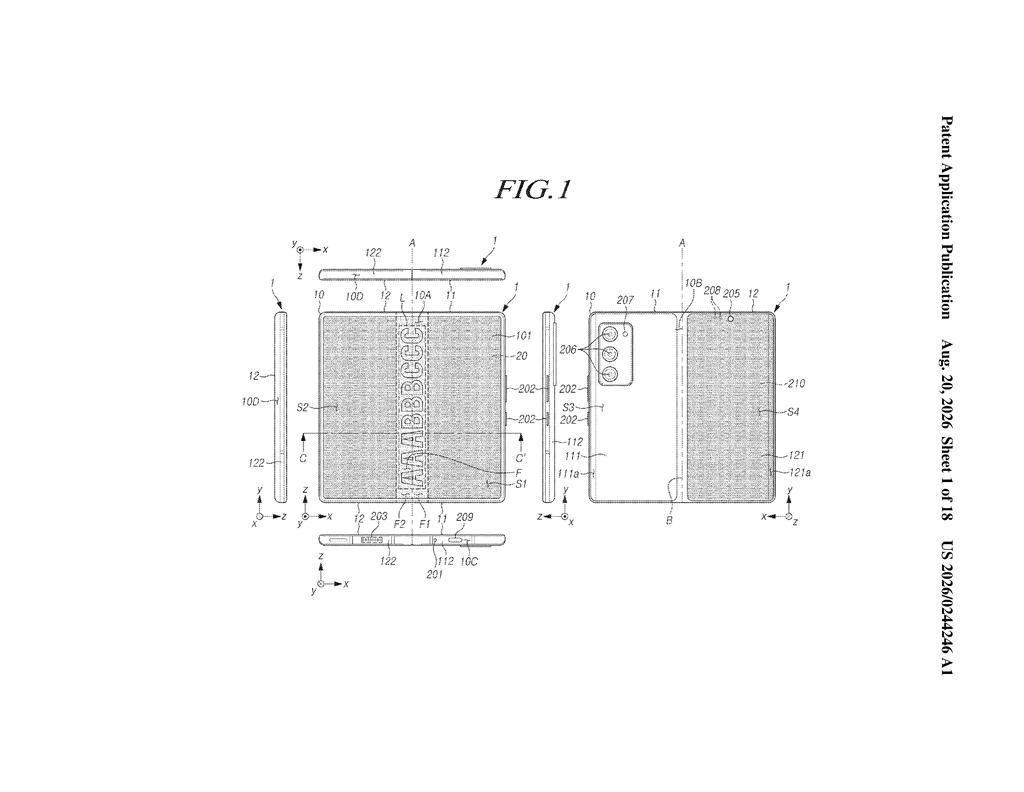
Why folding screens get weird patterns, and what Samsung is doing
Every time you unfold a Galaxy-style phone and look at the hinge area, your eyes and the screen are playing a quiet optical tug-of-war. The pixels are arranged in a repeating grid, and if anything else on the screen (like a protective layer) has its own repeating pattern, the two grids can clash and create a distracting rainbow shimmer called moiré.
Samsung's patent describes a way to stop that clash before it starts. The front glass cover in the bendable zone gets tiny openings or shallow recesses cut into it, arranged in a grid of their own. The critical detail is the angle: that grid of holes is tilted between 7 and 38 degrees relative to the pixel grid underneath. Tilting it by just the right amount means the two patterns never line up in a way that creates visible banding.
The same glass also needs to be flexible enough to fold without cracking, which is why the openings are only in the bending zone and not across the whole screen. You get a cover that is rigid where it needs to be and flexible where it bends, without the rainbow artifact penalty.
… a glass member having a first pattern formed by a plurality of openings or recesses formed corresponding to a variable region and disposed at a predetermined period …
Translation: The folding glass has a textured pattern of tiny holes or grooves in the bending area.
How the angled hole pattern cancels the optical interference
The patent covers a flexible display assembly built from two main layers working together.
The display panel contains a pixel array: rows and columns of subpixels, each emitting a specific color of light, spaced at a fixed, repeating interval. Any repeating structure laid on top of another repeating structure at a similar scale can create moiré, the same wavy interference pattern you see when two window screens overlap at a slight angle.
The front cover glass is where the invention lives. Rather than being a uniform flat sheet, the glass has a region (the bendable, "variable" zone) where a pattern of openings or recesses is etched or cut in. That pattern is also periodic, meaning the holes repeat at a regular spacing. The key claim is the angle: the hole grid must be rotated between 7 degrees and 38 degrees relative to the underlying pixel grid. This angular offset is enough to push any moiré artifact outside the range that human eyes can detect.
The patent also mentions an adhesive layer with different rigidities across the bend zone versus the flat zone, so the glass can flex in the hinge area while staying stiff on the flat panels. Together, the angle-offset pattern and the variable-stiffness adhesive are meant to let the cover glass bend thousands of times without cracking or producing visual noise.
… an adhesive layer having different rigidities corresponding to a transformable area and a non-transformable area of a flexible display …
Translation: The glue holding the screen together has varying stiffness where the phone bends versus where it stays flat.
What this means for folding phone glass quality
For anyone who owns or is considering a folding phone, screen quality in the crease area has always been the weakest point of the form factor. A cover glass that actively suppresses moiré through its own geometry, rather than relying solely on software color correction or thicker coatings, could make that zone look noticeably cleaner in real use.
For engineers and product teams building foldable displays, the specific angle range (7 to 38 degrees) is the heart of the claim. If Samsung secures this as written, any competitor using a similarly periodic hole pattern in a flexible cover glass would need to prove their angle falls outside that window or that their geometry works on a different principle. The flexible-display space is exactly the kind of place where plain-English patent summaries help track who is staking out the optical engineering territory underneath the glass you tap every day.
Samsung's latest application is the 58th we've tracked in our foldable phone patent watchlist since May, building on ideas like a spring-loaded gear hinge and a rail-embedded speaker.
Claim 1 is deliberately broad in one dimension and narrow in another, which is an interesting combination. Broad: it covers any flexible display with any periodic opening pattern in the front glass, regardless of hole shape, size, or material. Narrow: it then pins the whole claim to a specific angular range, 7 to 38 degrees, relative to the pixel array. That numerical range is the enforceability hinge. If a competitor's hole pattern lands at 6 degrees or 39 degrees, claim 1 likely does not reach them, which means Samsung's attorneys will need strong data showing that range is non-obvious and not already in prior art. Patents built around a precise numerical window often face validity challenges, but they also give clear freedom-to-design guidance to rivals, which has real market value regardless of litigation.
Get our take in your Top Stories
Liked this breakdown? Add Patentlyze as a preferred source on Google, and our plain-English take shows up more often in your Top Stories the next time Samsung patent news breaks.
There are more where this came from
We read every patent application Big Tech publishes and send you the ones worth knowing. Plain English, free, every week.
The drawings
18 drawing sheets from US 2026/0244246 A1 · click any drawing to enlarge


Want this weekly breakdown for a company we don't cover? Patentlyze Pro →
Be the first to weigh in