
Qualcomm Patents a System to Fairly Split Power Between Different Processor Types
Modern chips cram in performance cores, efficiency cores, and AI processors all at once, and deciding how much power each one gets is a genuinely hard math problem. Qualcomm has filed a patent for a system that hands out power in weighted "credits," adjusting on the fly when some cores are idle.
What Qualcomm's per-core power rationing actually does
Ever tried to split a restaurant bill fairly when everyone ordered something different? That is basically what a chip has to do with electricity every second it runs.
Your phone's processor is not one uniform thing. It has fast cores for heavy apps, slow cores for background tasks, and separate blocks for AI work. Each one needs power, but they don't all need the same amount at the same time. Qualcomm's patent describes a system where a central "energy manager" on the chip hands out power credits to each processing block according to a pre-set weight, kind of like a weighted voting system. A high-priority core gets more credits; a low-priority one gets fewer.
When a core goes idle or is paused, its unused credits don't evaporate. They can be redistributed to whoever needs them. The weights themselves are stored in reprogrammable memory, so the chip can be tuned without redesigning the hardware.
In contrast to integrated circuits (ICs) having uniform clusters of homogeneous processor cores, the task of dividing a total IC power budget is more complicated in ICs having heterogeneous clusters and processing circuits with various activity levels.
Translation: Splitting power gets tricky when chips mix different kinds of processing cores that work at varying speeds.
How the energy credit weights get assigned and redistributed
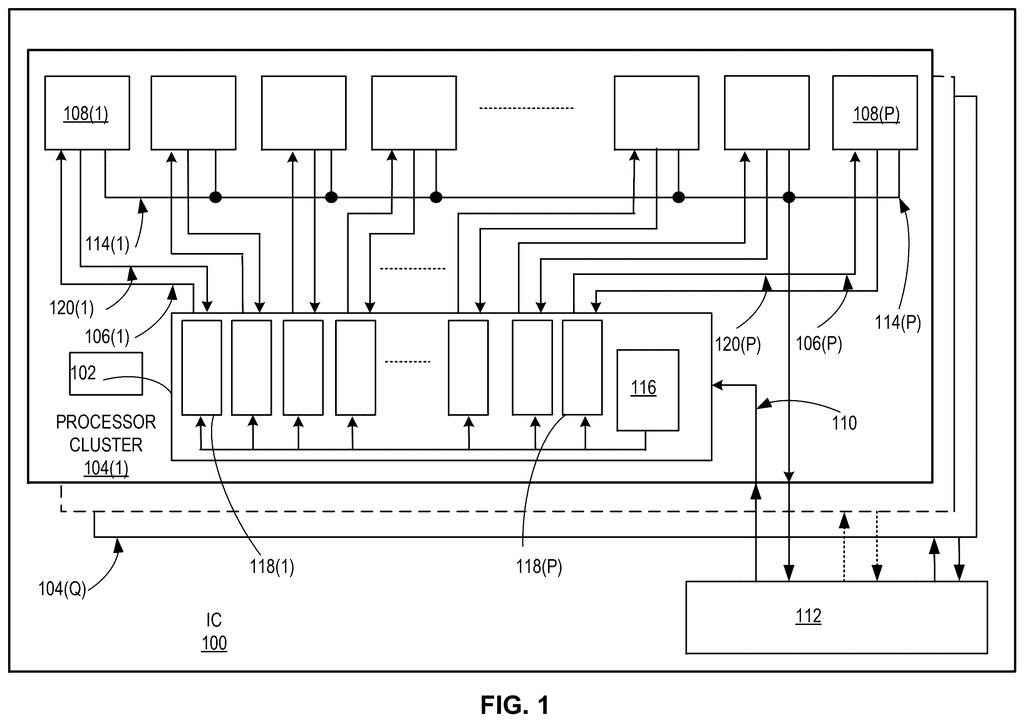
The patent describes a cluster energy management circuit sitting above a group of mixed processor cores. A "cluster" here means a set of cores that share a power budget, much like a team sharing an expense account.
The central circuit receives a cluster energy credit (a timed allowance of how much energy the whole group can spend in a given window) and then divides it among individual cores. The split is not equal. Each core has an assigned weight, stored in a programmable register, that determines its share. A weight of 2 versus a weight of 1 means the first core gets twice the allocation.
The system also monitors suspension signals: flags that indicate a core is halted, sleeping, or otherwise not consuming power. When a core is suspended, its credits are not wasted. The patent says those credits can be reallocated to active cores, squeezing more useful work out of the same total budget.
Because the weights live in reprogrammable storage, software or firmware can adjust the ratios at runtime, letting the chip adapt to different workloads without a hardware redesign.
What this means for phones and chips juggling many tasks
For you as a user, this is about battery life and sustained performance. A chip that wastes power credits on sleeping cores, or starves a busy AI block because it is stuck with a fixed share, ends up throttling sooner or draining faster. A smarter credit system keeps all the active parts fed and lets the chip run longer at full speed before it has to slow itself down to cool off.
For chip designers, the programmable weights are the real value. Instead of hardwiring a power split that works for one use case, Qualcomm's track record in power-management patents points toward chips that can be reconfigured in software for phones, laptops, cars, or industrial hardware, all from the same silicon base.
Qualcomm's 54th filing we've tracked in the AI chip wars since July builds on their parallel AI calculations chip and their ordered fast calculations method.
Every phone with a powerful chip inside is secretly running a negotiation: how much battery to spend on the camera, the maps app, the background sync, all at once. When a chip has multiple types of processors with different appetites, that negotiation gets expensive to get wrong. Bad power splits mean your phone gets hot, slows down, or dies before dinner.
What this patent addresses is the messiness of that negotiation at the hardware level, where a fixed budget gets carved up dynamically based on what each processor type is actually doing moment to moment. The programmable weights matter because they let a manufacturer tune one chip for a budget phone and a flagship without redesigning the silicon.
The engineering problem is proportionate to the solution here. Chips are only getting more heterogeneous, and the gap between good and bad power management is measured in real battery hours and real thermal complaints from real customers.
There are more where this came from
We read every patent application Big Tech publishes and send you the ones worth knowing. Plain English, free, every week.
The drawings
6 drawing sheets from US 2026/0277289 A1 · click any drawing to enlarge


Want this weekly breakdown for a company we don't cover? Patentlyze Pro →
Be the first to weigh in