
Apple · Filed May 6, 2026 · Published Sep 17, 2026

Apple's New Patent Covers a MacBook Top Case That Senses Touch and Pressure Anywhere on Its Surface

Apple is exploring a MacBook design where the entire top surface of the base, not just the trackpad, can detect where you touch it and how hard you press. That's a significant expansion of what a laptop's body can sense.
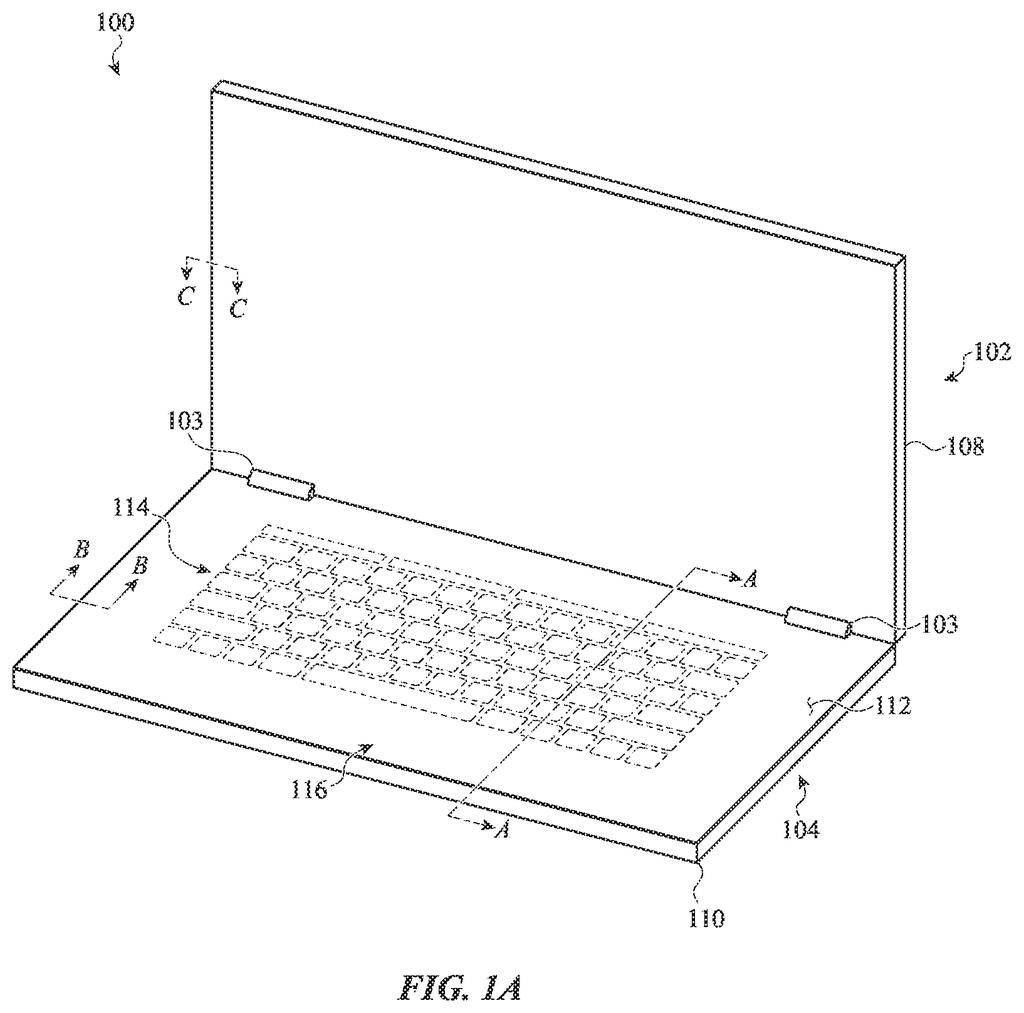
A laptop with a top case that senses touch and pressure across its surface, including the keyboard area. Drawing from patent filing US 2026/0277330 A1.
A laptop with a top case that senses touch and pressure across its surface, including the keyboard area.
See all 108 drawings from this filing ↓
Publication number US 2026/0277330 A1 US20260277330A1
Applicant Apple Inc.
Filing date May 6, 2026
Publication date Sep 17, 2026
Inventors Christiaan A. Ligtenberg, Brett W. Degner, Ron A. Hopkinson, Asif Hussain, Dinesh C. Mathew, Mikael M. Silvanto, Chang Zhang, Zheng Gao, Robert Y. Cao, Keith J. Hendren, Bryan W. Posner, Simon R. Lancaster-Larocque, Alex J. Lehmann
US classification 345/173
Status when we published Waiting for an examiner (Jun 12, 2026)
Parent application is a Continuation of 18922369 (filed 2024-10-21)
Document 20 claims

What Apple's whole-deck touch sensing actually does

A MacBook sits on a desk, its keyboard deck a flat, inert surface that only really pays attention to your fingers in two places: the keyboard and the trackpad. Everything else is just aluminum.

Apple's patent describes a laptop where the entire top case, the big surface your wrists rest on, is one continuous sensing layer. Touch it anywhere and the machine knows where your finger landed. Press down and it also knows how hard. The top case would be made from a dielectric material (a non-conducting substance that lets sensor signals pass through it) rather than metal, which would otherwise block the sensing hardware underneath.

In practice, this could mean the area currently occupied by a fixed trackpad, or by nothing at all, becomes interactive real estate. You could tap, swipe, or press in zones that today do nothing.

From the filing · CLAIM 1
… a top case, formed from a dielectric material, coupled to the bottom case and comprising: a top member defining a top surface of the base portion; and a sidewall integrally formed with the top member and defining a side surface of the base portion; …

Translation: The laptop body uses a special insulating material that forms both the wrist rest area and the outer edges.

How the two sensor systems split the work

The patent describes a portable computer split into two main physical sections: a display portion (the screen lid) and a base portion (the keyboard deck), connected by a hinge.

The base portion uses a top case made from a dielectric material, meaning a non-metal, non-conducting material like glass or ceramic. Standard MacBook aluminum would block the electric fields that capacitive touch sensors rely on, so switching to a dielectric lets sensors underneath the surface actually work across the entire deck.

Inside, two separate sensing systems handle different jobs:

  • First sensing system: determines the location of a touch, mapping where on the surface a finger or object made contact, much like a large touchpad grid.
  • Second sensing system: determines the force of the same touch, measuring how hard the user is pressing, similar to Apple's Force Touch technology already found in MacBook trackpads.

The top member (the flat upper surface) and the sidewall are described as integrally formed, meaning they are one continuous piece rather than separate panels joined together. That single-piece construction is important for distributing sensor coverage without gaps or seams interrupting the sensing area.

From the filing · THE ABSTRACT
… a first sensing system configured to determine a location of a touch input applied to the top surface of the base portion and a second sensing system configured to determine a force of the touch input.

Translation: Internal sensors track exactly where your fingers touch the laptop body and how hard you press down.

What this means for the future MacBook keyboard area

If Apple builds this into a real product, the physical keyboard deck of a MacBook could become a large, pressure-sensitive touch surface. That opens the door to gestures anywhere on the wrist-rest area, dynamic input zones that appear on a display embedded in the deck, or a larger version of today's trackpad that stretches across most of the base.

Claim 1 covers essentially any portable computer with a dielectric top case and those two sensing systems working together. That's a fairly broad structural claim: it does not specify how big the sensing area must be, what material exactly the dielectric is, or what software interprets the inputs. If granted as written, it could give Apple a blocking position on an entire category of whole-deck sensing laptops, not just one specific implementation.

Apple's tenth filing in input and haptics we've tracked since May joins earlier work on a pressure-sensing side button and air gestures for Siri.

Editorial take

Claim 1 covers any portable computer where the top surface of the keyboard deck is made from a non-metal material and the whole surface can sense both where you touch it and how hard you press. That scope is wide. Apple did not write in a specific material, a specific sensor type, or any size limit on the sensing area.

In practice, that breadth means the claim reaches well beyond a trackpad. A full glass or ceramic deck that responds to location and pressure anywhere across its surface falls inside the boundary Apple has drawn here.

That matters because the combination of location and force sensing is claimed as a structural feature of the case itself, not as a discrete component tucked underneath it. Any design that puts those two capabilities into a non-metal laptop deck would need to reckon with this claim.

Get our take in your Top Stories

Liked this breakdown? Add Patentlyze as a preferred source on Google, and our plain-English take shows up more often in your Top Stories the next time Apple patent news breaks.

There are more where this came from

We read every patent application Big Tech publishes and send you the ones worth knowing. Plain English, free, every week.

The drawings

108 drawing sheets from US 2026/0277330 A1 · click any drawing to enlarge

Laptop with sensing top case, drawing sheet 1 from US 2026/0277330 A1
Sheet 1 Laptop with sensing top case
Laptop input and output components, drawing sheet 2 from US 2026/0277330 A1
Sheet 2 Laptop input and output components
Exploded view of laptop base, drawing sheet 3 from US 2026/0277330 A1
Sheet 3 Exploded view of laptop base
Cross-section of laptop base, drawing sheet 4 from US 2026/0277330 A1
Sheet 4 Cross-section of laptop base
Cross-section of laptop base with components, drawing sheet 5 from US 2026/0277330 A1
Sheet 5 Cross-section of laptop base with components
Exploded view of laptop base, drawing sheet 6 from US 2026/0277330 A1
Sheet 6 Exploded view of laptop base
Cross-sections of laptop base edges, drawing sheet 7 from US 2026/0277330 A1
Sheet 7 Cross-sections of laptop base edges
More cross-sections of laptop base edges, drawing sheet 8 from US 2026/0277330 A1
Sheet 8 More cross-sections of laptop base edges
Show the other 52 sheets
Apple’s New Patent Covers a MacBook Top Case That Senses Touch and Pressure Anywhere on Its Surface patent drawing, sheet 9
Sheet 9
Apple’s New Patent Covers a MacBook Top Case That Senses Touch and Pressure Anywhere on Its Surface patent drawing, sheet 10
Sheet 10
Apple’s New Patent Covers a MacBook Top Case That Senses Touch and Pressure Anywhere on Its Surface patent drawing, sheet 11
Sheet 11
Apple’s New Patent Covers a MacBook Top Case That Senses Touch and Pressure Anywhere on Its Surface patent drawing, sheet 12
Sheet 12
Apple’s New Patent Covers a MacBook Top Case That Senses Touch and Pressure Anywhere on Its Surface patent drawing, sheet 13
Sheet 13
Apple’s New Patent Covers a MacBook Top Case That Senses Touch and Pressure Anywhere on Its Surface patent drawing, sheet 14
Sheet 14
Apple’s New Patent Covers a MacBook Top Case That Senses Touch and Pressure Anywhere on Its Surface patent drawing, sheet 15
Sheet 15
Apple’s New Patent Covers a MacBook Top Case That Senses Touch and Pressure Anywhere on Its Surface patent drawing, sheet 16
Sheet 16
Apple’s New Patent Covers a MacBook Top Case That Senses Touch and Pressure Anywhere on Its Surface patent drawing, sheet 17
Sheet 17
Apple’s New Patent Covers a MacBook Top Case That Senses Touch and Pressure Anywhere on Its Surface patent drawing, sheet 18
Sheet 18
Apple’s New Patent Covers a MacBook Top Case That Senses Touch and Pressure Anywhere on Its Surface patent drawing, sheet 19
Sheet 19
Apple’s New Patent Covers a MacBook Top Case That Senses Touch and Pressure Anywhere on Its Surface patent drawing, sheet 20
Sheet 20
Apple’s New Patent Covers a MacBook Top Case That Senses Touch and Pressure Anywhere on Its Surface patent drawing, sheet 21
Sheet 21
Apple’s New Patent Covers a MacBook Top Case That Senses Touch and Pressure Anywhere on Its Surface patent drawing, sheet 22
Sheet 22
Apple’s New Patent Covers a MacBook Top Case That Senses Touch and Pressure Anywhere on Its Surface patent drawing, sheet 23
Sheet 23
Apple’s New Patent Covers a MacBook Top Case That Senses Touch and Pressure Anywhere on Its Surface patent drawing, sheet 24
Sheet 24
Apple’s New Patent Covers a MacBook Top Case That Senses Touch and Pressure Anywhere on Its Surface patent drawing, sheet 25
Sheet 25
Apple’s New Patent Covers a MacBook Top Case That Senses Touch and Pressure Anywhere on Its Surface patent drawing, sheet 26
Sheet 26
Apple’s New Patent Covers a MacBook Top Case That Senses Touch and Pressure Anywhere on Its Surface patent drawing, sheet 27
Sheet 27
Apple’s New Patent Covers a MacBook Top Case That Senses Touch and Pressure Anywhere on Its Surface patent drawing, sheet 28
Sheet 28
Apple’s New Patent Covers a MacBook Top Case That Senses Touch and Pressure Anywhere on Its Surface patent drawing, sheet 29
Sheet 29
Apple’s New Patent Covers a MacBook Top Case That Senses Touch and Pressure Anywhere on Its Surface patent drawing, sheet 30
Sheet 30
Apple’s New Patent Covers a MacBook Top Case That Senses Touch and Pressure Anywhere on Its Surface patent drawing, sheet 31
Sheet 31
Apple’s New Patent Covers a MacBook Top Case That Senses Touch and Pressure Anywhere on Its Surface patent drawing, sheet 32
Sheet 32
Apple’s New Patent Covers a MacBook Top Case That Senses Touch and Pressure Anywhere on Its Surface patent drawing, sheet 33
Sheet 33
Apple’s New Patent Covers a MacBook Top Case That Senses Touch and Pressure Anywhere on Its Surface patent drawing, sheet 34
Sheet 34
Apple’s New Patent Covers a MacBook Top Case That Senses Touch and Pressure Anywhere on Its Surface patent drawing, sheet 35
Sheet 35
Apple’s New Patent Covers a MacBook Top Case That Senses Touch and Pressure Anywhere on Its Surface patent drawing, sheet 36
Sheet 36
Apple’s New Patent Covers a MacBook Top Case That Senses Touch and Pressure Anywhere on Its Surface patent drawing, sheet 37
Sheet 37
Apple’s New Patent Covers a MacBook Top Case That Senses Touch and Pressure Anywhere on Its Surface patent drawing, sheet 38
Sheet 38
Apple’s New Patent Covers a MacBook Top Case That Senses Touch and Pressure Anywhere on Its Surface patent drawing, sheet 39
Sheet 39
Apple’s New Patent Covers a MacBook Top Case That Senses Touch and Pressure Anywhere on Its Surface patent drawing, sheet 40
Sheet 40
Apple’s New Patent Covers a MacBook Top Case That Senses Touch and Pressure Anywhere on Its Surface patent drawing, sheet 41
Sheet 41
Apple’s New Patent Covers a MacBook Top Case That Senses Touch and Pressure Anywhere on Its Surface patent drawing, sheet 42
Sheet 42
Apple’s New Patent Covers a MacBook Top Case That Senses Touch and Pressure Anywhere on Its Surface patent drawing, sheet 43
Sheet 43
Apple’s New Patent Covers a MacBook Top Case That Senses Touch and Pressure Anywhere on Its Surface patent drawing, sheet 44
Sheet 44
Apple’s New Patent Covers a MacBook Top Case That Senses Touch and Pressure Anywhere on Its Surface patent drawing, sheet 45
Sheet 45
Apple’s New Patent Covers a MacBook Top Case That Senses Touch and Pressure Anywhere on Its Surface patent drawing, sheet 46
Sheet 46
Apple’s New Patent Covers a MacBook Top Case That Senses Touch and Pressure Anywhere on Its Surface patent drawing, sheet 47
Sheet 47
Apple’s New Patent Covers a MacBook Top Case That Senses Touch and Pressure Anywhere on Its Surface patent drawing, sheet 48
Sheet 48
Apple’s New Patent Covers a MacBook Top Case That Senses Touch and Pressure Anywhere on Its Surface patent drawing, sheet 49
Sheet 49
Apple’s New Patent Covers a MacBook Top Case That Senses Touch and Pressure Anywhere on Its Surface patent drawing, sheet 50
Sheet 50
Apple’s New Patent Covers a MacBook Top Case That Senses Touch and Pressure Anywhere on Its Surface patent drawing, sheet 51
Sheet 51
Apple’s New Patent Covers a MacBook Top Case That Senses Touch and Pressure Anywhere on Its Surface patent drawing, sheet 52
Sheet 52
Apple’s New Patent Covers a MacBook Top Case That Senses Touch and Pressure Anywhere on Its Surface patent drawing, sheet 53
Sheet 53
Apple’s New Patent Covers a MacBook Top Case That Senses Touch and Pressure Anywhere on Its Surface patent drawing, sheet 54
Sheet 54
Apple’s New Patent Covers a MacBook Top Case That Senses Touch and Pressure Anywhere on Its Surface patent drawing, sheet 55
Sheet 55
Apple’s New Patent Covers a MacBook Top Case That Senses Touch and Pressure Anywhere on Its Surface patent drawing, sheet 56
Sheet 56
Apple’s New Patent Covers a MacBook Top Case That Senses Touch and Pressure Anywhere on Its Surface patent drawing, sheet 57
Sheet 57
Apple’s New Patent Covers a MacBook Top Case That Senses Touch and Pressure Anywhere on Its Surface patent drawing, sheet 58
Sheet 58
Apple’s New Patent Covers a MacBook Top Case That Senses Touch and Pressure Anywhere on Its Surface patent drawing, sheet 59
Sheet 59
Apple’s New Patent Covers a MacBook Top Case That Senses Touch and Pressure Anywhere on Its Surface patent drawing, sheet 60
Sheet 60

Sheets 61 to 108 are in the full USPTO filing.

Browse all the drawings 108 drawing sheets
Patent filing page

Source. Full patent text and figures from the official USPTO publication PDF.
Reader comments

Be the first to weigh in

Start the discussion

Real name or a handle, either is fine. Comments are read by a person before they appear, so allow a little time. Keep it about the filing.