
Microsoft Patents a Touchpad That Fakes the Feel of Different Surfaces
Microsoft is working on a laptop touchpad that doesn't just click, it could make your finger feel like it's dragging across sandpaper, glass, or fabric depending on what the software tells it to do.
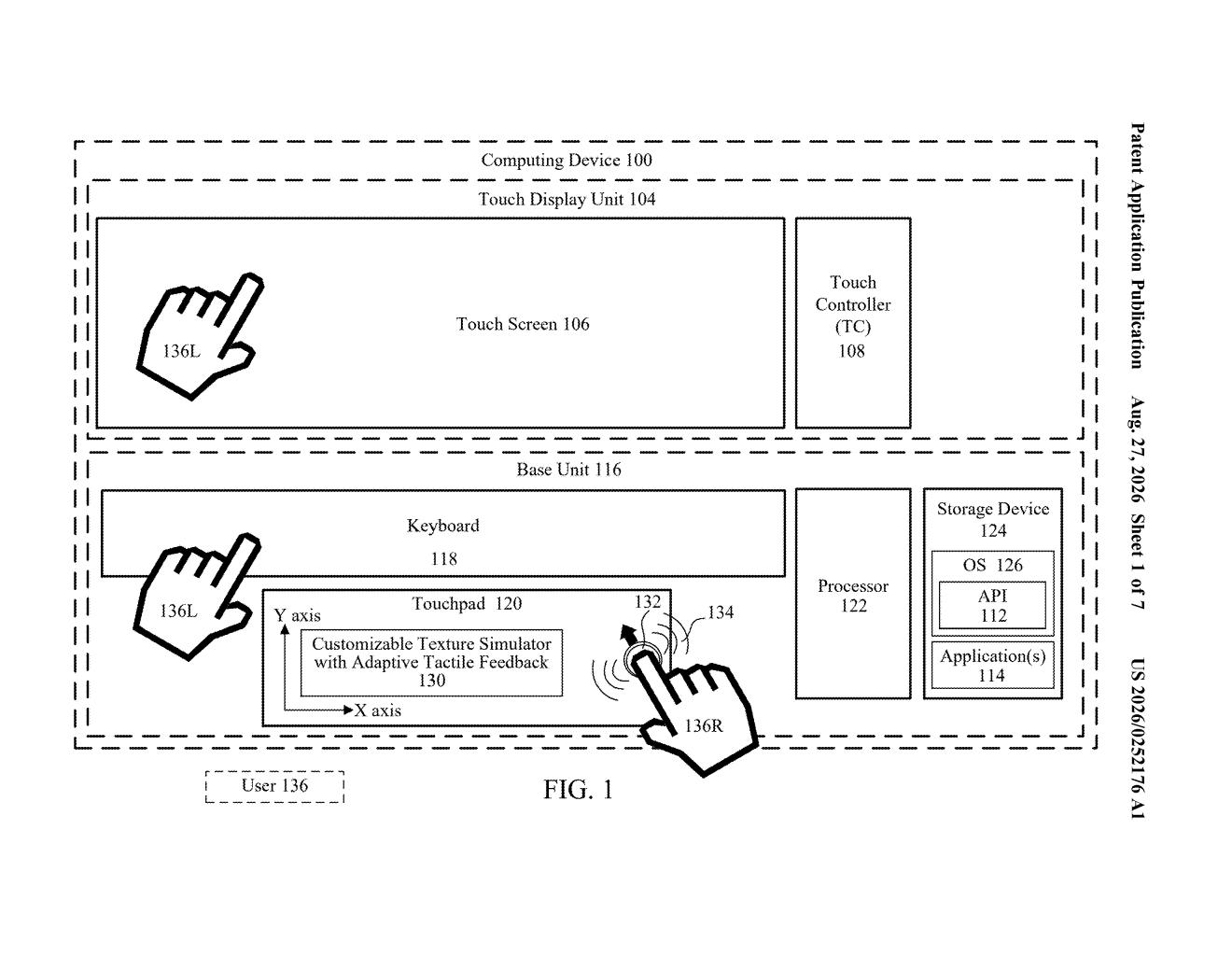
What Microsoft's texture-simulating touchpad actually does
Imagine running your finger across your laptop touchpad and actually feeling the rough grain of a stone texture, or the smooth glide of polished metal, depending on what's on screen. That's the experience Microsoft is trying to build with this patent.
Right now, most laptop touchpads give you one kind of vibration feedback, maybe a faint buzz to confirm a click. This system would instead read how fast you're moving your finger, how hard you're pressing, and which direction you're swiping, then pick the right vibration pattern to match a simulated surface texture. The result is supposed to feel consistent no matter where on the pad you touch.
Think of it like a tiny speaker under your fingertip, playing the right 'sound' for each texture, except instead of sound, you feel it. Designers, gamers, or anyone who works with visual content could get physical feedback that matches what they're looking at on screen.
a waveform selector configured to select a waveform for the touchpad haptic feedback based at least on a simulated surface type; …
Translation: The system picks a specific vibration pattern to match whatever virtual material is being displayed.
How the system matches vibration to your finger's speed and pressure
The patent describes a touchpad equipped with haptic actuators (small motors or vibration elements) that can run along one or more axes of the pad. The system layers several inputs together to decide what kind of vibration to produce at any given moment.
A waveform selector chooses the shape of the vibration based on the simulated texture type, rough surfaces might get a jagged, high-frequency wave; smooth surfaces get a softer one. Then an amplitude selector adjusts how strong that vibration is, taking into account:
- How fast your finger is moving (velocity)
- How hard you're pressing (force)
- Which direction you're swiping
The direction adjustment is particularly notable. Because a touchpad's actuators are physically fixed, the same swipe can feel different depending on the angle, a finger moving diagonally might hit the actuator's axis at an awkward angle and produce a weaker or uneven sensation. The system compensates for that by adjusting the amplitude weight based on direction, so the texture feels the same whether you swipe left, right, or diagonally.
A touch sensor feeds a continuous stream of position and force data into an attribute determiner, which calculates velocity and direction from that series of readings. All of this happens fast enough to feel real-time to the user.
… provide consistent tactile sensations regardless of the location and direction that a user touches and moves a finger on the touchpad.
Translation: The trackpad adjusts its feedback so it feels the same no matter where or how you swipe.
What this means for laptop haptics and creative software
For most laptop users, touchpad haptics are mostly an afterthought, a click confirmation and maybe a bit of scroll feedback. This patent points toward touchpads that could carry meaningful information through touch alone, letting a video editor feel the difference between scrubbing over a cut versus a transition, or letting a 3D artist feel the surface of a model they're rotating.
The challenge is that making vibration feel like a real texture at scale, across millions of different fingers, pressures, and use patterns, is genuinely hard. Microsoft's haptic touchpad filings sit alongside a broader wave of plain-English patent summaries covering how PC makers are rethinking physical input as software does more of the sensory work. Whether this reaches shipping hardware depends on how well the calibration holds up in real conditions, and how much it adds to the cost of a device.
This is the sixth Microsoft filing we've tracked in input and haptics since May, building on ideas like splitting a trackpad into zones and a two-position locking hinge.
Making a touchpad mimic the feel of sandpaper or velvet requires the system to track finger speed, pressure, and direction all at once, and adjust its vibrations continuously. If any one of those readings slips, the illusion collapses, and a wrong texture sensation is more jarring than no texture at all. The multi-axis vibration hardware and the software managing it cost more to build and drain more battery than a standard touchpad.
That trade is defensible in an expensive device for designers, but hard to justify in a laptop where buyers are already watching the price. The one piece that reads as durable engineering regardless of price tier is the angle-compensation logic, which adjusts vibration strength based on which direction your finger swipes to cover for the physical limits of fixed motors.
That specific problem has a clear answer here, and it is likely to ship even if the full texture-simulation suite stays a premium feature.
Get our take in your Top Stories
Liked this breakdown? Add Patentlyze as a preferred source on Google, and our plain-English take shows up more often in your Top Stories the next time Microsoft patent news breaks.
There are more where this came from
We read every patent application Big Tech publishes and send you the ones worth knowing. Plain English, free, every week.
The drawings
7 drawing sheets from US 2026/0252176 A1 · click any drawing to enlarge


Want this weekly breakdown for a company we don't cover? Patentlyze Pro →
Be the first to weigh in