
Samsung Patents a Tighter Way to Store the Math Behind AI Models
Most of the numbers inside an AI model are zero, which means chips are wasting time and memory hauling around a lot of nothing. Samsung's new patent describes a method to skip those zeros more efficiently, store only what matters, and navigate the rest with a compact set of directions.
What Samsung's matrix compression actually does for your devices
Ever tried to find one email in a ten-year archive? Now picture a spreadsheet with a million cells where 90% of them are blank. If you copied every blank cell faithfully, you'd be moving a huge file just to get at a handful of numbers.
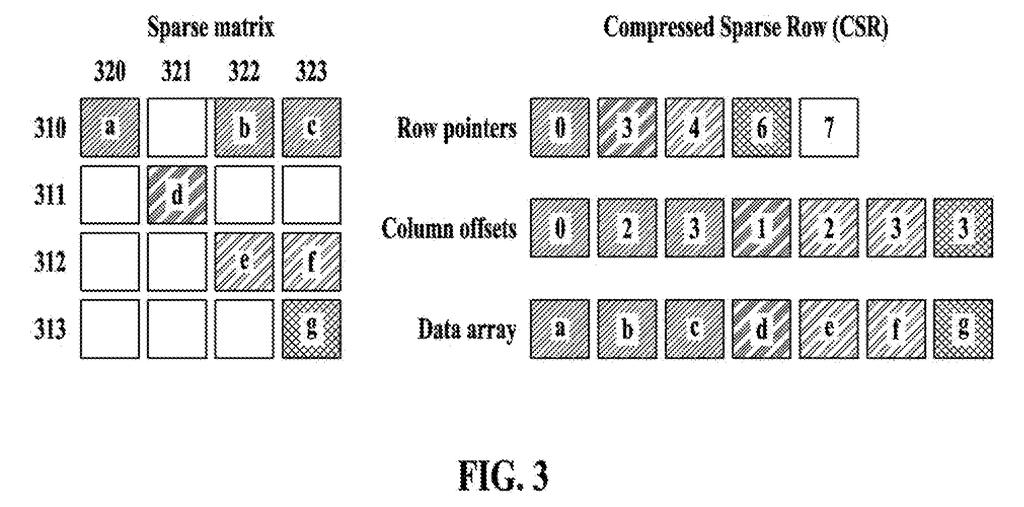
AI models work with exactly this kind of data, called a matrix, and most of it is zeros. Samsung's patent describes a system that strips those zeros out entirely, stores only the real values, and then keeps a compact set of notes (a "pointer" and an "offset") so the chip can reconstruct where each number originally sat.
The practical effect: less memory used, less time spent fetching data the processor doesn't need. For you, that could translate into AI features that run faster on a phone or a chip that sips less power doing the same work.
… identifying a plurality of non-zero data elements in the input matrix and generating a data array in which the plurality of non-zero data elements are arranged sequentially; …
Translation: It skips empty data slots to line up only the active numbers in a clean row.
How the pointer-and-offset system skips empty matrix cells
The patent describes a sparse matrix compression method, which is a way of storing mathematical grids (matrices) that are mostly empty.
The process has four main steps:
- Extract non-zero elements: the system scans the input matrix and pulls out only the cells that contain actual values, packing them into a flat list called a data array.
- Generate pointers: for each row or column, a pointer is created that records either where in the flat list that row's values start, or how many non-zero values that row contains. This lets the processor jump straight to the right section without reading everything before it.
- Generate offsets: an offset records the relative gap between non-zero values along a row or column direction. Think of it as a breadcrumb that says "skip three cells, then stop" rather than spelling out every empty cell in between.
- Store the compressed matrix: the data array, pointers, and offsets together form a compressed representation that goes into memory.
The offset scheme is the key differentiator here. Instead of storing an absolute position (which can require large index numbers), it stores a relative jump, which can be encoded in fewer bits and is cheaper to decode during computation.
… generating an offset indicating a relative interval between the plurality of non-zero data elements; and designating, to the offset, a relative index in a row or column direction, …
Translation: It maps the exact distance between active data points to navigate the grid efficiently.
What this means for AI performance in Samsung chips
Modern AI models, whether they run in a data center or on a phone's dedicated chip, spend a significant fraction of their time and power just moving numbers around. If the matrix holding those numbers is stored more compactly, the chip reads less data per operation, which means faster inference and lower power draw.
For Samsung, which makes both the Exynos chips inside its Galaxy phones and memory chips sold to other manufacturers, a patented compression format could be built into hardware accelerators. If the compression and decompression logic is baked into the chip itself, the benefit arrives automatically, without any extra work from app developers or users. You'd just notice the phone staying cooler or the AI assistant responding a bit quicker.
Samsung's 54th filing we've tracked since June in our AI chip wars watch adds to a run that includes splitting AI work across two chips and fixing memory signal reception.
The concrete win for someone using a Galaxy phone is modest but real: an AI feature that responds a little faster, drains the battery a little less, and generates a little less heat in your hand. None of that shows up in a spec sheet.
What this patent actually describes is a smarter way to skip over the blank spaces in the math that powers on-device AI, so the chip does less pointless work. Less pointless work means the processor finishes sooner and sits idle longer, which is where the battery savings come from.
Most people will never notice this directly, and that is probably the point. The features that feel effortless usually have invisible plumbing underneath making them possible.
There are more where this came from
We read every patent application Big Tech publishes and send you the ones worth knowing. Plain English, free, every week.
The drawings
9 drawing sheets from US 2026/0277784 A1 · click any drawing to enlarge


Want this weekly breakdown for a company we don't cover? Patentlyze Pro →