
Sony Patents Touchscreen Game Controls That Change Behavior Mid-Play
Sony has filed a patent for touchscreen controls that don't stay fixed, where the same button on your screen can do entirely different things depending on what just happened in the game.
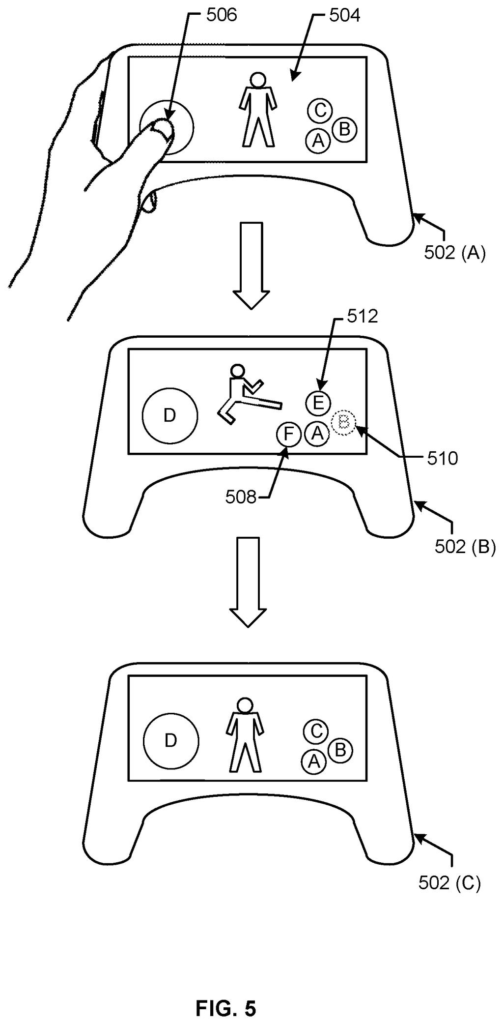
How Sony's context-shifting touch buttons would work
You're playing an action game on your phone, tapping the same on-screen button over and over, but the button always does the same thing no matter what's happening around you. That rigidity is one of the biggest complaints about touchscreen gaming compared to a physical controller.
Sony's patent describes a system where tapping one spot on the screen can temporarily change what other buttons do. Tap a button to mark an enemy, and for a brief window after you lift your finger, a second button nearby stops doing its usual thing and instead triggers a special attack on that target. Once the timer runs out, everything snaps back to normal.
The key ingredient is a persistence timer, a short countdown that keeps a "state" (basically a context or mode) alive even after you've let go. This lets the controls respond to what's happening in the game rather than always behaving the same way, which is something physical PlayStation controllers already do through pressure sensitivity and button combinations.
… initiating a persistence timer upon detecting a release of the first touch input, wherein the status assigned to the on-screen object remains active for a non-zero period of time defined by the persistence timer; …
Translation: A timer starts when you lift your finger, keeping your previous action active briefly.
How the persistence timer rewires on-screen buttons
The patent describes a method for making on-screen touchscreen controls context-aware, meaning they can shift behavior based on what the player just did.
Here's the basic sequence:
- A player taps a first button at a specific location on the screen, which assigns a status (a tagged property, like "targeted" or "charged") to an on-screen game object such as an enemy or a character ability.
- When the player lifts their finger, a persistence timer starts. This timer keeps that status alive for a defined window of time, even though the finger is no longer touching the screen.
- While the timer runs, a second on-screen button shifts from its default behavior to a modified one, because the system now knows a status is active.
- If the player taps that second button before the timer expires, the game triggers a special action tied to the status rather than the button's normal function.
The underlying idea is that the system tracks a "state" (think of it as a temporary mode) and uses that state to decide what each button means at any given moment. This is similar to how holding a shoulder button on a physical controller can turn face buttons into different commands, except here it's driven entirely by software and timing rather than physical pressure.
… generating, based on the second state, second activation data that includes an indication of a second action different from the first action.
Translation: The same touch control triggers a totally different action later.
What this means for mobile PlayStation gaming
Physical game controllers have had multi-function buttons for decades, where the same button does different things depending on context. Touchscreens have always struggled to match that because every on-screen button is fixed to a single function. This patent is Sony's attempt to close that gap through software alone, no new hardware required.
If this ends up in a PlayStation mobile app or a cloud-gaming interface, it could make touch-only gaming feel meaningfully closer to a real controller for you as a player. Sony's track record in touchscreen controller patents suggests the company is treating this as a genuine long-term problem worth solving, not a throwaway experiment. The practical ceiling, though, depends on how well game developers actually wire their titles into this kind of context system.
Sony's 522nd filing in our Sony coverage since May follows work like an AI gaming co-pilot and visual layer editing, showing how broadly we've tracked the company's patent applications.
The shortest route to shipping this is actually quite short. Nothing here requires new hardware: it's a software layer that sits on top of any touchscreen. Sony could theoretically deploy it inside the PlayStation app or its cloud-gaming client without touching a single physical device.
The harder part is adoption on the game side. For context-shifting buttons to work well, each game has to define meaningful states and map them to button behaviors. That's developer work, and it only pays off if the system is widely supported. A clever patent doesn't automatically produce a well-integrated ecosystem.
Still, the core mechanism described here is tight and specific enough to suggest this came from real usability testing, not a speculative filing. The persistence timer in particular is a practical design choice: it solves the problem of players needing to hold two things at once by giving them a brief window to act sequentially instead.
There are more where this came from
We read every patent application Big Tech publishes and send you the ones worth knowing. Plain English, free, every week.
The drawings
7 drawing sheets from US 2026/0273391 A1 · click any drawing to enlarge


Want this weekly breakdown for a company we don't cover? Patentlyze Pro →