
Qualcomm Patents a Phone That Changes How It Finds You When Signals Bounce
Your phone's GPS is at its worst exactly when you need it most, deep inside a mall, surrounded by skyscrapers, or underground. Qualcomm has filed a patent for a system where the network itself warns your phone about those bad conditions and tells it to switch to a more reliable location method on the fly.
What Qualcomm's location-switching system actually does
Ever tried to get directions in a downtown canyon of glass towers and watched your blue dot spin? That's because radio signals bounce off buildings before reaching your phone, making it think you're somewhere you're not.
Qualcomm's patent describes a system where the mobile network sends your phone a heads-up message: "Hey, signals in this area are bouncing badly." Your phone reads that warning and automatically switches to a location method that handles those conditions better, then reports back where you actually are.
The key idea is that the network, not you, kicks off that switch. You don't tap a setting or open an app. The handoff happens in the background, and the location your phone sends back is supposed to be more accurate than if it had stuck with its default approach.
receive, via the one or more transceivers, from a network entity, a request for location information, wherein the request comprises an environment information element indicating heavy multipath and non-line-of-sight (NLOS) conditions in an area of the UE …
Translation: The phone gets a location request that warns about messy signal bounces and blocked lines of sight in the area.
How the network tells your phone to change location modes
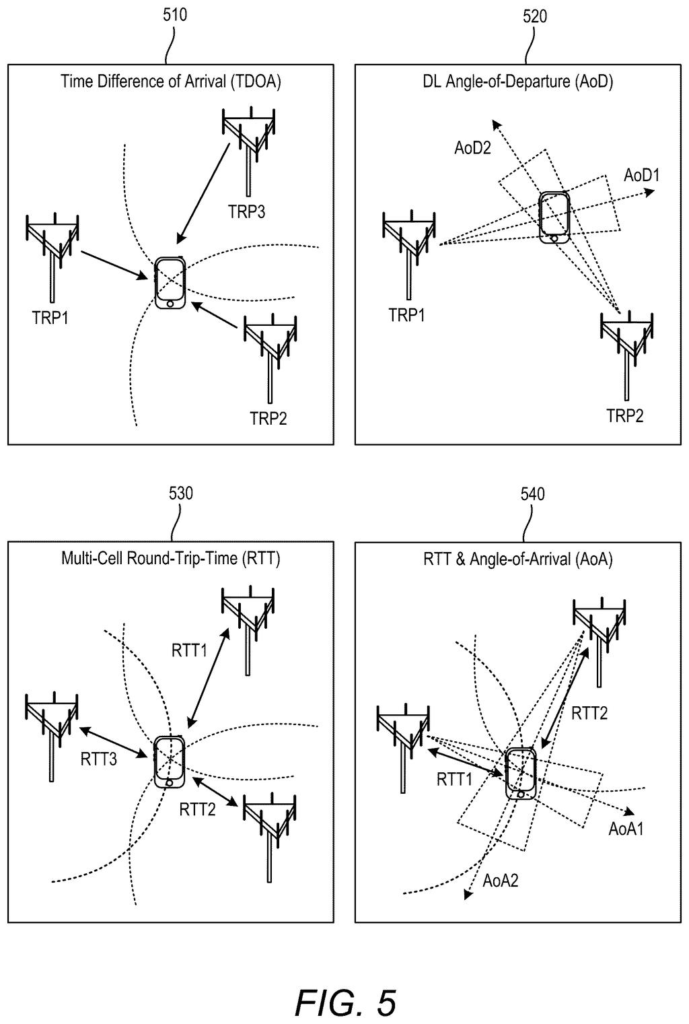
The patent centers on a specific problem in wireless positioning: multipath and non-line-of-sight (NLOS) conditions. Multipath means a radio signal bounces off walls, floors, or buildings before reaching your phone, so the phone calculates the wrong distance to the tower. NLOS means there's no clear path between the phone and the signal source at all. Both conditions make location estimates unreliable.
The solution described has three steps:
- A network entity (a cell tower or a location server) sends the phone a location request that includes an "environment information element," a small data flag that describes the surrounding conditions as having heavy multipath and NLOS.
- The phone reads that flag and switches its operational mode, meaning it changes which positioning technique it relies on. The patent doesn't lock in a specific technique; it covers any switch driven by that environmental signal.
- The phone obtains a new location estimate under the switched mode and sends that back to the network.
The architecture puts the decision-making intelligence partly on the network side. The network has a broader view of which areas are problematic (say, a known tunnel or a dense urban block) and can proactively flag that in the request rather than waiting for the phone to figure it out through repeated failed attempts.
… switching, based on receiving the indication of the heavy multipath and NLOS conditions, an operational mode of the UE, obtaining location information based on the switching, and sending, to the network entity, the location information …
Translation: The device changes how it tracks position to handle the signal interference and then sends the results back.
What this means for GPS accuracy in cities and buildings
For everyday users, this matters most in the places where GPS already fails: parking garages, subway stations, dense city blocks, large indoor venues. If this approach works as described, your phone could deliver a better location fix in those spots without you doing anything. Emergency services and navigation apps stand to benefit the most, since a wrong location in a crisis or on an unfamiliar road is far worse than a slow one.
For the industry, the patent stakes out a particular design philosophy: the network warns, the device adapts. That's a different model from putting all the intelligence in the phone itself, and it could shape how future 5G and 6G positioning standards handle difficult environments. Qualcomm keeps filing on wireless positioning as location accuracy becomes a core feature of next-generation cellular specs.
Qualcomm's 429th filing in our Qualcomm coverage since May adds to a body of work that includes a light-based fingerprint sensor and an autopilot safety cutoff.
Claim 1 covers any phone that receives a network message flagging bad signal conditions and then changes how it figures out its location in response. The claim sets no requirement for what the new location method must be, only that the switch happens after receiving that environmental warning.
That breadth matters because the claim effectively covers the decision itself, not a particular solution. Any phone designed to take location-finding guidance from the network and act on it, which describes how virtually every modern device handles positioning, could fall inside this claim.
If granted, this patent could give Qualcomm leverage over phone and chip makers whose devices follow network cues when choosing how to locate themselves, regardless of the specific technique those devices use afterward.
There are more where this came from
We read every patent application Big Tech publishes and send you the ones worth knowing. Plain English, free, every week.
The drawings
14 drawing sheets from US 2026/0292760 A1 · click any drawing to enlarge


Want this weekly breakdown for a company we don't cover? Patentlyze Pro →
Be the first to weigh in