
Google Patents a Network Method for Keeping XR Video Quality Consistent on 5G
Streaming video to a VR or AR headset over a mobile network is brutal on timing: one late packet and the frame breaks. Google has filed a patent describing how the network's brain can decide, on the fly, whether to apply special quality rules to those data streams.
What Google's XR data-quality network trick actually does
Every time your phone or a wireless headset starts a video call or streams a VR scene over a mobile network, the network has to decide how carefully to handle your data. Not all data is equal: a text message can arrive a split second late without anyone noticing, but video frames for a VR headset absolutely cannot.
Google's patent describes a way for the core network (the behind-the-scenes control system that runs a mobile carrier's traffic) to look at what device you're using and what the local cell tower supports before deciding whether to attach special quality-of-service rules to your session. Those rules tell the network to keep packets tightly grouped and on time, which matters a lot for extended reality (XR) devices like AR glasses or VR headsets.
The idea is that the network shouldn't blindly apply these stricter rules to every session. Instead, it checks conditions first and only switches them on when they're actually needed and supported. That could help carriers handle XR traffic without wasting network resources on sessions that don't need the extra attention.
How the core network decides when to flag a PDU session
The patent covers a procedure inside a mobile network's core network (CN), the centralized software layer that manages how data flows between devices and the internet, sitting above the individual cell towers.
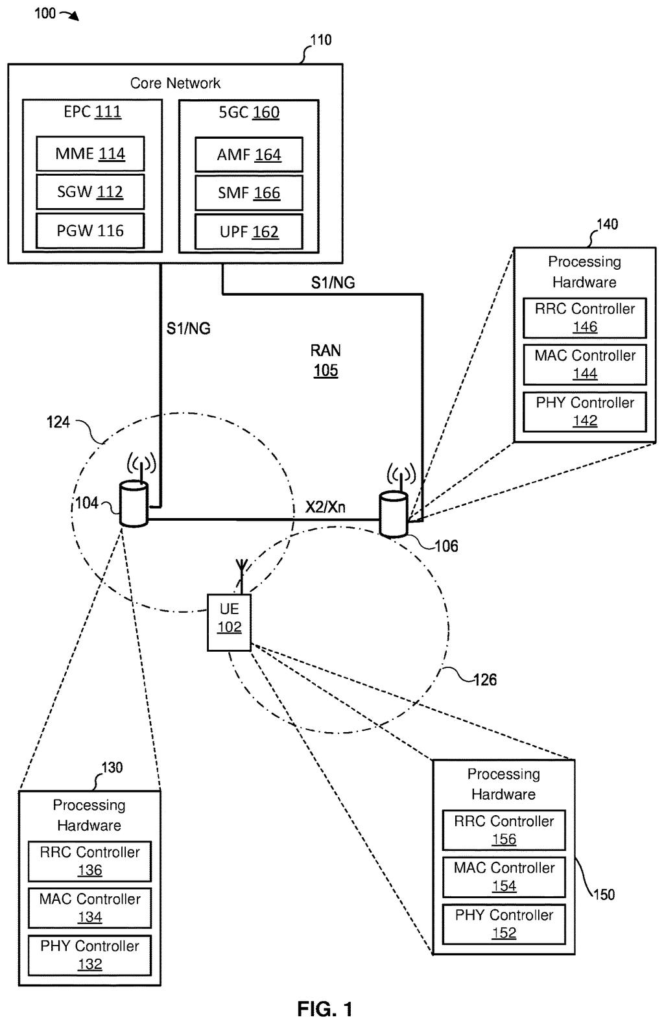
When a device opens a PDU session (a packet data unit session, basically a dedicated pipe for sending data over 5G), the core network must request resources from the base station (the cell tower the device is connected to). This patent describes a decision step inserted into that request process:
- The core network checks a condition related to the user equipment (the device) and/or the base station, such as whether the device or tower actually supports PDU Set handling.
- Based on that check, it decides whether to include a PDU Set QoS parameter in its resource request. QoS (quality of service) parameters are instructions that tell the network how to prioritize and group packets.
- The base station then responds to that request, either confirming or declining the resource allocation.
The specific QoS parameters in question are designed for XR services (extended reality, covering VR, AR, and mixed-reality applications), where groups of related video frames need to arrive together and on time. The patent's contribution is the conditional logic: don't include those parameters unless the situation warrants it.
What this means for wireless XR headset performance
XR headsets are one of the more demanding things you can ask a mobile network to handle. They need low latency, consistent timing, and tightly grouped data packets. Right now, applying the right quality settings to those sessions is not always automatic, and a mismatch between what the network sends and what the hardware can handle wastes resources.
If this approach were built into carrier infrastructure, it could mean fewer dropped or garbled frames on wireless XR devices, without forcing every session through expensive high-priority handling. For everyday users, that translates to a more stable experience when using AR or VR applications over 5G, which is increasingly the target platform for untethered headsets.
Google's 741st filing in our Google coverage since May adds to a pattern that includes nearby device linking and fingertip blood pressure sensing.
Claim 1 is deliberately broad. It covers any core network method that (1) decides whether to include a PDU Set QoS parameter based on some condition related to the device or base station, and (2) sends that request to a base station. That framing could cover a wide range of implementations, because the claim does not specify what the condition must be or how the decision is made.
In practice, that breadth is a double-edged thing. A broad claim is harder to design around, but it also faces more scrutiny from patent examiners looking at prior art in 3GPP standards bodies, where a lot of this QoS and XR work happens in public. Much of what this patent describes overlaps with ongoing 5G standardization work, and that public record tends to narrow what's actually patentable.
For readers outside the telecom industry, the honest verdict is that this is a fairly technical, infrastructure-level filing. It would not produce a user-facing feature you'd notice on a spec sheet. Its value, if it holds up, is in the carrier and equipment-maker licensing layer, not in any product Google sells directly to consumers.
There are more where this came from
We read every patent application Big Tech publishes and send you the ones worth knowing. Plain English, free, every week.
The drawings
13 drawing sheets from US 2026/0292601 A1 · click any drawing to enlarge


Want this weekly breakdown for a company we don't cover? Patentlyze Pro →
Be the first to weigh in