
Apple Patents a Faster Way for iPhones to Switch Between Satellites
Every time your phone hands off from one cell tower to another, it runs a little timing dance to sync up. Over satellites, that dance is painfully slow. Apple's new patent describes a way to skip it entirely.
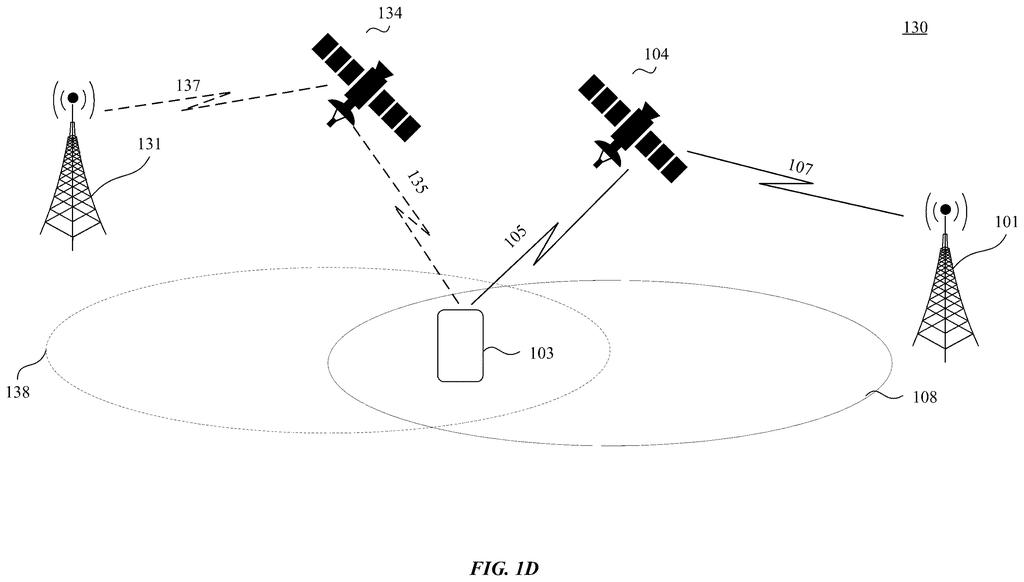
What Apple's satellite handover shortcut actually does
When your phone moves from one cell tower's coverage to another's, it has to go through a quick back-and-forth process called a random access handshake. That process figures out the precise timing needed for your phone's signal to reach the new tower cleanly. On the ground, it takes milliseconds. Over a satellite orbiting hundreds of miles up, the signal delay is so large that the same process can take much longer and disrupt your connection.
Apple's patent describes a method where the handover command itself, sent from your current base station, already includes the timing information the phone needs. So instead of asking the new satellite for that timing, your phone calculates it ahead of time and immediately starts transmitting. The result is a much faster switch with no waiting room in between.
This matters most for non-terrestrial networks, which is the technical label for satellite-based mobile coverage. As iPhone models gain direct satellite connectivity for emergencies and remote areas, keeping those connections stable while satellites move overhead becomes a real engineering problem.
receive, using the transceiver and from the source base station, a handover command to perform a Random Access Channel (RACH)-less handover operation to a target base station, wherein the handover command comprises a timing advance (TA) configuration …
Translation: The phone gets instructions from its current connection to switch directly to a new tower without the usual greeting process.
How the iPhone skips the timing handshake mid-switch
The patent covers a specific handover method for situations where a phone is connected through a non-terrestrial network, meaning a satellite base station rather than a ground tower.
In a standard handover, the phone first sends a Random Access Channel (RACH) message to the new base station. That message kicks off a negotiation where the new station tells the phone how much to adjust its transmission timing, a value called the Timing Advance (TA). TA matters because the signal has to arrive at exactly the right moment; too early or too late and the network drops it. Over a low-Earth or medium-Earth orbit satellite, the signal round-trip alone can run to hundreds of milliseconds, making this handshake noticeably slow.
Apple's proposed fix is called a RACH-less handover. Instead of waiting, the phone's current base station embeds a TA configuration inside the handover command it sends before the switch. The phone then calculates the TA value itself from that configuration, potentially using known satellite position or propagation data, and begins transmitting to the new satellite immediately upon receiving the handover command.
The claim covers the full chain:
- Receive a handover command containing a TA configuration
- Compute the TA value from that configuration
- Send the first uplink transmission to the new base station using that pre-computed value
Some aspects of this disclosure relate to apparatuses and methods for implementing mechanisms for Random Access Channel (RACH)-less handover for Non-Terrestrial Networks (NTN).
Translation: This patent describes techniques to make satellite handoffs faster by skipping standard connection steps.
What this means for satellite calls and emergency coverage
For most people today, satellite connectivity on a phone is an emergency feature, used when there is no cell signal at all. But as carriers and device makers push toward broader satellite coverage, the quality of that connection, including how well it holds up as satellites move across the sky, becomes a daily concern rather than a backup scenario. A handover that stalls or drops is far more noticeable over a satellite link than over a ground network.
Apple has been filing around satellite and non-terrestrial network connectivity for several years. Claim 1 of this patent is written broadly: it covers any UE (phone, tablet, or other device) that performs this pre-computed timing approach. If granted, that scope could apply across any chipset or platform implementing the same method, which gives the patent real strategic weight in standards discussions where this approach may be negotiated into 5G and 6G satellite protocols.
Apple's 465th filing in our Apple coverage since May continues a thread on low-power radios, following a patent on waking the main chip selectively and one on sparing the battery during wake.
Claim 1 is written at a level of abstraction that covers the core concept, not just one implementation. It does not restrict to a particular satellite orbit, a particular way of computing the TA value, or a particular radio standard. That breadth is either a strength or a vulnerability depending on what prior art exists in 3GPP standards bodies, where RACH-less handover for NTN has already been an active topic.
If Apple can defend that scope, this is a claim worth holding. The RACH procedure is a documented bottleneck for satellite handovers, and baking the timing calculation into the handover command rather than negotiating it live is a clean architectural answer. Companies competing in satellite-to-phone connectivity would need to route around this method or license it.
The honest caveat is that 3GPP standardization processes often preempt broad device-level patents like this one, because the method ends up defined in a shared spec rather than owned by any one company. Whether Apple filed early enough, and with enough specificity, to matter in that arena is the real question.
There are more where this came from
We read every patent application Big Tech publishes and send you the ones worth knowing. Plain English, free, every week.
The drawings
10 drawing sheets from US 2026/0292620 A1 · click any drawing to enlarge


Want this weekly breakdown for a company we don't cover? Patentlyze Pro →
Be the first to weigh in