
Sony Patents a Two-Fence Safety Zone for Guiding Drones and Robots Around Objects
Instead of giving a drone or robot one boundary to respect, Sony's patent describes wrapping a target object in two separate invisible fences, then using the space between them as a guided movement corridor.
What Sony's paired geofence idea actually does
Every time an autonomous drone circles a building or a robot arm works around a piece of equipment, someone has to define exactly where it can and cannot go. Too loose a boundary and the machine drifts too far; too tight and it risks a collision.
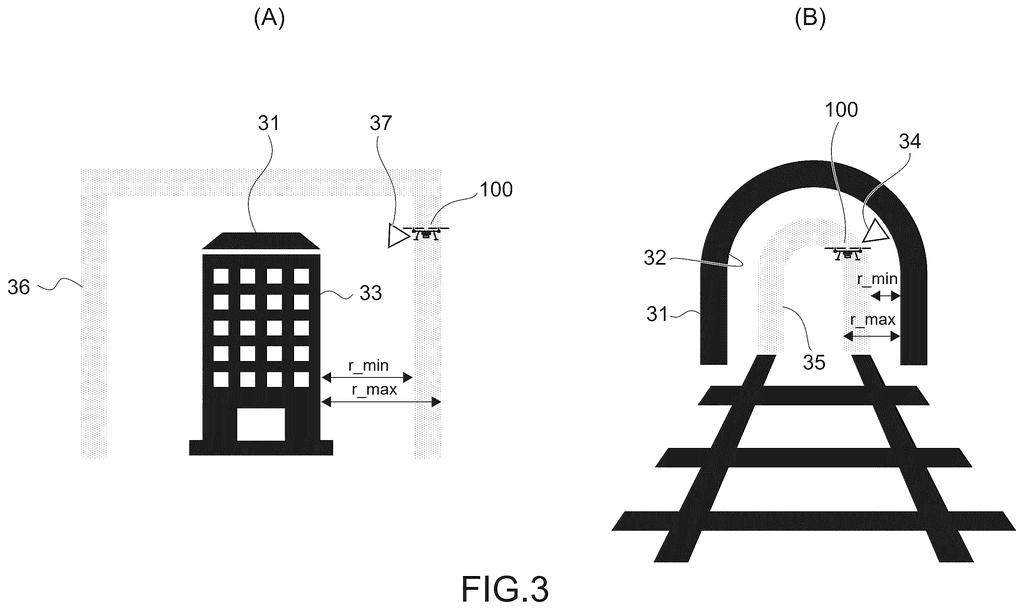
Sony's patent describes a two-fence approach. Rather than drawing a single line in space and saying "stay outside this," the system generates two distinct boundaries around a target object, one closer and one farther away. The zone between those two rings becomes the region where the moving machine is allowed to operate.
Think of it like lane markings on a road, except the road wraps around an object in three dimensions. The machine stays in its lane, the object in the center is protected, and the area beyond the outer fence stays off-limits too. It is a straightforward idea, but defining movement corridors this precisely is genuinely hard to do with a single boundary.
generating a first geofence spaced from a target object; generating a second geofence spaced from the target object and different from the first geofence; and generating, using the first geofence and the second geofence, a movement region in which a mobile object is movable.
Translation: Sony's system draws two separate invisible boundaries around an obstacle to map out where a drone can safely fly.
How two boundary rings define a movement corridor
The patent covers a software method with three steps. First, the system generates a first geofence (a virtual boundary in space) at some defined distance from a target object. Second, it generates a second geofence, also centered on that object but at a different distance or with a different shape. Third, it uses both fences together to define a movement region, which is the navigable space available to a mobile object such as a drone or robot.
The key insight is that a single geofence only tells a machine where it cannot go on one side. A pair of fences creates a bounded corridor: the mobile object must stay outside the inner fence (to avoid hitting the target) and inside the outer fence (to stay within the operational zone). That corridor is the movement region.
The patent does not prescribe a specific shape for the fences. They could be spherical, cylindrical, or irregular, which means the method could adapt to differently shaped target objects. The mobile object is any machine capable of autonomous or semi-autonomous movement, and the target object is whatever the system is set up to work around.
- Generate inner geofence around the target
- Generate outer geofence around the target
- Define the space between them as the allowed movement region
What this means for automated drone or robot operation
For any automated system that needs to orbit, inspect, or work around a physical object, defining movement boundaries in software is cheaper and more flexible than physical barriers. A drone inspecting a wind turbine, a delivery robot navigating around parked cars, or a camera drone circling a subject could all benefit from a corridor defined this way, because it simultaneously prevents collisions with the target and keeps the machine from wandering too far.
The practical value depends entirely on how accurately the system can place those fences in real space, which requires reliable sensing and mapping. If Sony is building toward drone or robotic camera systems, Sony's interest in autonomous imaging and drone operation gives this filing some context, but the patent itself is a general-purpose method that does not lock into any specific hardware.
Sony's 528th filing in our Sony coverage since May adds to a pattern of AR work that includes glasses that hide blocking objects and room-scanning to shape your view.
The core idea here is software: wrap a target object in two virtual boundary rings and use the space between them as a travel lane for a drone or robot. Nothing in the patent requires new chips, sensors, or physical hardware, which means the logic itself could theoretically ship as an update to platforms that already exist.
What has to exist first is everything the patent does not cover: a reliable way to detect the target object, know its location, and place those boundaries accurately in the real world. That surrounding infrastructure is a separate, harder problem.
So the shortest path to a product runs through someone who already has object detection and positioning figured out, and simply needs a clean method for generating movement corridors on top. For them, this is ready-to-build plumbing. For everyone else, it is one piece of a much longer assembly.
There are more where this came from
We read every patent application Big Tech publishes and send you the ones worth knowing. Plain English, free, every week.
The drawings
10 drawing sheets from US 2026/0289805 A1 · click any drawing to enlarge


Want this weekly breakdown for a company we don't cover? Patentlyze Pro →
Be the first to weigh in