
Samsung Patents a Refrigerator Door That Knows When You're Holding It Open
Auto-closing refrigerator doors are useful right up until the moment they slam shut while your hands are full. Samsung's new patent describes a fridge smart enough to tell the difference between a door you forgot and a door you're holding.
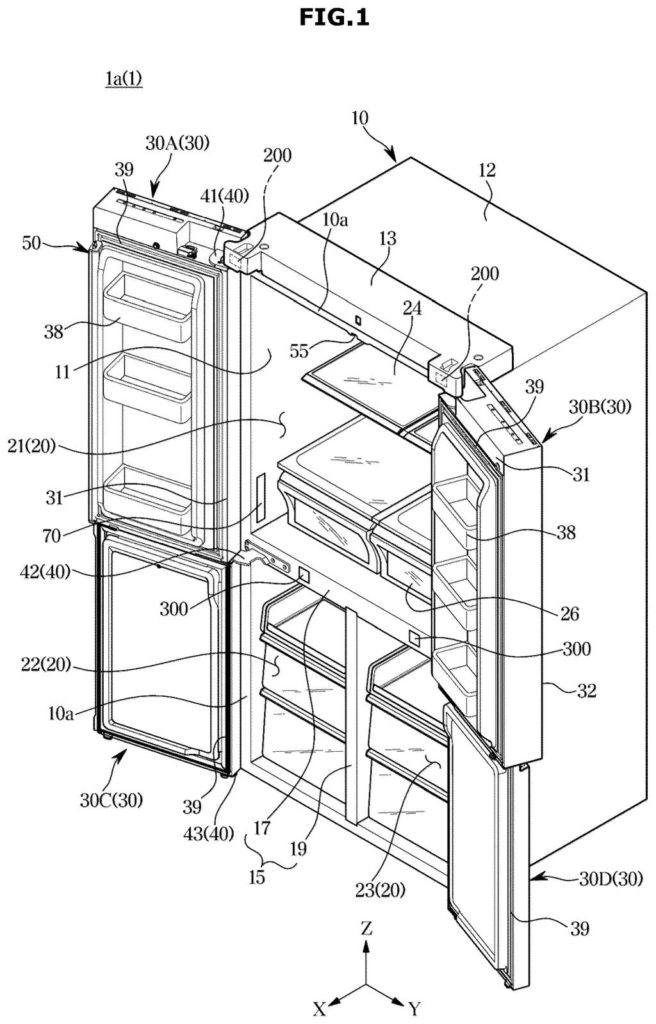
What Samsung's door-mode switching actually does for you
Imagine you're transferring leftovers from a pot to storage containers, and your refrigerator door keeps swinging shut every time you turn away for five seconds. The fridge's automatic timer sees an open door and does its job. You, however, are not done.
Samsung's patent describes a refrigerator with two modes: an automatic mode that closes the door after a set condition is met (a timer, a sensor trigger), and a manual mode that leaves the door wherever you put it. The key part is how it switches between them. If the fridge's sensor detects that you've pushed or held the door open to a specific angle, the system interprets that as intentional and flips itself into manual mode, pausing the auto-close.
In plain terms: the fridge stops treating every open door as a mistake waiting to be corrected. When you mean to leave it open, a simple physical cue tells it so.
control the door driving device to close the door based on a condition to close the door being satisfied in an automatic mode, maintain the opening of the door at the angle relative to the main body based on the condition to close the door being satisfied in a manual mode …
Translation: It switches between automatically shutting itself and staying propped open depending on how you use it.
How the sensor detects your hold and flips the control mode
The patent describes a refrigerator with a motorized door (the door driving device) and a sensor that tracks what angle the door is open at, not just whether it's open or closed.
In automatic mode, the controller watches for a closing condition, which could be a timer, a proximity sensor detecting no one nearby, or some other trigger. When that condition is met, the motor pulls the door shut.
Here's the switch: if the door sensor detects that the door has been moved to and held at a particular angle, the controller reads that as a deliberate human action. It then shifts from automatic mode to manual mode. In manual mode, even if the closing condition fires, the controller ignores it and leaves the door alone at whatever angle it was set.
The claim is written broadly, so the specific angle or sensor type isn't fixed. The core logic is:
- Door sensor detects angle = user intention detected
- Mode switches from auto to manual
- Auto-close is suspended until further instruction
This is a straightforward state-machine design: the system has two states, and a physical input from the user is what triggers the transition.
What this means for people tired of a fridge that fights back
For anyone who has had a refrigerator door nudge shut while loading groceries or plating a meal, the appeal is obvious. Auto-closing doors are a convenience feature that becomes a nuisance the moment the fridge's idea of "done" doesn't match yours. A system that recognizes intentional positioning and backs off is a direct fix for that friction.
Samsung has been filing around appliance automation since at least the early 2020s, and this patent fits that pattern. The practical question is whether the angle-detection is precise enough to distinguish "I held the door here on purpose" from "I just bumped it open." If the threshold is well-tuned, this is a genuine quality-of-life improvement for a device most households use dozens of times a day.
Samsung's 23rd sensor filing we've tracked since May adds to a series that includes a radar movement method and a GPS accuracy system in our growing sensor patent coverage.
Auto-closing fridge doors solve a real problem but create a new one: the door decides when you're done, not you. This fix lets you override that by simply holding the door at a certain angle, which keeps it open as long as you need without pressing anything or saying anything.
The moment you'd actually notice this is when your hands are full, you're mid-recipe, or you're half-asleep and the door keeps swinging shut on you. Those are exactly the moments when fumbling for a button is too much to ask.
Whether it works in practice comes down to how precisely Samsung sets that angle trigger. Too hair-trigger and it overrides itself constantly; too sluggish and you'll never hit the right spot naturally. The idea is sound, but the tuning determines whether this becomes a feature people rely on or one they forget exists.
There are more where this came from
We read every patent application Big Tech publishes and send you the ones worth knowing. Plain English, free, every week.
The drawings
16 drawing sheets from US 2026/0287246 A1 · click any drawing to enlarge


Want this weekly breakdown for a company we don't cover? Patentlyze Pro →
Be the first to weigh in