
Samsung Patents an AI System That Makes Phone GPS More Accurate
GPS on your phone is often wrong by several meters, especially in cities. Samsung is training an AI to figure out which satellite signals to trust, and which to ignore.
What Samsung's ML-weighted GPS actually does for you
Every time your phone plots your position on a map, it listens to signals from a handful of satellites overhead and tries to triangulate where you are. That sounds simple, but city buildings, weather, and even your phone's own hardware introduce errors that can put your blue dot half a block away from where you actually are.
Samsung's new patent describes a machine learning model baked into the GPS chip itself. Instead of treating all satellite signals equally, the model learns which signals are reliable right now and assigns each one a score called a solver weight. The GPS calculation then leans harder on the trustworthy signals and discounts the noisy ones.
The result, on paper, is a position fix that is closer to where you actually are, without needing a faster chip or a clearer sky. It is all about being smarter with the signals you already have.
… minimizing, by training a machine learning (ML) model, a prediction error of the at least one of the pseudorange or the pseudorange rate; determining, with the ML model, solver weights for a GNSS solver in the GNSS receiver based on the minimization of the prediction error …
Translation: An AI model trains to reduce errors and calculates weights to help the receiver figure out where it is.
How the ML model learns to trust or distrust each satellite signal
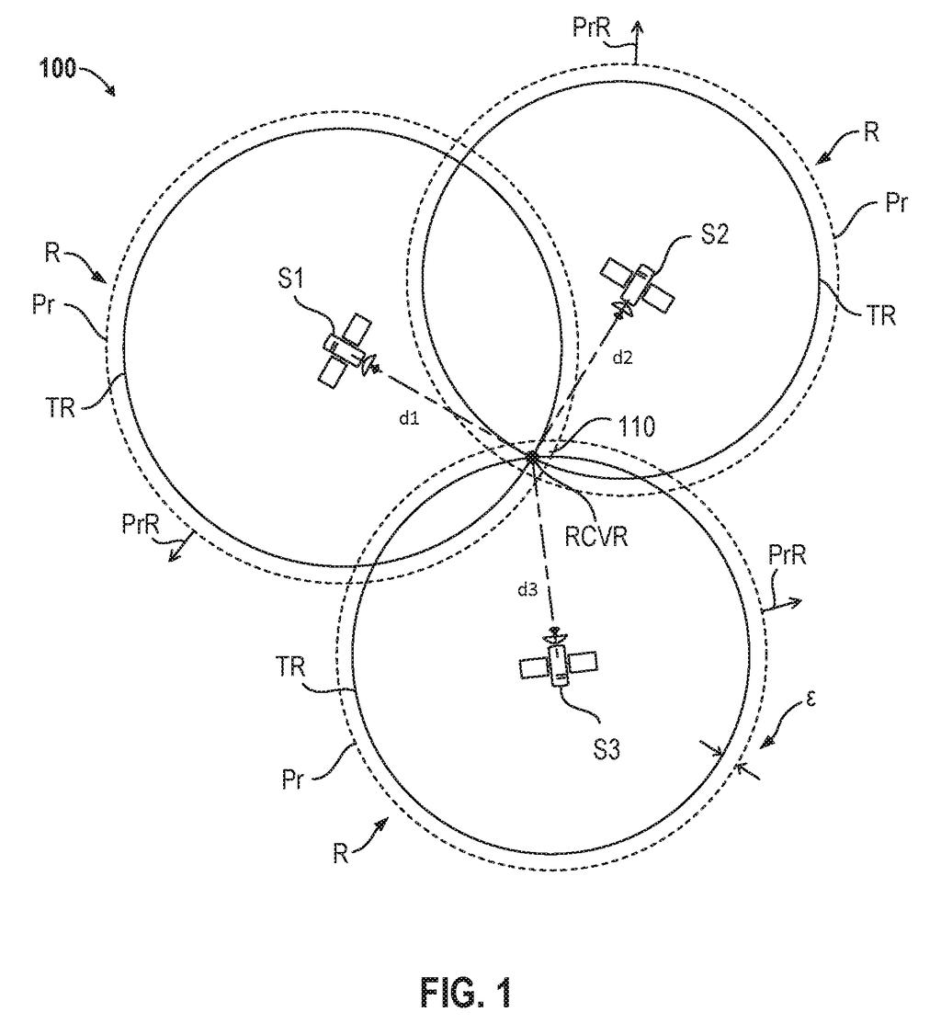
A GPS receiver works by measuring how long signals take to arrive from multiple satellites. The raw distance estimate from each satellite is called a pseudorange (pseudo because it contains clock errors and other noise, not a perfectly clean measurement). The rate at which that distance is changing is called a pseudorange rate, which helps estimate how fast you are moving.
The Samsung system adds a machine learning model to the receiver. During training, the model compares what it predicted the measurement error would be against what the error actually turned out to be. That gap, the difference between the predicted error and the true error, is what the model is trying to shrink.
Once trained, the model outputs solver weights: a score for each satellite signal that tells the GPS solver how much to trust that signal when computing your position or velocity. Signals the model has learned to be noisy get a lower weight; clean signals get a higher one.
- The model processes pseudorange and pseudorange rate data on-device, inside the GNSS receiver itself.
- It minimizes prediction error through standard ML training, then freezes its weights for live use.
- The GNSS solver ingests those weights and produces a position or velocity estimate biased toward the most reliable signals.
… providing, with the processor, the solver weights to the GNSS solver to predict at least one of a position or a velocity of the GNSS receiver …
Translation: The system uses those calculated weights to more accurately track your location and movement.
What better GPS weights mean for everyday navigation
For most people, a few meters of GPS error is annoying but tolerable. Turn-by-turn navigation sometimes puts you on the wrong side of a divided road, or your delivery app thinks you are one building over. These are the everyday costs of imprecise satellite weighting.
Samsung's steady investment in on-device AI for sensors suggests the company sees the receiver chip, not just the software layer, as a place to compete. If this approach ships in future Galaxy hardware, the improvement would be invisible to you but felt every time navigation places you where you actually are, not where the satellites approximately think you are.
That makes this Samsung's 226th filing in our cell phone patent coverage since May, a series that includes ideas like vibration tied to fold angle and split windows on a cover screen.
The ML model here runs on the processor already inside a GPS receiver, so Samsung would not need new chips to ship this. Training happens in advance, and the live step is lightweight enough to run continuously without draining a phone battery.
The open question is whether a model trained in one environment, say a clear suburban road, assigns the right weights when a driver enters a dense city block or a parking garage. The patent does not describe how that gap would be handled, and that is where lab results and real-world results could diverge.
Even so, the target is measurable, the hardware cost is low, and the problem affects every GPS-equipped device Samsung already sells. That combination makes this one of the more practical AI-in-navigation ideas, with a shorter road to a real product than most filings of this type.
There are more where this came from
We read every patent application Big Tech publishes and send you the ones worth knowing. Plain English, free, every week.
The drawings
8 drawing sheets from US 2026/0267009 A1 · click any drawing to enlarge


Want this weekly breakdown for a company we don't cover? Patentlyze Pro →