
Samsung Patents an Air Conditioner That Adjusts Based on Where You Move
Samsung is patenting an air conditioner that watches how you move around a room and adjusts the temperature automatically based on where you've settled. No app, no remote, no manual override required.
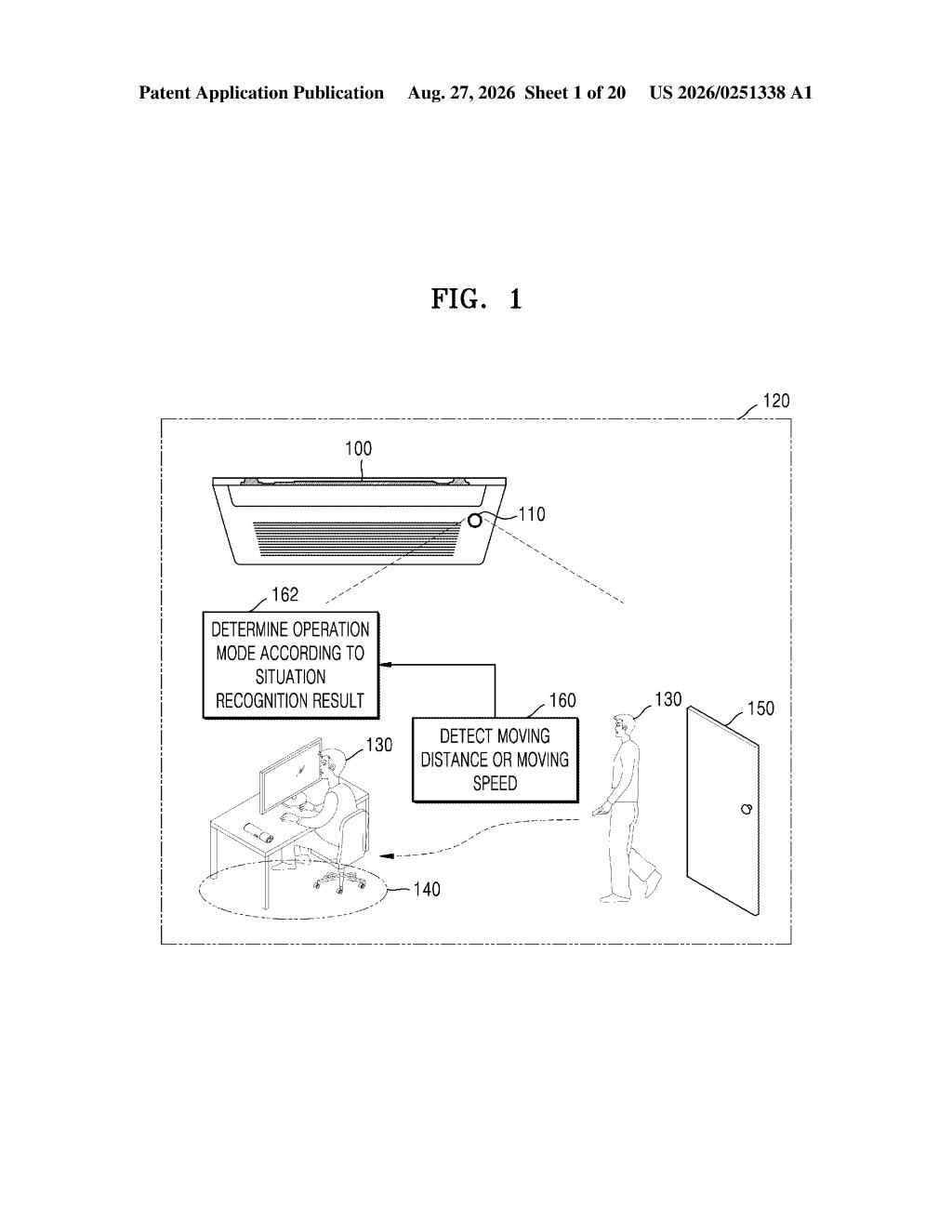
What Samsung's movement-tracking AC actually does
Most air conditioners treat every corner of a room the same way, blasting cold air whether anyone is there or not. Samsung wants to change that by teaching its AC units to pay attention to where people actually are.
The system uses a detection sensor (think of it like an overhead radar that can tell where a person is without a camera) to track your position and movement as you go about your day. If you walk slowly into a room or stop moving for a while, the air conditioner recognizes that you've probably settled in that spot and switches to the cooling mode that fits that area.
So if your living room is a "movie zone" and your desk is a "work zone," the AC could automatically shift from a lighter breeze to a stronger, more direct flow the moment you sit down to work, all without you touching anything.
obtain, based on sensor detection values of the detection sensor, coordinate information and a movement path of a person detected in a target space …
Translation: The system tracks where you are and how you walk around the room using sensors.
How the sensor maps your path and picks a cooling mode
The patent describes an air conditioner paired with a detection sensor that continuously captures a person's position as coordinate data inside a room. The system then builds a movement path from those data points, essentially a trail of where you've been.
Here's where the logic kicks in: the system only acts on that path if your movement clears a threshold. If you cross a room quickly, the AC holds off. But if your movement distance or speed falls below a set level (meaning you've slowed down or stopped), the system interprets that as a sign you're settling in somewhere.
Once it decides you've parked yourself in a designated area for long enough (a configurable time threshold), it switches the air conditioning module into the operating mode assigned to that zone. The heat exchanger in the AC unit then runs according to those zone-specific settings.
- Detection sensor maps your real-time position as coordinates
- Movement path analysis filters out casual walk-throughs
- Dwell time in a named zone triggers a zone-specific cooling mode
- The air conditioning module adjusts automatically with no user input
… based on determining that the detected person has been staying in a first specified area for a first reference time or longer, control the air conditioning module by an operation mode corresponding to the first specified area …
Translation: It changes the cooling settings if you sit in the same spot for a while.
What this means for automatic climate control at home
For everyday users, the appeal is simple: an air conditioner that behaves like it knows what you're doing, without requiring a smart-home setup, voice commands, or constant phone interaction. The system is self-contained, using only a sensor and onboard processing, so it doesn't depend on a cloud connection or a linked app.
The claim Samsung has filed is broad. Claim 1 covers the combination of path-based situation recognition and zone-specific control without restricting it to any particular sensor type, room layout, or cooling hardware. That width means, if granted, this patent could apply to a wide range of products, from window units to central systems, and could complicate competitors building similar movement-aware climate control. Samsung files frequently in the connected-home space, and this patent sits alongside smart-appliance air conditioning filings covered in this week's Big Tech patents.
That makes this Samsung's 19th filing in the sensor patents we've tracked since May, a group that includes one on a self-checking radar angle system and one on adaptive compass calibration.
Claim 1 is broad in a way that should make competitors uncomfortable. It doesn't specify what kind of sensor does the tracking, how many zones a room can have, or what the cooling modes actually do. The core lock is simple: track movement, infer context from dwell time, apply a zone mode. That's a wide net.
In practice, this would be hard to design around without doing something meaningfully different, like requiring manual zone selection or bypassing automatic path analysis entirely. Any air conditioner that watches where you sit and shifts its settings to match could fall inside this claim as written.
Whether Samsung can hold that ground through examination is another question. The patent office often narrows claims with this much reach. But as filed, this is a strong opening position in what could become a contested corner of the home appliance market.
Get our take in your Top Stories
Liked this breakdown? Add Patentlyze as a preferred source on Google, and our plain-English take shows up more often in your Top Stories the next time Samsung patent news breaks.
There are more where this came from
We read every patent application Big Tech publishes and send you the ones worth knowing. Plain English, free, every week.
The drawings
20 drawing sheets from US 2026/0251338 A1 · click any drawing to enlarge


Want this weekly breakdown for a company we don't cover? Patentlyze Pro →
Be the first to weigh in