
Google Patents an AI That Reads Your Pulse to Flag Heart Disease Risk
Google has filed a patent for a system that uses the same light-based pulse sensor already in millions of phones and smartwatches to estimate a person's cardiovascular disease risk, no blood draw or hospital visit required.
What Google's pulse-based heart-risk AI actually does
Every time a doctor orders a full heart-risk workup, the bill can run into hundreds of dollars and several clinic visits. Most of that cost comes from blood tests, specialized equipment, and trained staff to run it all. Billions of people in lower-income parts of the world simply don't have access to any of that.
Google's patent describes a system that sidesteps the expensive gear entirely. Instead of a blood draw, it reads the tiny pulses of light that bounce back through your fingertip or wrist, the same signal your phone's health app already calls your heart rate. A deep-learning model processes that raw pulse wave, pulls out a set of meaningful patterns, and combines them with two basic facts (your age and sex) to produce a cardiovascular disease risk score.
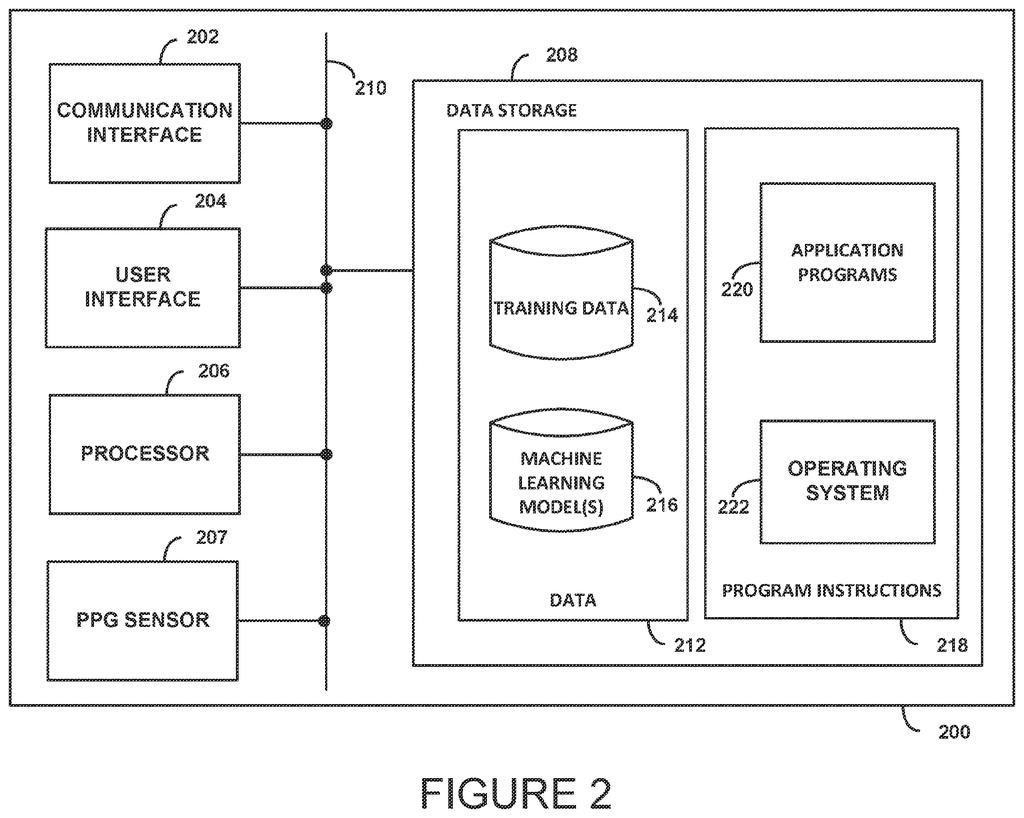
The sensor hardware required already exists in consumer devices and in cheap clinical pulse oximeters. That's the point: a test that used to need a lab could, if this works as described, run on something a village clinic already owns.
… determining a set of model coefficients of the composite model to predict, based on the second set of features, the heart rate, and a set of demographic information, a cardiovascular disease risk score …
Translation: The system calculates heart disease risk using demographic details and pulse data.
How the model turns a pulse wave into a risk score
The patent describes a two-stage composite model. In the first stage, a deep-learning neural network ingests a raw photoplethysmographic (PPG) waveform, which is the optical pulse signal recorded when a light source shines through skin and a sensor measures how much bounces back. Blood volume changes with each heartbeat, so the waveform encodes a lot of cardiovascular information beyond just pulse rate.
The neural network converts that waveform into a large set of numerical features (think of them as a long list of measurements describing the shape of the pulse). A second step then projects those features down into a smaller, compressed set, a process sometimes called dimensionality reduction, which keeps only the patterns most predictive of heart-disease risk while dropping noise.
In the final stage, a set of model coefficients (basically a weighted formula, similar in spirit to a logistic regression equation used in clinical risk calculators) combines:
- The compressed pulse-wave features
- The PPG-derived heart rate
- Age and sex of the individual
The output is a single cardiovascular disease risk score. The training process optimizes all three components together so the final score is calibrated against real clinical outcomes, not just intermediate signal quality.
Available long-term predictive tests for CVD risk include costly, clinically intensive diagnostics that include the efforts of highly trained clinical or laboratory staff like blood or other fluid draws and related laboratory testing, ECG, sphygmomanometer-based blood pressure measurement, or other tests.
Translation: Traditional heart tests require expensive clinical visits and specialized staff.
What this means for low-cost heart screening worldwide
For people in wealthy countries with good insurance, this might eventually surface as a health feature on a phone or wearable. But the patent's stated motivation is broader: resource-constrained healthcare settings where lab tests and ECG machines are unavailable. A PPG sensor costs a few dollars and requires no trained technician, which means a working version of this system could theoretically run population-level cardiovascular screening in places that currently have none.
The catch is that a patent describes an invention on paper, not a clinically validated product. Getting a heart-risk algorithm certified as a medical device requires large prospective trials and regulatory approval, a path that takes years. Still, several Google health-sensor filings this year suggest the company is making a sustained effort to turn consumer hardware into diagnostic tools, and this patent adds a concrete technical proposal to that effort.
Google's 13th filing we've tracked in wearables that read your body since May follows its work on a fingertip blood pressure sensor and heart rate by skin tone.
The path from patent to clinic is long here, and the document is candid about why. Teaching a model to work reliably across different ages, skin tones, and cheap consumer sensors is hard, and none of that proof appears in a filing like this.
What the document does establish is a clear mechanical idea: a neural network reads a pulse signal, a simple formula converts the result into a cardiovascular risk score, and the whole thing could run on hardware that already exists in most clinics and homes. No new device required, just software layered onto a pulse oximeter you can buy for twenty dollars.
If that software can clear the regulatory bar, which will require substantial real-world testing across diverse populations, the practical reach could be large. Most of the world has a pulse oximeter long before it has a cardiologist, and this approach is designed around closing exactly that gap.
There are more where this came from
We read every patent application Big Tech publishes and send you the ones worth knowing. Plain English, free, every week.
The drawings
9 drawing sheets from US 2026/0283560 A1 · click any drawing to enlarge


Want this weekly breakdown for a company we don't cover? Patentlyze Pro →
Be the first to weigh in