
IBM's New Patent Covers Keeping Human-Shaped Work Robots Charged Through the Floor
IBM has filed a patent for a way to charge humanoid robots by having them stand on a special spot in the floor, where magnets lock their feet in place and wireless power flows up through their boots. No plugs, no docking arms, just a robot walking to a spot and parking itself.
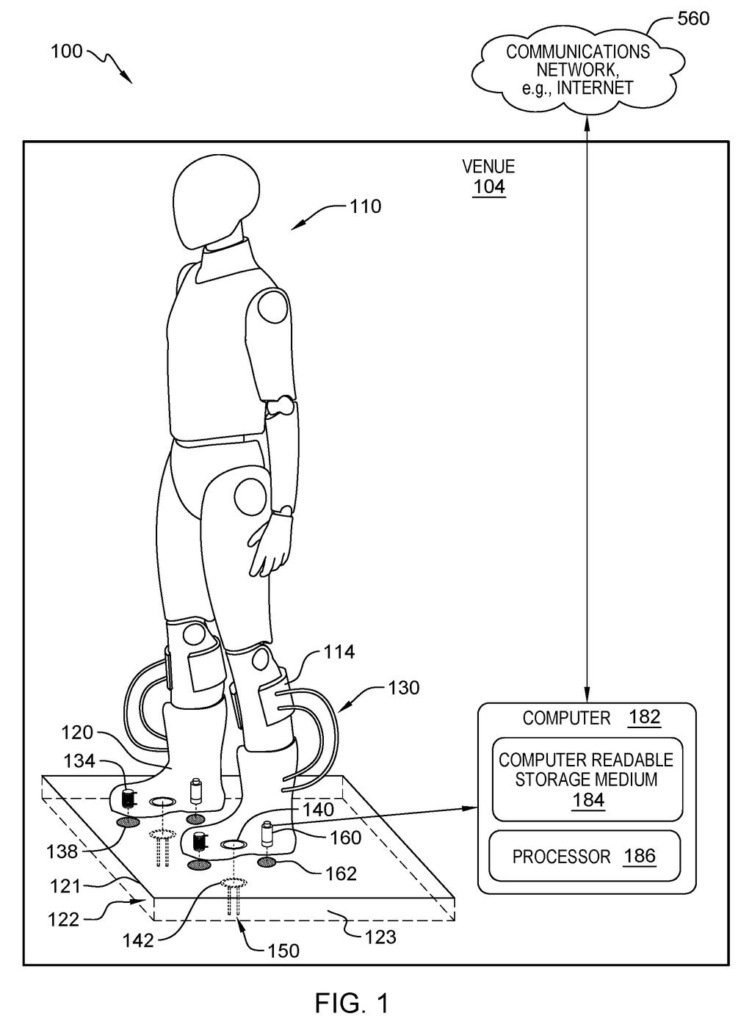
What IBM's robot-charging boot system actually does
A warehouse robot finishes its shift and walks to a marked spot on the floor. It doesn't need a human to plug it in or a robotic arm to snap a cable into place. The floor does all the work.
That's what IBM is describing in this patent. The robot's boots contain three things: a wireless power receiver, an RFID reader (a short-range scanner that reads a small chip in the floor), and an electromagnet. When the robot steps onto the right floor tile, the electromagnet turns on and locks the boots to the floor, the RFID chip confirms it's standing in exactly the right spot, and wireless power starts flowing up through the soles of its feet.
For you as a bystander or a workplace manager, this means a humanoid robot could recharge on its own without any human intervention, the same way your phone charges on a wireless pad, except the robot walks to it and clicks into place.
aligning boots of a humanoid robot to a location on a floor in a work venue; the aligning of the boots including aligning a power receiver in the boots to a power transmitter in the floor; …
Translation: The robot stands on a specific floor spot to connect its shoes to a hidden power source.
How the boots lock, identify, and charge at once
The patent describes a three-part system built into a humanoid robot's boots and a corresponding set of components embedded in the floor at a designated charging location.
Boot side:
- A wireless power receiver in the sole that picks up energy from a transmitter in the floor (the same principle as Qi wireless charging for phones, but scaled up).
- An RFID reader that scans an RFID tag (a passive chip, no battery required) in the floor tile to confirm precise alignment before charging begins.
- An electromagnet that activates once alignment is confirmed, physically locking the boot to a matching electromagnet in the floor so the robot stays put during the charging session.
Floor side: A matching set of components sits flush with the floor surface: the wireless power transmitter, the RFID tag, and the electromagnet.
The robot navigates to the location autonomously. The RFID handshake acts as a position check, so power only flows when the geometry is correct. The magnetic lock prevents the robot from drifting or being bumped off the charging spot, which matters in an active work environment with other machines or people moving around.
The patent frames this as a method, meaning the claim covers the process of aligning and locking, not just the hardware design.
… an electromagnet in each of the boots can be aligned to an electromagnet in the floor at the location which secures the boots to the floor in a locked position when the electromagnet is turned on.
Translation: Magnets in the shoes turn on to clamp the robot's feet tightly to the floor while it charges.
What this means for robots in real workplaces
Humanoid robots are moving from controlled labs into real workplaces, and one of the most practical problems is keeping them charged without dedicated human staff. A system like this lets a robot autonomously recharge during a break in its task schedule, the way an autonomous vacuum returns to its base, but for a full-sized robot that can walk upright.
The electromagnet lock is the detail that makes this practical rather than theoretical. Wireless charging already exists, but a robot that can be nudged off its charging pad mid-session is a reliability problem. By anchoring the feet magnetically and confirming position via RFID before enabling power, the system adds two layers of redundancy that a simple floor pad would not have. IBM's interest in humanoid-robot infrastructure shows up here in a patent focused less on the robot's intelligence and more on the unglamorous logistics of keeping it operational.
IBM's fourth battery and power filing we've tracked since June follows ideas like drones sharing charge mid-flight and wearables that harvest body energy.
Claim 1 is written at a method level and covers the full sequence: align, RFID-verify, electromagnet-lock, then charge. That breadth is meaningful. It doesn't claim any one piece of hardware in isolation; it claims the combination of all three steps happening together. That framing would make it harder for a competitor to design around by simply swapping in a different locking mechanism while keeping the RFID-plus-wireless-power sequence.
The narrowness comes from the humanoid-robot-boot framing. The claim is tied to boots on a floor, which limits its reach to upright, bipedal robots. A wheeled robot with an underbody charging plate, or a robot arm that docks at the wrist, would likely fall outside this claim without a generous reading.
As a practical matter, this is a workmanlike filing that solves a real problem: autonomous recharging for humanoid robots in messy, populated spaces. The RFID-as-alignment-check is the clever bit, because it turns a passive, cheap chip into a precision positioning signal before expensive power transfer begins. That's an engineering decision worth noting, even if it doesn't rewrite the field.
There are more where this came from
We read every patent application Big Tech publishes and send you the ones worth knowing. Plain English, free, every week.
The drawings
6 drawing sheets from US 2026/0291257 A1 · click any drawing to enlarge


Want this weekly breakdown for a company we don't cover? Patentlyze Pro →
Be the first to weigh in