
Microsoft Patents a Fix for Video Quality Rules That Break When Splitting Work Across Processors
Modern video encoders cheat in clever ways to compress footage faster, but some of those tricks break when you try to speed things up by running multiple encoding threads at once. Microsoft has filed a patent that lays out specific rules to stop that from happening.
What Microsoft's parallel video encoding fix actually does
Every time a streaming service sends you a video, software called a video encoder has spent time squeezing that footage down to a fraction of its original size. Encoders use all kinds of shortcuts to do that quickly, including copying small patches of an image from nearby areas instead of describing them fresh every frame.
The problem is that one popular speed-up technique, called wavefront parallel processing, lets the encoder work on several rows of a video frame at the same time, like multiple people painting rows of a fence side by side. Some of those copy shortcuts assume the encoder has already finished the rows above, and when you run rows in parallel, that assumption falls apart.
Microsoft's patent describes a set of rules for when and how an encoder can safely use those copy shortcuts while rows are being processed in parallel. It also covers how a decoder on the receiving end should handle video that was compressed under those rules, so playback stays correct.
Various innovations facilitate the use of intra-picture prediction modes such as palette prediction mode, intra block copy mode, intra line copy mode and intra string copy mode by an encoder or decoder when wavefront parallel processing (“WPP”) is enabled.
Translation: New methods allow specialized video compression modes to work properly when multiple processors divide up a frame.
How the encoder enforces safe reference region boundaries
The patent targets several video compression techniques that all involve copying data from one part of a frame to compress another part:
- Palette mode: an image region is described as a small set of colors (a palette), and nearby regions can reuse that palette instead of defining their own.
- Intra block copy (IBC): a rectangular block of pixels is copied from somewhere else in the same frame.
- Intra line copy and intra string copy: similar copy operations at different granularities.
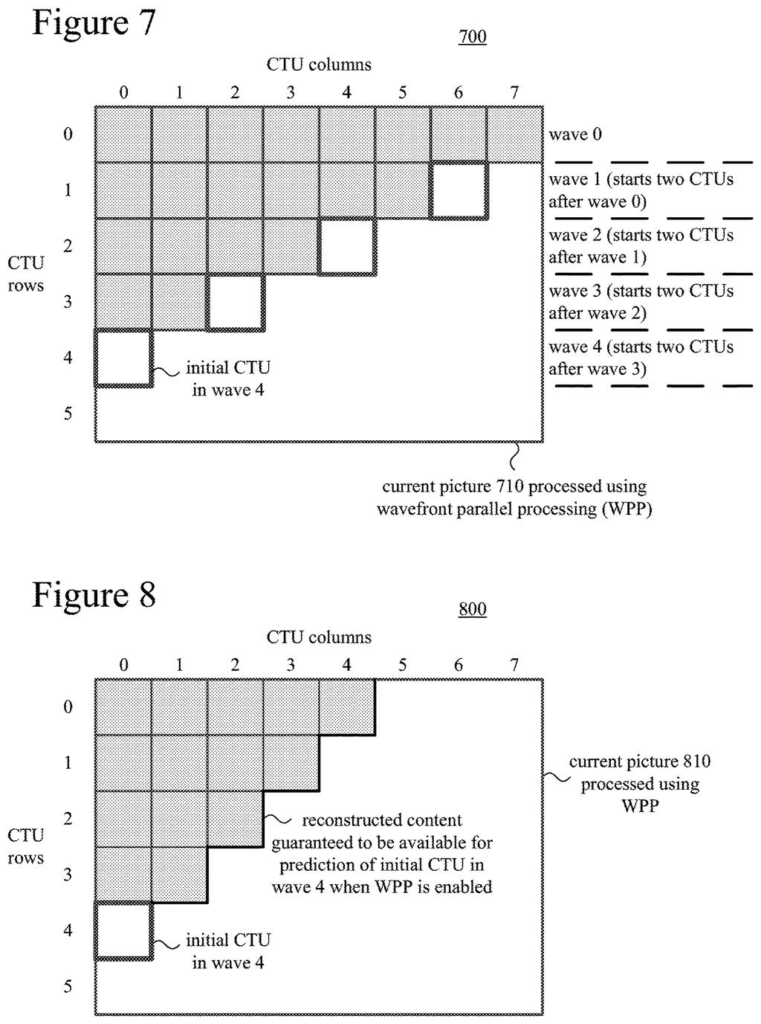
Wavefront parallel processing (WPP) is a technique that lets the encoder process multiple horizontal rows of a frame at the same time, each row starting slightly after the one above it, like a staircase offset. The problem is that all of those copy modes assume the encoder can freely reference regions above or to the right of the current area, and WPP doesn't guarantee those regions are ready yet.
For palette mode, the patent says an encoder or decoder should seed the palette for the first unit in a new row using palette data from the row above, which is already finished. For intra copy modes, it enforces geometric constraints on where the copied region can come from. The key rule: if a reference block is above and to the right of the current block, the horizontal distance to it must be no greater than the vertical distance, keeping the copy safely inside the already-processed staircase zone.
A flag in the compressed bitstream tells a decoder whether WPP was active during encoding, so both sides of the pipeline agree on which rules applied.
What this means for faster, more efficient video compression
Video compression standards are built up from layers of small rules like these, and getting them wrong means either corrupted video or encoders that have to artificially slow down to avoid conflicts. For the companies building encoders into chips, streaming software, and broadcast equipment, having a clear ruleset means they can safely turn on parallel processing without disabling useful compression modes.
For you as a viewer, the practical payoff would be faster encoding times and potentially better video quality at the same file size, since the encoder doesn't have to skip useful shortcuts. Microsoft has been filing around video compression and parallel processing in standards-adjacent work, which fits its position as both a cloud provider and a platform vendor with Azure Media Services and Teams video infrastructure.
Microsoft's 453rd filing in our Microsoft coverage since May follows work like the color-switching video patent and the thermal lens patent.
Getting two video processing techniques to cooperate requires settling exact rules before a single line of code can be written. This patent establishes those rules, which puts it firmly at the foundation stage, well upstream of anything a viewer or customer would recognize as a feature.
From here, software has to implement the rules, standard-setting bodies likely need to adopt them, and streaming infrastructure has to be rebuilt or updated to use the result. None of those steps are small, and none are guaranteed.
What the filing does confirm is that Microsoft is doing careful, detailed engineering work on compressing video faster and more cheaply at enormous scale, where encoding billions of hours of footage is a real operating cost. The distance to a shipping product is long, but the underlying problem is consequential and the work appears serious.
There are more where this came from
We read every patent application Big Tech publishes and send you the ones worth knowing. Plain English, free, every week.
The drawings
13 drawing sheets from US 2026/0303845 A1 · click any drawing to enlarge


Want this weekly breakdown for a company we don't cover? Patentlyze Pro →
Be the first to weigh in