
Meta Patents a System for Keeping All Your Avatars Looking Like They Belong Together
Every time you tweak your avatar's nose or eyes, something has to stop you from accidentally creating a character that looks like it escaped from a completely different game. Meta's new patent is about how to enforce that invisible design fence automatically.
What Meta's avatar consistency system actually does
Imagine you're building an avatar for a social media app or a VR world, and the app lets you slide every facial feature to your liking. Without guardrails, you could end up with proportions so extreme that your character looks nothing like anyone else on the platform. That visual chaos is exactly what this patent tries to prevent.
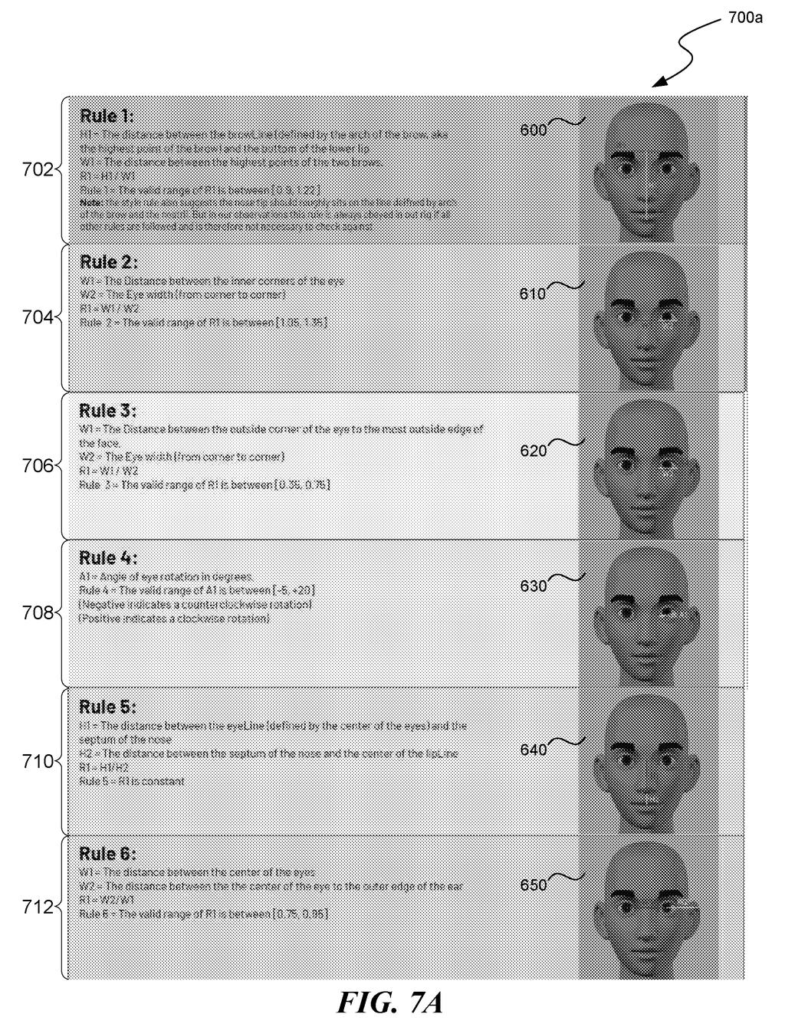
Meta's approach starts by generating thousands of random face configurations and measuring their features: eye spacing, nose length, ear angles, lip proportions. The system then figures out which of those random faces actually fit the platform's intended look and feel, and uses their shared measurements to set strict rules for what any avatar can look like.
The result is a set of limits baked into the customization tool. When you adjust your avatar, you're only moving sliders within a pre-approved range, so your character always reads as part of the same visual family as everyone else on the platform.
… determining a subset of testing avatars, of the random set, wherein determining the subset is performed such that the multiple measurements of each testing avatar of the subset of testing avatars conforms to the stylistic framework; …
Translation: The system filters the random avatars to find ones that actually fit the required visual style.
How Meta measures faces to lock in a design style
The patent describes a two-stage pipeline for locking down avatar aesthetics across a platform like a video game, social network, or extended reality environment.
Stage one: random generation and measurement. The system creates a large random set of test avatars, then measures specific anatomical features on each one. Measurements include things like the angle of an eyelid, the ratio of nose width to face width, and the distance between facial landmarks. These aren't subjective judgments; they're geometric values a computer can compare.
Stage two: filtering and constraint extraction. The system identifies which randomly generated avatars actually fit the platform's defined stylistic framework (think of it as a written style guide, but expressed as numerical ranges instead of mood-board images). From that filtered subset, it extracts the shared measurement ranges that all the qualifying avatars have in common. Those ranges become the hard constraints that govern every future avatar.
The practical output is a ruleset that avatar-creation tools can enforce. Sliders in a character editor, for example, would be bounded by these constraints so users can only reach configurations that stay inside the approved aesthetic. The method works for any computing platform that needs a consistent visual identity across a large, user-generated avatar population.
Measurements of anatomical features (e.g., eye, ear, nose, lips) of each testing avatar of the random set may be determined.
Translation: Software measures specific facial parts like the nose and lips on every randomly generated test figure.
What this means for Meta's VR and social platforms
For Meta specifically, this matters because its platforms span Horizon Worlds, Instagram, and Ray-Ban smart glasses social features. Avatars that look wildly inconsistent undermine the sense that you're in a shared, designed world rather than a collection of random graphics.
For you as a user, it's a tradeoff: you get less total freedom in avatar customization, but the platform looks more coherent and professionally designed. Meta keeps filing on avatar and identity systems for extended reality, and this patent fits that pattern. The real question is whether users accept the guardrails cheerfully or feel creatively boxed in, which depends almost entirely on how wide those constraint ranges turn out to be in practice.
Meta's 155th filing in our Meta coverage since May extends its shared-space work, following patents on muting audio from listeners and anchoring AR objects across rooms.
Every avatar built on this system will look like it belongs together, which is the point, but that coherence costs something real: the rules about face proportions get written once, before any experimentation begins, and they become the permanent ceiling for what any face on the platform can ever look like.
The sampling process is clever at discovering workable proportions automatically, but it doesn't move the hard judgment anywhere. It just moves it earlier, where it's less visible and harder to revisit later.
Whether users feel seen by their avatars depends entirely on how broadly that founding vision was drawn. A generous framework produces a platform where most people can find themselves; a narrow one produces a platform where many cannot, and nothing downstream fixes that. That founding decision is where this design either earns its users or loses them.
There are more where this came from
We read every patent application Big Tech publishes and send you the ones worth knowing. Plain English, free, every week.
The drawings
14 drawing sheets from US 2026/0301291 A1 · click any drawing to enlarge


Want this weekly breakdown for a company we don't cover? Patentlyze Pro →
Be the first to weigh in